
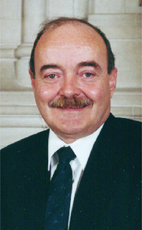
House of Commons photo

Crucial Fact

  • His favourite word was quebec.

Last in Parliament May 2004, as Independent MP for Chambly (Québec)

Won his last election, in 2000, with 50% of the vote.

Statements in the House

Municipal Grants Act November 5th, 1999

Mr. Speaker, the member who spoke before me spent a good half hour using Bill C-10 as an excuse to introduce the Reform Party's objections to the Nisga'a treaty. I, however, am going to try to get the debate back to Bill C-10, back to the municipalities and to federal-provincial relations.

This bill is going to have a title that is far better adapted to reality—for which I congratulate the minister. It will no longer speak of grants. I am going to read its official full title—an act respecting payments in lieu of taxes to municipalities, provinces and other bodies exercising functions of local government that levy real property taxes.

I trust then that there will be no more talk of grants, for a grant is a gift, and that means that the recipient, the grantee, is receiving a present. The federal government is very big on giving gifts. Moreover, in this bill, as my distinguished colleague from Vancouver Quadra has indicated, the minister's discretionary power is omnipresent.

That is the point. It is the minister who will be going about distributing largesse. That is one thing we can say about the Liberals: they are past masters at this kind of disguised gift and at ministerial interference. If an MP from their party asks the minister to exercise his discretionary power on behalf of a municipality in his riding, it is a rare thing for the minister to refuse.

However, if someone from another political party is facing the same problem, the minister rarely has the funds. He is rarely able to comply and to exercise this discretionary power, which he has obtained under just about all the laws passed in this parliament since 1993. I have been in this House since October of that year.

We can congratulate the government on the new title. However, it is not accurate when it comes to legislation on payments made in lieu of taxes to municipalities.

There is a difference between income tax and property tax. But this is a minor fault that will not be held against the government. What we can criticize it for, however, is paving the way for discretionary action, petty political jockeying, under the table arrangements, as well as unjustified and unjustifiable gifts. We are not happy about this aspect of the bill. The minister's discretionary power is really exorbitant.

There is also something of grave concern to municipalities, in particular to the Union des municipalités du Québec, which we contacted. The bill was introduced here on October 27, 1999 at first reading, that is, only a few working days ago. Municipalities were not given much time to examine the bill carefully and assess its real impact. The government is pressing us to adopt this bill immediately but, frankly, municipalities are not pleased with this legislation.

If we look at the substance of the bill and draw a parallel between this piece of legislation and other ones, we see a constant. It is always the same thing when the government tables any bill. With all its bills, the government has this annoying propensity, this bad habit of targeting the poor and making them pay because they form the largest group.

The Employment Insurance Act is a case in point. Today, we are told that the minister—who is using very conservative figures—will amass a surplus of some $95 billion over the next five years.

But where does he take all that money? He gets it through cuts in transfers to the provinces, which are directly accountable to people. The provinces are on the front line when it comes to dealing with the public. So, the federal government makes cuts affecting hospitals and many other services, uses its tremendous taxing power to get more money, and then its spending power, all this with a cavalier attitude, bragging all along about having money and being able to interfere in just about any area.

This often creates false hopes, false expectations or even real expectations. However, when the time comes to meet these expectations, the federal government passes the buck to the provinces.

In Quebec, we have a pharmacare program. It cost Quebecers a lot of money to establish that program. All Quebecers are paying for it. I am told that the program is working well. Fortunately, and thank goodness, I am not sick and I do not really use that program. But everyone says that it is working well. When the federal government noticed how successful the program was, it hastened to step in.

In the budget speech, the government mentioned the possibility of launching a pharmacare program. Once the program is up and running, once people have come to trust it and rely on it, the federal government will pull out, as it always does and leave people stuck with a program that they will then have to beginning supporting themselves.

It is the same thing with employment insurance. This government does not have the courage to bring in tax increases, but it knows that most of those with jobs pay taxes, since all of those with jobs are subject to tax. So, by keeping EI premiums high, the government can count on those with jobs paying premiums and will be able to rake in $95.5 billion over the next five years, which is shocking and scandalous.

When I say this bill is no different, or that the attitudes are the same as in the past, I mean that when a municipality wants to build a road, water or sewer infrastructure, the cost of laying down a bed so that lines do not shift, crack or break through freezing and thawing is extremely high. Taxpayers figure that the cost of bringing in a line, or building a road or sidewalks will be shared among users, those who will benefit from the infrastructure.

This holds for everyone except the government. In my riding, for instance, there is a rehabilitation centre for young offenders with about 800 feet in frontage.

Le Guide Des Papillons Du Québec November 3rd, 1999

Mr. Speaker, this summer an important work on the butterflies of Quebec and Labrador by Louis Handfield, a notary in Mont-Saint-Hilaire, in the beautiful riding of Chambly, was published. It comprises 1,100 pages of text and colour plates.

It is the outcome of thirty-five long years of research and observation and thousands of hours of data collection; it is destined to become an encyclopedia of knowledge in this field.

When I attended the book launch, Mr. Handfield spoke of his one regret: the lack of co-operation by Heritage Canada, which does not allow specimens to be collected in national parks.

On behalf of Mr. Handfield, and in the name of science, I call upon Heritage Canada to make an exception to this ban for entomologists research and studies.

I must again express my admiration for Mr. Handfield, a modest, frank and straightforward gentleman and for his work, which is sure to be a priceless reference tool for at least the first hundred years of the new millennium.

Congratulations, Louis, for this wonderful contribution to natural science.

Canada Elections Act October 19th, 1999

It is true.

Petitions June 1st, 1999

Mr. Speaker, I am pleased to table a petition on behalf of those who delivers mail in rural areas. The petitioners ask that section 13.5 of the Canada Post Corporation Act be amended to allow them to organize and bargain collectively.

Canada Post Corporation is no better than the government. Over the past few years, it has racked up huge profits on the backs of the least fortunate, those who never have a chance to be heard.

This is why the present petition, signed by 113 persons, all from Quebec, asks the government to amend the Canada Post Corporation Act to restore some balance and allow these people to earn a decent living.

Division No. 539 May 31st, 1999

Mr. Speaker, I was present at the last vote, but I do not think I was recognized.

Division No. 539 May 31st, 1999

Mr. Speaker, on a point of order. It has been drawn to my attention that I was not recorded as voting in favour of the motion on the last vote. I want to make sure that this is done.

Division No. 425 May 13th, 1999

Mr. Speaker, with all due respect, we are given to understand that there is freedom of expression in this House. Seeking the unanimous consent of the House for the point my colleague wishes to make is a bit like seeking its approval for what he will say and the approach he will take.

This means that, from now on, what we want to say in the House must first be approved by a majority of members.

Public Sector Pension Investment Board Act May 11th, 1999

Mr. Speaker, I am pleased to speak on Bill C-78, which aims at establishing a kind of investment board to manage the pensions of public servants, members of the RCMP and of the Canadian armed forces.

According to accounting charts submitted by actuaries—not the opposition's acutaries but those of the government, the people in power—at present the surplus in these three pension funds totals $30.2 billion.

This morning, I listened with great interest to members of the governing party who see themselves, as always, as those who have the absolute truth. They were telling us that they could not make a mistake and that they knew and understood the issue because of their skills as managers and that the surplus had to be deposited in the consolidated revenue fund, that is in the hands of government. There was no doubt in their mind about that.

When a government has a majority in the House, it can say anything false it wants, and no one can force it to do its duty, because it is convinced that it cannot be wrong since it has a majority in the House.

Last week in committee, I listened to the witnesses, among them distinguished actuaries, people who work in investments, and also pensioners. We had the Public Service Pensioners Association, which was represented, if I am not mistaken, by Mrs. Jeanne Smith. I asked her what amount a retired public servant got.

Of course, there are several categories of retired public servants. There is one apart from the others, consisting of generals and very high ranking members of the Canadian forces, who enjoy a pension equivalent to that of a cabinet minister having worked for 30 years and thus being entitled to the maximum. Those people receive a pension of $115,000, $120,000 or $130,000 a year. The day after their retirement, they are hired at a salary of $180,000, $200,000 and even $250,000, based on my information, to act as consultants for the Canadian armed forces and the government, to help the government make decisions.

Most people—even though it is disgusting to see such cases as these—do not, the day after they retire, sit in the same chair, use the same telephone and carry out the same duties as the day before, while collecting an annual pension of $115,000, $120,000 or $130,000 and getting a new salary that is sometimes just as exorbitant to do the same job, but as a consultant. This is outrageous.

However, this is not the case for the average member of the Public Service Alliance of Canada. I asked Mrs. Smith how much a retired public servant gets. She gave me a few examples. A public service employee who worked for 23 years and who is living alone collects an annual pension of $8,900 or $9,000. With 30 years of service, that annual pension is $15,000. These are gross, not net figures.

Along with the hon. member for Compton—Stanstead—who sits on my left and whom I salute—I visited military bases across Canada last year, with the Standing Committee on National Defence. We saw military personnel housed in PMQs, which are houses that were built in the middle of the century, immediately after World War II. These houses have not been maintained or renovated.

It is now unthinkable to live in a house that would not have a hood to vent cooking odours above the stove. Yet, this was common in all the PMQs that we visited, since they were built in the middle or late forties, when these hoods were a great luxury.

It was the same everywhere. When the committee tabled its report, it recommended a considerable improvement in how we house our soldiers, as well as how we pay them, so that they can live decently. But all these recommendations were naturally shelved. The government did not want to hear them. It gave a paltry increase to soldiers to ease its conscience. With their minds easy, the Liberal members opposite are busy congratulating themselves. The government came up with a few million dollars to increase soldiers' pay, but their living conditions are completely unacceptable.

I see the member who just sat down, the committee chair, giving me a look. But, at the time, this member was as disgusted as I was at the conditions in which our soldiers lived and worked. Naturally, when they are paid so little during their working lives, they cannot be expected to have built up a huge pension.

The government is benefiting in all sorts of ways. When it underpays its employees, its contributions as an employer are lower, because these are a percentage of salary. The government is ahead on all counts, so members opposite can sleep easy. They say that the government has contributed its share, that there are surpluses, and that, when there were deficits, the government naturally stepped in to help.

I would agree that the government—because this is what it wants, and because it made up deficits in the fund in the past, although it has paid itself back by now—should be able to recover some of its past outlay, if it thought it made one, which is far from certain.

But before helping itself to the accumulated surplus in the pension funds, the government should try to improve the plans, not for the retired generals I mentioned earlier who are now pulling in $250,000 or $300,000 annually, but for those at the bottom of the totem pole. These employees have kept their noses to the grindstone all their lives without asking too many questions. And they certainly were not asking whether their pension plan was well run. Their energy went into doing what they were paid to do.

They trusted their employer, but it failed them miserably. Today, there is a cumulative surplus of $30.2 billion and the government will grab it and put it in its pockets, leaving these people, most of whom are below the poverty line, to try to make ends meet and unable to enjoy a well deserved retirement. We never had cause to complain about our federal public servants. But once they retire, we complain about them, and say that they get too much. If the government had something to complain about, it should have said so before they left the public service. Now it is too late.

The Bloc condemns this approach, the same one that was used in regard to EI fund. The federal government long ago stopped contributing to the EI fund, but there is a $15 billion surplus in the fund. All workers pay into the fund, but very few receive benefits. We are told that only 35% of the workers are eligible to benefits, even though 100% of them pay premiums.

Once again, the government has grabbed the surpluses. This is misappropriation of funds. Since this morning, all opposition parties agree on that. The government must stop stealing. It is Robin Hood in reverse: it takes from the poor to give to the rich. In the original scenario, Robin Hood took from the rich to give to the poor.

For all these reasons, the population, the civil servants, particularly the RCMP officers, who are not known as complainers—one must be very committed to join the RCMP—and proved long ago that they were ready to make many sacrifices to be members of the RCMP, wear the stetson and ride a horse, all those people do not complain, but they must have something to live on.

Bernard Voyer May 5th, 1999

Mr. Speaker, the Bloc Quebecois salutes the courage, determination and perseverance of Quebec adventurer Bernard Voyer, a member of the first team to reach the summit of Mt. Everest this year.

This long climb, undertaken with two Americans, two Swedes and nine Sherpas, was completed last night. One can well imagine the great feeling of accomplishment being experienced by Bernard Voyer at this time.

Mr. Voyer is the second Quebecer to have accomplished this exploit, which serves as a reminder that fidelity to one's objectives allows one to attain the loftiest of summits, and that tenacity, constancy and energy can overcome all obstacles and make all things possible.

Reaching the roof of the world is an accomplishment few others can equal. Mr. Voyer, we are proud of you and hope you can now enjoy a well-deserved rest.

Access To Information Act May 4th, 1999

Madam Speaker, I am pleased to speak for a few minutes on Motion M-2, which reads:

That, in the opinion of this House, the Parliament and Crown Agencies should be subject to scrutiny under the Access to Information Act.

When we talked about raw milk cheese, during the previous parliament, I tried to get information on available raw milk cheese import quotas. I went to the Access to Information Commission, but the minister imposed a veto. He used all his energy to keep this information from me. Is there anything more harmless than this information on cheese import quotas?

On another occasion, I asked for information from another department. I got the information, but it made no sense. Much had been covered with a big black marker, and this was probably the gist of the document. I was left with the date at the top and a signature at the bottom, but hardly anything in between. And they claim they are abiding by the Access to Information Act.

Some ministers screen just about any request for information on their department. It is a sign of fear. Why would a minister bother to read, in some cases up to 95%, of all such requests? Does the minister himself cross out everything he wants to keep from us? In that case, the Access to Information Act is pretty much useless.

Everything we want to know or everything that is likely to be of interest to the person who made the request is crossed out by the minister, his assistants or his staff, which makes the Access to Information Act almost totally ineffective.

Crown corporations that are separate legal entities from the government should be subject to the application of the Access to Information Act. However, and I agree with the parliamentary secretary on that point, there are types of commercial information that cannot be released.

Let us take, for example, the Canadian Investment Corporation, the corporation responsible for managing the federal government's housing stock. If a competitor had access to its list of prices, its costs and other information of a purely internal nature, information related to the daily management of its affairs, we can see the damage the corporation could incur if it were forced to provide these details to its competitors.

It is not always MPs who request information, it is not always people who are concerned with protecting a certain part of the internal affairs of these organizations. Therefore, there is some danger in that and it could cause a lot of damage. I think the member for Red Deer, who made the proposal, agreed with what the parliamentary secretary said earlier, and I have to say that I share the same view. I am greatly concerned about this.

In parliament, we, the members, would be compelled to provide information. I believe there are things all would want to keep confidential. That is what we call the right to privacy. When we consider issues that have nothing to do with management but only with members themselves, it means that, pursuant to the Access to Information Act, one could ask individual members of parliament how much money they have in the bank, whether their house is mortgaged, how much money they owe. The motion before the House could be construed to mean that this kind of information could be obtained through the access to information commission.

I do not think that is the purpose of this motion nor the goal of its sponsor. No one in the House would want this either. It would be rathr difficult to apply the terms of such a motion. Of course, we respect and understand the sound principles on which it is based. My party share the concerns of the members of parliament and especially the hon. member for Red Deer who brought forward this motion.

But maybe we are overshooting, as my grandfather used to say. Some people could be affected and hurt if this motion were passed. Fortunately, it is not a votable item. It could have very undesirable if not deleterious effects, which would make us regret the day we passed such a motion.

I think the principle is sound. When I was co-chair of the joint scrutiny of regulations committee. When we asked to examine the bylaws of crown corporations, our requests were often turned down. We were told “We are an independent agency. The bylaws that we pass and publish are none of parliament's business”.

That was pretty frustrating, because these crown corporations are government creatures run on public funds. But when they are asked to give us information, they pretty well tell us to drop dead.

In my riding of Chambly, there was a post office sandwiched between two malls. There was a rumour that it was up for sale. The two mall owners came to my office. They asked me whether they could be assured that they would be notified in order to put in a bid, to purchase the post office business, which would have to move. Fortunately, it did not happen.

At the time, I had recently been elected and I was not very familiar with how to handle this. I phoned Canada Post Corporation and talked with an official. I wanted some assurances. Would there be a call for tender? Would it be public? I was told “Listen sir, if Canada Post decides to give away its post office, the government has no say in that decision. As long as we submit a positive balance sheet to the government, it does not ask any questions”. I thought it was totally appalling to get such an answer, but it was the truth. The person who gave me the information did not want to mislead me. He was telling me that the act, as it was worded, allowed Canada Post to do that.

As members can see, the Access to Information Act could be used in that situation. We could ask bodies, organizations or crown corporations to appear before a House committee or someone to justify their actions.

Therefore, we agree with the principles behind this motion. But it would have to be amended before we could support it.