
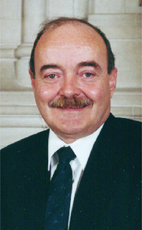
House of Commons photo

Crucial Fact

  • His favourite word was quebec.

Last in Parliament May 2004, as Independent MP for Chambly (Québec)

Won his last election, in 2000, with 50% of the vote.

Statements in the House

National Housing Act May 4th, 1999

Mr. Speaker, I had occasion to speak earlier to the motions in Group No. 2, and now, like the other members, I will move on to the motions in Group No. 3.

I wonder where the government is headed with Bill C-66. It has decided to go into business abroad. It wants to build low cost housing abroad and probably wants to get into housing development abroad. But is this the role of a government? Must the government not first and foremost defend the interests of Canadians and look after their welfare?

The government, through the Canada Mortgage and Housing Corporation, is getting involved in a commercial operation it has no business in. The structure was not designed for that. This was not the intent of Canadians in establishing the CHMC; rather, it was to help Canadians who wanted to acquire a house.

Earlier, when I finished my last intervention, I spoke of the context of the negotiation of world trade agreements, the WTO and all that. My colleague from Trois-Rivières spoke of the government's new mentality with respect to its foreign partners, the famous negotiation with the other provinces on the social union framework agreement. It is proof the federal government is literally going over the provinces' heads and leaving them off to one side in all aspects of the daily lives of Canadians. It is now positioning itself as the only real government for Canadians, and the provinces are being left out in the cold.

That can be seen in Bill C-66, when my colleague from Hochelaga—Maisonneuve proposed amendments to the text of it to permit agreements with the provinces on public housing.

They were, of course, rejected by the committee, and the parliamentary secretary followed the party line on this issue. I wonder if she listened to us. In any case, it does not change anything, because the decisions are made long before anything happens in committee.

I remember when the committee heard witnesses, including GE Capital, on the eve of the clause by clause review of the bill. A document was given to us in English only. I asked that it be translated, because I wanted to read it and make comments. The committee, with the support of the government majority, had already decided which amendments, which changes to the bill would be acceptable or unacceptable, this before even having heard the last witnesses. The hon. member to my left can attest to that, because he was sitting on that committee.

So, this bill was rammed through. We were not given an opportunity to assess its impact on Canadians as regards social housing and housing development. The bill was rammed through.

The member for Kelowna, who spoke before me, alluded to the issue of accountability. With this bill, who is responsible for what? The regulations will no longer be made through an order to the governor in council and notice will no longer be given in part II or III of the Canada Gazette .

Now, everything will be done in secret. This legislation is similar to Bill C-47, Bill C-48 and Bill C-49, in the previous parliament. Former Bill C-84 changed the whole procedure and the responsibility concerning the making of regulations. Now, the government wants to run things informally. This is often a cause for concern. It becomes a real maze. Even the experts will get lost.

Without strict rules, no one will be accountable. Not all ministers will operate the same way. There will come a time when one will overturn another's decision. The reason there were stringent rules for passing regulations was so that the procedure would be clear. Now, all that has gone by the board.

In the name of efficiency, the rules of the game are going to be changed by means of a mere notice on behalf of the minister in the Canada Gazette . A few days later, the regulation will take effect, but no one will comply because it is no longer announced. This is one of the biggest problems with Bill C-66 and as responsible members of this House we cannot go along with it.

Appointments to the board of directors are also a farce. The parliamentary secretary did not go into any detail. I know she is an honest women and I suspect she is quite uncomfortable with this bill, with this way of appointing friends of the regime to the head of a crown corporation. Will the CMHC be audited in future, given that it will be independent of the government per se? It will pay dividends and therefore becomes a crown corporation.

Will it be subject to audit by the Auditor General of Canada? I do not know, but Atomic Energy of Canada Limited is not, nor are a number of crown corporations. Canada Post Corporation is no longer audited by the Auditor General of Canada.

Crown corporations are all exempted from auditing by the Auditor General of Canada. The government says nothing about this. We end up with corporations here and there, as Nav Canada, etc. There are large ones, small ones, corporations of all sizes, but they all have one thing in common: they no longer have a boss.

They are no longer managed by parliament. It does not make decisions for them. Crown corporations make their own decisions and from time to time the minister makes decisions, when relations are good. If things are not going well, the minister does not seem to have much more authority because parliament no longer decides.

This is what is tragic in the current Liberal approach. Literally, they push parliament to the sidelines when the time comes to make decisions and they do so in the name of efficient management. However, efficiency does not justify everything. We cannot bypass parliament in the name of efficiency. We cannot work around parliament in the name of efficiency and cost effectiveness.

This bill reassures no one. For various reasons, Reformers, Bloquists, New Democrats and Progressive Conservatives are against this bill. Not for the same reasons, but it still proves that this bill is flawed. This is what happens when a bill is rammed through and amendments are drafted even before the last witnesses have been heard in committee. This is steamroller democracy.

I cannot support such a bill. It has become a real joke. I see the government member laughing because he knows this bill has become a real joke, but he is paid to do that.

National Housing Act May 4th, 1999

Madam Speaker, I am pleased to rise today to speak to Bill C-66, an act to amend the National Housing Act and the Canada Mortgage and Housing Corporation Act and to make a consequential amendment to another act.

I spoke in the debate on the motions in Group No. 1 and I said then that the Bloc Quebecois did not support this bill. My friend from Hochelaga—Maisonneuve focussed particularly on social housing.

I listened earlier to the member for Frontenac—Mégantic, who spoke in the debate before this one. He read us statistics that indicated some people in the national capital region were spending over 50% of their income on accommodation. This is appalling, especially when this country has had since 1946 an organization to make it easier to acquire residential property.

We could say that the Canada Mortgage and Housing Corporation has failed thoroughly in meeting its objectives. The public housing crisis is not just here in the national capital, in Ottawa, it is pretty well everywhere. There are people who, for reasons it is not up to us to judge, are now needy and must have help from others and society to get housing.

The government did not take the opportunity provided by this bill to acknowledge a reality. While I do not know every major Canadian city, I am nonetheless aware that homelessness is a growing Canadian issue. Even Toronto is not immune to this problem, which affects increasingly younger people.

We now find entire families—father, mother and two or three kids—sleeping wherever they can, under bridges, or over subway air outlets, in Montreal or Toronto. Yet, this legislation has been very helpful to Canadians in the past. I cannot understand the attitude of this minister who introduces a legislative amendment but totally ignores the whole emerging issue of homelessness in Canada.

This bill amends the Canada Mortgage and Housing Corporation Act, which was meant to make it easier for Canadians have access to real estate property, by requiring smaller downpayments from them. Since Bill C-66 amends a number of acts, I cannot understand why the minister did not take this opportunity to also amend the Interest Act. I read about 10 articles on this issue. I tried, through a private member's bill, to have a limit of three months' interest set as the penalty charged by lending institutions to get out of an existing mortgage.

The Reformers, whose generosity and magnanimity are legendary, are opposed to such a measure. I was quite surprised by that. After all, western farmers are not all millionaires or billionaires. Some have mortgages or liens on their farm equipment, which is getting bigger all the time, but costlier as well.

When after a good harvest or a stroke of luck a farmer wants to change vehicle, as some couples change houses, and goes to pay back his loan, the lenders, who are all faithful contributors to the Liberal Party coffers, hit him with a huge penalty for cancelling the loan.

I wish the minister, who is sensitive to the plight of prospective home owners, had taken this opportunity to bring penalties back to a more reasonable level. I believe a three month penalty is adequate, especially in view of the mobility of capital and the speed with which one can reinvest. It is instantaneous through the Internet and other electronic means.

When I was a notary in Longueuil, especially during the worst years of the interest crisis, in 1982, I knew someone who was forced to sell two small income properties. A bank I will not name, out of kindness, even though it showed none to others, charged this individual a $28,500 to $29,000 penalty to cancel the mortgage. It squeezed something like $58,000 out of a person who was already in dire straits and had to sell his income property at a loss because he could no longer pay the interest. It stomped on someone who was already down.

I would have liked the minister to be a bit more aware of what is going on in the housing industry and to put a stop to what his friends who contribute to his campaign funds are doing.

The NDP member who spoke before me also talked about—and it is worth mentioning—the way people are appointed to the board of directors of the CMHC. It will be another patronage haven, and this Liberal government has become a master at making appointments. It is one of its specialties.

Every day, as critic for Public Works Canada, I receive a list of appointments to Atomic Energy Canada, Canada Post Corporation or some other agency. I checked in the book I had ordered from the Chief Electoral Officer of Canada. The first 10 names I found were the names of individuals who had contributed to the election fund of the Liberal Party of Canada. Granted, these were not always large contributions. We are talking about $150, $200, $250, $300. Contributions from companies are always a bit larger.

Still, one can wonder whether having contributed to the Liberal Party's election fund is a requirement to get appointed to the CMHCs board of directors.

Soon we will have a new board in charge of managing the $30 billion in misappropriated funds from public employees pension programs. Those who will sit on that board will also be friends of the government. The same goes for the millennium scholarship foundation. The Liberals have become masters at this. Mind you, I do not envy them.

Pork barrelling has taken unprecedented proportions with the Liberal Party. There is no holding back. The Liberals are in office. They criticized the Progressive Conservatives for being too generous in that regard, but the Conservatives look like boy scouts compared to the Liberals, who have been in office for nearly six years now. They sure know how to make patronage appointments. They have it down to an art. It is often subtle, but it is well done.

What interest is there for the taxpayer? In introducing a bill such as this, at least the Interest Act could have been modified. The big banks could have been told “We are not still in the last century; speedy investments are the way things are done now”.

There is no great interest in supporting this bill, particularly since it is responding to the new criteria of universality. As the hon. member for Trois-Rivières has already remarked, the federal government is the one that will call the shots, the one who is boss, because CMHC is heading into the international forum, and it is the one setting standards. There is quite simply nothing doing as far as social housing and negotiations with the provinces are concerned.

1999 Budget Implementation Act May 4th, 1999

Madam Speaker, the truth hurts, as evidenced by the reaction of the member for Beauce. It may not always be a good thing to tell the truth, but it is more often hard to hear it. This is why the member is getting all worked up. Every now and then, he demonstrates to us that the truth is not always easy to hear, and that it would be much easier, out of extreme courtesy and abnegation, not to say anything. Perhaps the members of the Liberal Party would be less frustrated, but that is the way things are.

History keeps repeating itself. In 1867, Quebecers were fooled into joining a federation and have never been able to get out of it. This is the impression we have. Why? Because of things like this.

At one time, the Liberals held 74 of the 75 seats in Quebec. This is when they decided to unilaterally patriate the Constitution, without the agreement of Quebecers. Incidentally, the Constitution has yet to be signed by Quebec. If they are waiting for Quebec's signature to share the equalization system, it will never happen.

1999 Budget Implementation Act May 4th, 1999

Madam Speaker, I am pleased to rise to speak to Bill C-71. But first I would like to set the record straight regarding some disparaging comments the members for Elk Island and Etobicoke North made this afternoon on Quebec and Quebecers.

They took advantage of today's debate to demean Quebecers in the House; for Orangemen like these two, the temptation is great, of course. While my colleague, the member for Kamouraska—Rivière-du-Loup—Témiscouata—Les Basques was pleading for productive spending, the member for Etobicoke North seemed dumbfounded and asked “What is he talking about? What does he mean by productive spending?”

For the benefit of the member for Etobicoke North and several Ontarians who have been on the political scene for 25 or 30 years, and who cannot understand what a productive investment is because of their partisanship, I will explain by giving an example.

Canada was founded by today's Quebecers, who were called French Canadians at the time, but when English Canadians arrived in this country in 1760, it was said that there were two founding peoples, despite the fact that one was there 250 years before the other one, whether the member for Beauce likes it or not. And it is his own people he is trying to disown.

There were reportedly two founding peoples: the francophones, who arrived in 1534, and the anglophones, who arrived in 1760, 226 years later. However, to please everybody, it was said that there were two founding peoples who were equal, and I accept that. But we cannot brush away our past and our history so readily.

When the four provinces that formed Canada joined together to found the Canadian federation, Ontario was not what it is today. It even had huge budget deficits. Ontario needed money under the Union Act, 1840, and Quebec, or Lower Canada as it was called at the time, agreed to lend Ontario considerable sums of money, which were never repaid as a matter of fact.

From the moment the Canadian Constitution came to be—and this is where productive spending becomes important—for example, when the automobile was first introduced at the turn of the century, the federal government started to invest a lot of money in the Windsor area, in Ontario. It supported the establishment of the automobile industry in Ontario.

A few years later, Quebecers were told to be patient, that it would soon be their turn. They were told that, for them, it would not be the automobile industry, but the aviation industry. The francophones waited patiently, knowing that there were plenty of francophone MPs, mostly Liberal, at the time, for their turn to come.

Some 25 years ago, Michelin Tires wanted to set up business in Quebec. They were told “No, go to Nova Scotia. We will give you $52 million if you do”. That was a good incentive. They were paid not to set up business in Quebec. Yet this was a French multinational which would have had a natural tendency to gravitate to Quebec, where their language was spoken. But no, the government of the day invested $52 million to send them to Nova Scotia.

History has not yet shown whether this was a good decision, but we do know that, over the years, relationships had been particularly complicated, if only from the language point of view. Michelin's investment in Nova Scotia was not the best investment it ever made.

At around the same time, Quebec was again being told “Your future lies in aircraft construction. Ontario has its automobile industry, Quebec has aviation”. But when the famous CF-18 contract came up, the rule changed once more.

They were told “Too bad, the planes will also be built in Ontario, but there will be economic spinoffs for Quebec”. What kind of economic spinoffs? There was talk of $850 million, maybe $900 million. That was acceptable, but once again when the project was completed and the planes were being flown—and there were some crashes, but that is a whole other story—there were between $250 million and $300 million in economic benefits for Quebec. All the radio control knobs we made pretty well accounted for that $250 million. So much for the technological spinoffs, the productive spending. Once again, none for us. We just got the crumbs.

I heard what the hon. member for Elk Island had to say. He takes the cake. He needs a lesson in history. Between 1880 and 1900, 1.2 million Quebecers were forced to leave Quebec. They left the country and went to the northeastern American states and New England, because they were starving in Quebec.

At the same time, the Government of Canada populated western Canada. It brought people from eastern Europe and gave them land, two horses, sheep, a cow, chickens, all paid for by the taxpayers of Quebec and Ontario at the time. And now the member for Elk Island is telling us that Quebec is asking for too much and that our claims for equalization payments are unfair.

In 1870, Canada bought what was then called the North-Western Territory from the Hudson's Bay Company for 300,000 pounds Sterling, a considerable sum for Canadians at the time. But when the ancestors of the member for Elk Island, and probably those of many members here, settled there they were given land paid for in large part by Quebecers. In those days, Quebecers constituted about 50% of Canada's population. In other words, they paid about 50% of the taxes.

The member for Elk Island is denying this. While we cannot live in the past and constantly relive history, we can recognize that Quebecers can hold their heads just as high as anyone else. They contributed more than their share to this country. They anted up when it was time to do so. In wartime, they risked their lives in the battlefields of Europe.

We need offer no excuses to the member for Elk Island. Because of the policies of the federal government, which has always given Quebec the wrong end of the stick, we have a population of poor children in Montreal, which presupposes poor parents as well.

I see the member for Beauce watching me all in a state. This is what is happening in Quebec. It is the result of the policies of the Liberal Party of Canada, which started in 1973 to get into overblown deficits with its Minister of Finance at the time, who is now, ironically, the Prime Minister, the one most opposed to accumulated deficits.

National Housing Act April 28th, 1999

Madam Speaker, I listened to the comments of my colleague, the member for Hochelaga—Maisonneuve, and it was music to my ears.

The member for Hochelaga—Maisonneuve has consistently demonstrated his concern with poverty, an issue to which ministers of the party in power have been completely and totally insensitive for a good long while. One example of this is the EI reform, which has left many in abject poverty. The minister responsible for this aspect of the legislation and for government management is unbelievably insensitive to the straits people are in.

Because of the misery that he is causing, his fellow minister sitting just two seats from him has a poverty problem on his hands, given that he has to provide housing for these poor people. Every human being must, at a minimum, have a roof over his head.

The minister responsible for the National Housing Act and the Canada Mortgage and Housing Corporation Act is faced with responsibilities that he may not have anticipated. He did not expect it would turn out this way.

In Montreal alone, 500,000 people are living below the poverty line. The number may actually be higher, because I am quoting a figure that is at least a few months old already.

I am trying to figure out the Canada Mortgage and Housing Corporation. I heard the parliamentary secretary praise the CMHC earlier. I a, familiar with this corporation, since I used to work in the real estate sector. As I mentioned in a previous speech, the Canada Mortgage and Housing Corporation met the expectations that people had when it was first created, at the end of World War II, when Canadian troops back from the front were settling massively in cities. They settled in cities upon their return from Europe. People were leaving rural areas to settle in Montreal, Toronto or elsewhere. The CMHC was responding to a need.

Today, that need still exists. I am thinking of my young daughter who wants to buy a house—in fact she will do so next week—and would really have appreciated benefiting from the legislation, in the sense that, right now, the initial or minimal downpayment to buy a house is 10% of the total price. It used to be 5%. The minimum down payment has been changed to 10%. There are strings attached; CMHC does no one any favours. It charges for the services it provides and the guarantees it gives.

I have been asked to comment on this matter. When someone borrows $100,000 from a bank, CMHC tells the bank “If the borrower does not make his payments to you, then we will”.

For this service, a certain amount is charged, according to the size of the loan. Often the amount charged by CMHC for its services is greater than the minimum down payment required to purchase the property, in absolute terms.

This is rather odd. They get involved because the borrower does not have a lot of money, and then they hit him with higher charges than the amount required for the down payment in order to have a secured loan.

There is something unclear about this, something that is hard to understand, a question to which no one has given any answers, particularly not the minister sponsoring this bill.

The CMHC makes loans. The risk it assumes is estimated at 5%. In the past, I have seen CHMC repossess properties and lose its shirt. Loans have been made on which the payments have not been kept up, and then the lending institution, the bank or caisse populaire, tells CMHC “Give us our money, and take back the house”. So CMHC repossesses it and sells it for a fraction of the value it had guaranteed.

All this because the CMHC, for a long time now and for reasons of economy, no longer evaluates houses or the risk it is taking. It goes by statistics. They can often be very precise. However, it is a good idea to at least superficially look at the risk being taken, so that the fees charged those who have no other way of obtaining housing are reduced because the CMHC is taking fewer risks. Everyone would be delighted, and those who turn to the CMHC would be the first to benefit.

However, the minister prefers to act on statistics, even if they are not always true. If we take as an example a country where the population averages three feet tall and another where the population averages seven feet, I, who make suits for people five feet tall, would have no clients. It is a bit like that. The statistics and the standards sometimes mislead us.

I wanted to take this opportunity in my speech to remind the minister that, even if he is hiding behind statistical arguments—a lot of things can be proven with statistics—but in truth, he can cause hardship and move the CMHC away from its prime objective, which is to provide access to property, but not just any property, decent property.

There is also a danger in this bill, which I cannot let pass, and that is regulation. The bill says that the governor in council may make, amend, add or remove regulations at any time. It does not say “by order”, meaning after consulting with parliament or cabinet. In other words, without consulting anyone about government policy, the minister will now be able to publish regulations in Part II of the Canada Gazette , obviously in the interests of speed.

When I co-chaired the Standing Committee on the Scrutiny of Regulations, this was the argument used by departments. They thumbed their noses at democracy as it were, but said it was in the interests of speed and efficiency. There is no denying that democracy always costs a little bit more. It is easier not to have to be accountable, not to have to justify an action or a position, and to do as one pleases.

But members of the public are already paying so much in taxes that, when all is said and done, they are entitled to a minimum of respect. They are entitled to be informed that regulations will be amended, that the rules of the game will change and that things will be different. In this case, however, regulations will not be published anywhere but in the Canada Gazette . Often, they will be published after they have taken effect. That is even worse, and often happens.

In conclusion, I wish to applaud the efforts of the member for Hochelaga—Maisonneuve, and those of the New Democratic Party member for Bras d'Or—Cape Breton, who participated in the debate on this bill to try and make it more humane and sensitive to poverty, unlike the Reform Party members, who saw it as an opportunity to reward private enterprise, which is in competition with the CHMC, and as a good business opportunity.

Government Services Act, 1999 March 23rd, 1999

Madam Speaker, I rise on a point of order.

I would like to know if there is quorum to continue the proceedings of the House.

Government Services Act, 1999 March 22nd, 1999

You are not mistaken.

Pascal Hudon March 17th, 1999

Mr. Speaker, young Pascal Hudon has stopped his hunger strike, but he remains in prison in Mexico where, over the past five years, 38 Canadians have had similar misadventures.

Could the Minister of Foreign Affairs provide an update on the progress of steps taken by Canadian diplomatic personnel to have our young compatriot released quickly? Does he intend to warn Canadians of the dangers of the Mexican justice system?

Building Contracts March 15th, 1999

Mr. Speaker, of course this minister cannot answer the question I asked.

I would ask the minister responsible for public works whether Continental Asphalt was security cleared before it acted as a subcontractor for this contract to construct a short stretch of road and a guard house at the Prime Minister's cottage?

Building Contracts March 15th, 1999

Mr. Speaker, according to documents tabled in the House in justification of the fact that a contract was awarded without tenders for construction of a road and a guard house at the Prime Minister's cottage, the security factor was foremost.

My question is for the Minister of Public Works. How can the awarding of this contract to Construction R. Cloutier Inc., which apparently had undergone security clearance, be justified, when the work was done by two subcontractors? Had these two subcontractors been security cleared?