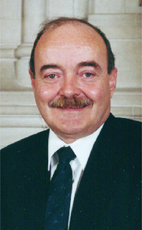
House of Commons photo

Crucial Fact

  • His favourite word was quebec.

Last in Parliament May 2004, as Independent MP for Chambly (Québec)

Won his last election, in 2000, with 50% of the vote.

Statements in the House

The Budget February 26th, 1998

Mr. Speaker, I listened with interest to the rather partisan remarks by my colleague for Mississauga West.

For at least 35 years now, I have been following budget presentations, and the Liberals have been in power a good 15 years of that time. I have never before seen a Liberal member rise and say that his Minister of Finance was totally wrong, that a mistake had been made. Definitely not.

From the first year the current Prime Minister was Minister of Finance, he got us into debt, debt that accumulated over 28 years. I do not understand the hon. member's thought process. How can 35 years worth of good result in something bad, like the current $583 billion accumulated debt.

But that is not really my main concern. The Minister of Finance brags about curbing his deficit. But on whose backs did he do that? There are 500,000 people living in poverty in Montreal. Just this morning, the headline in the paper read “Young mother of four has problem with leaky roof”.

How is this young woman with four children expected to set up a registered school savings plan for her children? They will probably die of hunger before they reach high school.

Supply February 10th, 1998

Madam Speaker, I would like the minister to tell me whether he still does not find it a bit odd that his court justices were asked for their opinion as a last resort. It is a bit like a divorce case. This is about divorce.

It is as if a couple had a difference in separation proceedings and one of the spouses told the other that his or her mother was going to settle the dispute. It is a bit like that.

Does he not think that his justices—appointed by him, paid by him and in his service—are not likely to be biased in the decision they are asked to give, a decision that should, if they have understood their role, suit their minister?

That is what is upsetting the people of Quebec at the moment, and he did not resolve the problem in his speech, earlier. I would like him to be a little more explicit.

Supply February 10th, 1998

Madam Speaker, I would like to ask the minister, who has just—

Ice Storm February 2nd, 1998

Mr. Speaker, the people of Quebec will long remember the start of 1998 when they poured all their energies into battling this terrible freezing rain storm. Everyone gave everything they could to help the disaster victims.

I would like to congratulate and to thank all the people of Quebec warmly for their solidarity and community spirit in such difficult circumstances.

However, there can only be criticism for the Minister of Human Resources Development, who kept people in a state of total confusion over their entitlement to employment insurance. Many were outraged to discover that they were not entitled to any compensation from the plan to which they had so long contributed.

I strongly urge this government to keep its promise to not further penalize those workers victimized by this terrible storm, who have already suffered enough as a result of it.

Postal Services Continuation Act, 1997 December 2nd, 1997

Mr. Speaker, as I listened to the Reform Party member, I once again got the impression that Reformers advocate the wrong approach.

I agree with the hon. member when he says that the issue should have been solved a long time ago, but the Reform Party did not suggest anything back then. The problem is that unionized employees were granted a right to strike and they are certainly entitled to avail themselves of this right. Perhaps it is the hypocrisy of the legislation that explains why the workers got taken. They exercised a right that was legitimately granted to them, and then they were told they should not have done so.

Such is the government's hypocritical way of doing things. It gives a right, and then removes it through special legislation. Reformers are no different. They saw it coming. They knew that postal workers might avail themselves of their right to strike. Today, they support the government's bill, but they do not have a long term vision to settle the conflict.

The bill before us is a band-aid solution. The Reform Party is supporting that band-aid solution. Why not have the political courage to tell postal workers “Postal services are essential services. There will no longer be any strikes in those essential services”? Instead of resorting to legislation to settle labour disputes, we could then solve the whole issue.

As is their custom, Reformers came from nowhere, got involved in the issue and are now bragging that they saw the light before everyone else. In fact, they have a short term vision and they never propose anything to help find a permanent solution to the Canada Post issue.

My question to the hon. member is: what does he have to suggest? What constructive measure would he suggest, so that in three or four years, when the collective agreement that we are imposing today through legislation expires, we do not have to relive the same situation? This is my question to the member from the Reform Party.

Supply November 25th, 1997

Mr. Speaker, I arrived late, but I would have voted with my party.

(The House divided on the amendment, which was agreed to on the following division:)

Supply November 25th, 1997

Mr. Speaker, I congratulate the last speaker. This is a man who is asking himself some hard questions.

Will the Calgary declaration, which I have only examined briefly, but which talks about the unique character of Quebec society, be accompanied by new inputs or amendments to the existing Constitution? If this notion of unique society were adopted in Quebec or elsewhere in Canada, has it been proposed to Quebeckers that this notion of Quebec's unique character be enshrined in legislation, which would be our new Constitution, and which would be accompanied by a change in the Senate, by a change in the division of legislative responsibilities, or whatever? I have heard nothing.

There is no doubt that Quebec is unique. It is unique in speaking French. It is unique in having its own poetry. It is unique in many of its structures.

But I would like the hon. member to tell me whether, in Calgary or in the consultations now under way, proposals to Quebeckers were formulated.

Canadian Wheat Board Act November 19th, 1997

The funny thing is that the preamble had no significance back then. Now, as the member for Malpeque sees it, the preamble explains everything, is highly significant, and could mislead the courts if they were called upon to interpret it.

Just recently, a new proposal was made in western Canada, about the unique character of Quebec, something comparable to the Pacific salmon, and it was said that “maybe that could be added to the preamble if a constitutional amendment is made”. Others said “No, it would go at the end”. Regardless of whether it comes before or after, I believe that a preamble has to give a general idea of the legislative text.

Of course, the preamble per se is not a section of the act, but a guide. We know that the members of this new Canadian Wheat Board, or some of them, are MPs who lost their seats in the last election, people who will get their reward from the Prime Minister and the party in power for their contribution to democratic debate on June 2. It might not, however, be a bad thing to remind them in a preamble that their primary authority is the farmers, the producers, not the one responsible for appointing them to the board, particularly when an act like this one is intended to last a good length of time, since it is made to be longlasting, hoping that it is the best possible.

If such is the case, if the government passes this legislation to be in effect for a goodly length of time, hoping to apply it for a long time, it is possible that its buddies who are appointed in this first batch to the Canadian Wheat Board could turn up elsewhere, be promoted to something else. However, its friends or those who could be friends with the others later on have to understand from reading the preamble of the bill governing them that its priority and purpose is to look after the interests of grain producers.

I do not understand why the member for Malpeque always rises here, waving his arms about as if this were a personal issue, as if it were an attack against him personally when we take apart and criticize a bill that he is defending. I do not know why he does not just use a little common sense. There must be common sense in Malpeque too.

The hon. member for Malpeque should drop his habit of leaping up and save his strength for other occasions, of which there are many in political life.

Moreover, I want to say too that the bill does not require the Canadian Wheat Board to be accountable to wheat producers. The bill requires it to be cost effective, but who is going to decide if it is cost effective? It is all very well to say the board will be managed in a way that ensures its cost effectiveness, but who is responsible for ensuring the cost effectiveness of the board? Is it the appointed head of the wheat board, the person who appointed the directors, friends of his political party? Or is it the producers, who may be affected by the sometimes irrational decisions and choices made by the administrators of public funds, decisions that are even less rational because they are not accountable to the people, the producers in this case?

I find the attitude displayed by the member for Malpeque, despite the carryings on of my colleague opposite who is protecting his chum and shares his views on the matter, in so vigorously opposing what we propose to put in the preamble of the bill, is mistaken and leaves that very impression with everyone including the Liberals. A member rose on a point of order saying he had the impression, from the way things were being dealt with, that the members considered him dishonest. That does not come from us. I was seated and had said nothing. If he thinks he is dishonest, it has a lot more to do with his bill.

The time may have come to focus on the bill and suggest that the hon. member for Malpeque stop challenging virtue and peace, order and good governance.

I can understand that the hon. member for Malpeque may want to sell just about anything to anyone; that is his job as parliamentary secretary. He can be made to say anything, that is his job, as he has to protect his minister. But let us try to get across to him what is really being asked by our colleagues in the Reform Party, with whom I seldom agree, but agree with this time. Good common sense ideas can spring from anywhere. I mentioned Malpeque, but they can also spring from western Canada.

I think that they are absolutely right. Without being partisan about this bill, I think it could be a good bill, a bill that does what it is meant to do and a bill that can have a positive effect. There is no need to get carried away and go on opposing the Reform proposal. As a former political figure in Quebec, the late Maurice Bellemare, used to say “What matters is not the size of the sledgehammer but the swing you put in the handle”. He has put quite a bit of swing in demolishing something that stands to reason and is founded in logic and necessity.

I urge all members of this House, especially those who feel as uneasy about this bill as the hon. member who spoke earlier, who feel attacked even though they are innocent—and they all are—, who feel targeted by the bill and threatened by its consideration, to share their feelings with the hon. member for Malpeque, who will inform his minister, who will in turn inform whomsoever he pleases, as long as the end result is that an interesting bill is brought back to us. If justice is not done to grain producers, it should at least appear to be done. That would be better than nothing. We cannot hope for more than that.

Canadian Wheat Board Act November 19th, 1997

Madam Speaker, I am pleased to speak to Bill C-4, an act to amend the Canadian Wheat Board Act and to make consequential amendments to other acts.

At this point in the proceedings, we are debating the preamble suggested by Reform Party members. For the party in power, and especially for the member for Malpeque, I would like to read the motion tabled by our friends in the Reform Party.

WHEREAS agriculture is a basic foundation stone of the Canadian economy; and

WHEREAS interprovincial and export trade in grain produced in Canada is an essential element of the agricultural sector of the economy; and

WHEREAS it is necessary to establish an organization to coordinate such trade; and

WHEREAS such an organization will have a very significant effect on the producers of grain and must therefore have the securing of the best financial return to them as its object and first priority and must be accountable to them for its performance;

THEREFORE Her Majesty, by and with the advice and consent of the Senate and House of Commons of Canada, enacts as follows:

I was surprised at the speech by the member for Malpeque, who is opposed to such a preamble. This is not the first time a preamble has been discussed. There was talk of a preamble when the notion of distinct society was raised in connection with the Meech Lake accord. There was a preamble in which Quebec was described as a distinct society.

I see the minister from West Island laughing. She lives in my riding. She played an active role in that affair.

Supply November 6th, 1997

Mr. Speaker, it is odd to hear the Liberals singing the praises of the GST. I have been listening to them since this morning. These are the folks who, back in 1993, were carrying on so, promising to scrap the GST, you will recall. Even an influential minister of that party saw fit to tender her resignation over it, and to get re-elected shortly after on it.

The minister has just accused us of partisan politics. This morning, I heard a western MP accusing the government of having bribed, bought off the people of the maritimes with this $920 million supposedly given to the maritimes to harmonize their tax with the GST, because the shortfall was over 5%.

When a government, which alone knows the date the next election is to be called, goes around waving $960 million for fishers hard hit by the employment insurance reform, might we not assume that it is trying to bribe the public? Fortunately, this sort of tactic does not work particularly well. I would ask the members of the party in power who come from the maritimes to rise and speak to the topic of the day. I invite them to do so. We would like to hear what they have to say on the subject.

When the minister responsible for regional development tells us that this subsidy was awarded totally fairly, I would to know where he is getting his information from. What is this 5% based on, if it is not arbitrary? How can the Minister of Finance justify this 5%? Why not 8% or 2% or 1% or 14%. Where does the figure 5 come from and how can he justify it?

The minister makes me think of this. Suppose his car hit mine the day my employer announced I was going to get a raise. I ask him for compensation and he says “Well, no. You just got a raise, you can pay for the repairs”. This is his sort of reasoning. I would like him to tell us what justification there is for 5%.