
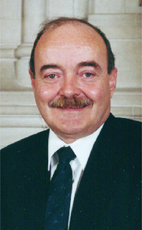
House of Commons photo

Crucial Fact

  • His favourite word was quebec.

Last in Parliament May 2004, as Independent MP for Chambly (Québec)

Won his last election, in 2000, with 50% of the vote.

Statements in the House

Supply May 14th, 1998

Mr. Speaker, I listened with great interest to my hon. colleague, whom I had the pleasure of working with on the Standing Committee on National Defence and Veterans Affairs, which he referred to.

I noticed pretty much the same things he did. I think the main concern right now in the Canadian forces is pay. Our military feel they are underpaid, and I agree. In addition, for non-commissioned officers and enlisted men, opportunities for advancement are practically nil. The organization is top heavy, which is unusual nowadays. That is another problem.

With respect to equipment, I agree with him that we need state of the art equipment meeting current military requirements. I think that, for the next little while at least, governments will have to balance spending between human resources, military equipment and military training. These three budgetary items must, unfortunately, be kept under tight control at this time.

I would like to hear what personal thoughts the hon. member for Compton—Stanstead has on this issue of financial resources apportioning for the purchase and use of equipment, for human resources, military pay, severance pay and so on, and finally for training military personnel, exercices conducted on land, on sea and in the air. Does he have any idea how these funds should be apportioned?

Saint-Jean-Baptiste-De-Rouville Hydro Co-Op May 13th, 1998

Mr. Speaker, my question is for the President of the Treasury Board.

Quebec's only hydro co-op, in Saint-Jean-Baptiste-de-Rouville, could go bankrupt if nothing is done to help it recover from the recent ice storm. The situation is as follows: there are 5,200 subscribers in a rural area spread over four federal ridings, the damage caused to the power grid totalled $10 million, and profits are minimal.

Will the government quickly answer the call for help from the hydro co-op in Saint-Jean-Baptiste-de-Rouville?

Supply April 28th, 1998

Mr. Speaker, I listened with some interest to what the member who just spoke was saying, but I have to say I find it utter nonsense.

The member is in favor of free trade, in favor of international trade. But does he know that, for example, Quebec's Unibroue, the micro-brewery Quebeckers are so proud of because it produces a quality beer that is sold all over the world, is unable to sell a single bottle of beer in Ontario because of the tariffs and structures the Ontario government has put in place to keep out producers from Quebec and, I suppose, from other provinces also?

I would like to say to the member that, without customers from Quebec who bought cars made by Ford, Chrysler and GM in Ontario, at almost double the price these same products are sold for in the United States, without protectionist measures, the Ontario economy would have taken a nosedive and its automobile industry would be dying.

I am in favor of trade, but we have to start from identical bases and production costs must be identical because of the commitment of governments to respect certain rights.

How can we sell a welding product, for example, when a welder in this country must wear special protective clothing, his workshop must be heated, and he must receive a minimum salary, whereas in Venezuela, I saw a welder working in shorts, barefoot, on the street corner, using the bottom of a bottle for a mask? How can we be competitive in these situations?

I would like my colleague to explain this to me because he seems to be the one who has the absolute truth, today, in the House.

Canadian Parks Agency Act March 19th, 1998

Madam Speaker, I congratulate the member for Beauséjour—Petitcodiac on a very caring speech.

Knowing that there are 500,000 poor children in the Montreal area, I wonder whether they will ever be able to set foot in a national park, given the new parks policy.

I raised this issue earlier with the NDP member. I am concerned that under the bill—I had a quick look at it—the Canadian government is turning the responsibility over to an agency.

For example, the agency created by the minister will develop policies, but the minister will not get involved in the areas listed under clause 13, which is at the heart of the way the agency will operate. Does this mean we might see the same situation as with Montreal airports where the transport minister can no longer get involved and has no say in the way airports are managed?

Will it be the same with the new agency? Could it be that once a given area has been shown to be profitable, contrary to section 4 of the old act, which said that parks were for the use and benefit of all Canadians, the minister will bring in an agency specializing in entertainment, or a huge corporation such as Walt Disney? This organization will then become responsible for the administration of the Banff National Park, for example, in return for a small fee and will be free to charge whatever prices it wants and to go after its usual clientele, namely the rich, the upper crust, while the poor, for whom national parks were designed and created in the first place, will no longer have access to them.

We are standing on a slippery slope. This seemingly innocuous bill has huge flaws and needs rethinking. I urge the minister to retain at least his power to get involved, especially under clause 13. It is at the heart of Canada's national parks management system. Without it, we might as well sell them to for-profit corporations. In fact, this is where we are heading.

I would ask the member, who gave such a good speech, to reassure me in this regard, if at all possible.

Canadian Parks Agency Act March 19th, 1998

Mr. Speaker, I was interested to hear my NDP colleague's analysis. I would like to know whether he has seen what I have.

The former section 4 of the National Parks Act reads essentially as follows “The National Parks of Canada are hereby dedicated to the people of Canada for their benefit, education and enjoyment, subject to this Act and the regulations”.

This section does not appear in Bill C-29. It is also closely related to the former section 7.(f), which provides that the government may set fees for the use of the parks.

Now, fees will be set, it appears, by the administration of the new parks agency. Its only obligation will be to publish them in the Canada Gazette , but that remains fairly haphazard. Will the fees be the same across Canada—a mari usque ad mare—or will they be set according to the clientele or the amount of traffic? Will there be different fees, for example, at Forillon National Park and at Banff National Park?

Could the member enlighten us on that?

Supply March 17th, 1998

Mr. Speaker, if this can make my NDP friend happy, I will say that francophones were one of the first two founding peoples. It was only later, when the English came, that we called ourselves French Canadians. Then, when we realized that this definition put us in opposition with English Canadians, we decided to call ourselves Quebeckers, and today—

Supply March 17th, 1998

Mr. Speaker, I listened with interest to the hon. member for Brossard—La Prairie, who became a Canadian about 20 years ago.

I simply want to remind him that, originally, there were two founding peoples in Canada, and the first one was a francophone people called the Canadiens. At the time, the term “Canadiens” referred strictly to francophones. Then came a period known as English Rule. Being the nice people that we are, we agreed that there would be two founding peoples, and Canadians who, until then had always been Canadiens, redefined themselves as French Canadians.

Supply March 17th, 1998

Yet he is one.

Supply March 17th, 1998

Mr. Speaker, I listened with interest to the Reform Party member. Thank goodness she was not born on December 25, because she would think she is God Almighty.

I was here when the incidents occurred and what concerns me about the attitude of Reformers is that they behaved like a bunch of fanatics. People who, individually, are usually sociable, tolerant and understanding behaved like a pack hunting some prey, and this scared me. History tells us—and there is no need to refer specifically to Germany during the second world war—that people wrapped in their flag like that often commit the worst possible crimes.

Could the hon. member tell us whether she is proud of the attitude displayed and the means used here by her colleagues in the Reform Party, including the threats made to the Speaker of the House, such as airing his private life in public? I wonder if she is proud of her fellow party members and if she is proud of herself, considering she was born on July 1.

Supply March 12th, 1998

Madam Speaker, I listened very carefully to the hon. member. One thing he seems to be forgetting in this debate is that—in the Fall of 1995, I think it was—the House passed a resolution on Quebec's distinct society. As usual, members opposite have forgotten all about it, of course. At the time, we kept saying it was wishful thinking and we have been proven right.

I want to say to the hon. member who just spoke that regional development depends quite a lot on manpower training. He voted in favour of Quebec's distinct society. If we were to go through Hansard , we would see that the hon. member has acknowledged it. Quebec, as a distinct society, can adjust its regional development according to its manpower training or can train its manpower according to its regional development.

For instance, if Quebec were to decide to focus its manpower training and education program on the aircraft industry and the federal government, just to please the Reform Party, were to centre its manpower training program on the cross-breeding on corn, this could very well hamper the manpower training and regional economic development initiatives of the provinces.

This is one part of the problem that the hon. member opposite, despite all his good intentions, I am sure, as well as the government tend to forget.

Is it not time for him to recognize that economic development is closely linked to the quality of manpower training? When we talk about manpower training, we are also talking about schooling leading to it. This problem has been completely ignored by the Prime Minister and his finance minister in the budget he recently brought down.

Therefore, my question to the member is this. How does he reconcile the maple leaf, Quebec regional development and the quality of manpower development? Can we find all this in the millennium fund or is it only window dressing to bring young Canadians to realize how heavily subsidized they are by the federal government, that the Liberal Party of Canada is their only hope for salvation, that only through the narrow ways of the Liberal Party of Canada will they go to heaven, and that besides that there is no salvation? This is what the federal government is trying to show us.

This is basically linked to economic, social and demographic considerations. Manpower training should meet our needs. I would like the member to comment on this.