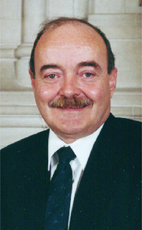
House of Commons photo

Crucial Fact

  • His favourite word was quebec.

Last in Parliament May 2004, as Independent MP for Chambly (Québec)

Won his last election, in 2000, with 50% of the vote.

Statements in the House

Canada Mortgage And Housing Corporation November 3rd, 1998

Mr. Speaker, the Canada Mortgage and Housing Corporation charges a $235 appraisal fee to all home buyers who make use of its services in securing a loan.

My question is for the Minister of Public Works. How can he explain the CMHC's imposition of this $235 appraisal fee on everyone, when appraisals are done in Quebec only 5% of the time?

Merit Principle October 27th, 1998

Madam Speaker, I read the motion by the member for Wetaskiwin, which reads as follows:

That, in the opinion of this House, the government should support the right of all job applicants to be evaluated solely on the basis of merit.

That is asking a lot from a government that, as late as yesterday—as I am the public works critic on contracts awarded or the section of the department that oversees a lot of big companies—sent my office a list of recent appointments.

For instance, Vivian G. Albot of Winnipeg, Manitoba, was appointed to the position of office manager for the board of directors of Canada Post. Ms. Albot was a contributor to the Liberal Party of Canada's campaign fund, I even have the amount here.

I have other examples, including the appointment of Gérald Préfontaine of Ottawa, Ontario, as a member of the board of Canada Post. Janis Cochrane was appointed a director of the Canada Mortgage and Housing Corporation.

What these people have in common is the fact that they contributed to a political party, specifically, the one handing out the jobs.

Another example is Cecil Mervin Ozirny of Melville, Saskatchewan, who contributed to the Liberals' election fund and who was given a position with the National Energy Board.

Is the prime requisite for such appointments the fact of having contributed something to the Liberal Party election fund or do these people really have skills not easily found or at least the same level as those of individuals who might apply or contribute to the management of the organizations I have just named?

Allow me to express my doubts, because I have a newspaper article here.

I remember the 1993 election campaign that brought the Liberals and the current Prime Minister to power, on October 25, 1993, to be precise. This election also produced the official opposition of which I was a member, with its then leader, Lucien Bouchard, who has since moved on to another stage. He has proved to the Prime Minister that he is a good manager and that he can practice in Quebec what he was preaching here, as he has brilliantly demonstrated. What he used to preach here, he put in practice in Quebec.

In their red book, the Liberals vilified the former Prime Minister of Canada, Mr. Mulroney, who, just before he left and handed power over to the newly elected leader of the Progressive Conservative Party, appointed 500 people to positions all over Canada. For instance, he appointed the manager of Montreal's Ritz-Carlton Hotel to the Senate, along with his wife's hairdresser, and he was roundly criticized by the Liberals.

In the red book, the Liberals were very critical of this kind of appointment. But who was recently appointed to the Canada Post Corporation? Pierrette Ringuette-Maltais, who used to sit in this place, who unfortunately—for her, of course—was defeated in the Edmunston region in New Brunswick. There have been others. There was Ross Fitzpatrick, a gentleman who had the bright idea of helping the Prime Minister to a capital gain of $45,000 by giving him shares in his company, which the Prime Minister sold at a profit of $45,000. He was another Liberal appointment.

Just to name a few members I have known in the House, André Ouellet was appointed to the Canada Post Corporation, David Berger was made Canada's ambassador to Israel, Ron Irwin was appointed to an important post, Canada's ambassador to Ireland, I believe.

They are thanking the friends of the Liberal Party. When the current Prime Minister returned to political life, he needed a safe riding. He had to win a seat somewhere to be able to sit in this House as the Leader of the Opposition.

A member by the name of Robichaud, a nice fellow from Beauséjour, in the maritimes, was kind enough to give up his seat so that the Prime Minister could get elected in a safe riding. It worked. Mr. Robichaud had to wait a few months for a national general election to be called and for Mr. Chrétien to win back his traditional riding, Shawinigan, and give him back his seat as the member for Beauséjour, which had become vacant.

Mr. Robichaud was elected in Beauséjour. He sat with us here during the 35th Parliament. Then came a young Liberal star and the Liberals said “The son of the governor general, now that is somebody”. They told him he would run in Beauséjour and asked Mr. Robichaud to step aside and let Mr. LeBlanc, the governor general's son, run for the Liberal Party in Beauséjour.

Unfortunately, it does not always work and, this time, it did not, but Mr. Robichaud was not blamed for the Liberal loss in Beauséjour. Mr. Robichaud, for whom a seat had been set aside in the Senate, soon replaced a good friend of the party who had been appointed to the Senate barely 14 months short of the compulsory retirement age in the Senate. He was obviously appointed to keep the seat warm until Mr. Robichaud was ready to make the move.

Sad to say, the good turns Mr. Robichaud did the Prime Minister were not done out of generosity. He did them because he knew that the payoff would be substantial.

It is no big deal if, in order to get some job, one must be a member of the Liberal Party and give $200, $250, $300 or $400. Many people in my riding would be quite willing to pay $400 to get a job in the Senate or with the Canada Post Corporation, or to sit on the board of directors of the Canada Mortgage and Housing Corporation.

I can think, among others, of my friend Michel St-Laurent, a carpenter who does all sorts of jobs for me and someone whom I really admire. I am convinced that he too would give $200, $300, $400 or $500 for such an appointment, but he never had that chance. He was never informed of any vacancies. They do not want him because he is not a Liberal, and being a Liberal is the first condition, the prerequisite for such an appointment.

When the Reform Party member, for whom I have a lot of respect, tables his bill on what he calls quotas, but what I would rather call employment allocation equity, we should also discuss the type of jobs given to friends of the party, who get huge salaries or fees—whatever you want to call it—and who often do no work at all, killing time at taxpayers' expense while, in some cases, pocketing millions of dollars.

Consider the case of the friend of the government who was appointed ambassador to the OECD. This gentleman is paid $255,000 per year and he is barely 52 or 53 years old. If he retires at age 75, he will have had an annual salary of $255,000 for 23 years. This amounts to quite a bit of money. It pays to be a Liberal.

Personal Information Protection And Electronic Documents Act October 22nd, 1998

Mr. Speaker, I have been listening since this morning to the various members who spoke on Bill C-54 which, according to its title, as the member for Rosemont pointed out, and according to the wording of the text, is aimed most of all at supporting and promoting electronic commerce.

We see that the concern for protecting the privacy of the consumer, the individual, is secondary. This is mainly a trade-related legislation, if I may say so. This is also why the industry minister has moved it.

Of course, this may be required for certain reasons. Many business people or companies will come forward to justify the existence of this bill. In general, the main reason for being in business is to maximize receipts and revenues. The fewer the restrictions, the bigger the profits.

But privacy is still important. As the member for Rosemont put it so eloquently—I concur with everything he said—the main concern should be the protection of personal information.

I would like to tell members opposite, especially the industry minister who tabled this bill, where indiscretions can lead sometimes.

I recall reading in the newspapers a few years ago—I will not say in which province—that police officers, who had a bank of confidential information, were selling it to collection agencies. Some would say “He who pays his debts grows rich”. I realize that, but these collection agencies were reselling this information to organized gang members who were looking for defaulters to, often times, physically abuse them. In one case, if my memory is correct, they killed one of them. The biker gang paid a tracing agency a small fee and destroyed somebody's life.

So, it is very important to protect personal information that may seem trivial to some, especially those who sell them, but that could have really dramatic consequences for those who are victims of this type of indiscretion.

The main concern of the minister is not to protect citizens and their property, but mostly to look after the industry and its profitability and to respond to the industry lobby's requests to facilitate the creation and growth of this or that type of business; that is his duty and I think he has done a good job so far.

To come back to the bill itself, subsection 7(1) reads: “For the purpose of clause 4.3 of Schedule 1—”

As we know, Schedule 1 is the code of ethics that applies to those whose job it is to betray their fellow citizens by releasing information about them. This code of ethics is full of may's, shall's and should's. The bill itself and the schedule, which is only wishful thinking, do not distinguish between the various people involved in this business, companies like Equifax and others that have made a lot of money as informers, collecting and selling information, because they do not give anything away for free.

Clause 7(1) says this, and I quote:

  1. For the purpose of clause 4.3 of Schedule 1, and despite the note that accompanies that clause, an organization may collect personal information without the knowledge or consent of the individual only if

(a) the collection is clearly in the interests of the individual and consent cannot be obtained in a timely way;

There is no problem with that. If someone is involved in a traffic accident and is unconscious, we want to know their blood type and we want to know their address to notify their parents. I understand why the government would include such a provision in this bill.

The bill says that personal information may be collected without the knowledge or consent of the individual if

(b) it is reasonable to expect that the collection from the individual would compromise the accuracy of the information or defeat the purpose or prejudice the use for which the information is collected;

I think about Equifax. If Equifax is gathering information on a person and that person does not want their financial, economic or even political past to be known, of course whoever is collecting the information for Equifax will choose not to ask the person directly knowing that they will not be willing to give that information. That opens the door for the gatherer to ask anybody for that information or to sell it to anybody. That is the danger.

It is not that the minister has not seen the dangers in his bill, but he has chosen to ignore them, especially the danger in clause 7(1)(b).

Paragraph (c) says this:

(c) the collection is solely for journalistic, artistic or literary purposes.

We can live with that. The provision that is really catastrophic for any individual is clause 7(1)(b). And it goes on. This bill contains plenty of loopholes.

The government has introduced a bill. There is a code of ethics—if I can call it that—that people who are in the business of buying and selling personal information have developed for themselves. The bill says that everything which is stated in the conditional in the schedule, in the code of conduct, is not compulsory. They can do it if they want to, if they think they should, if they could, if they would. Nothing is binding. Nobody is obliged to do anything.

The government would have us believe that this bill is truly aimed at helping people who are bothered by canvassers of all kinds and collectors using more or less clever tricks. A case in point is a company we all know, which obtained highly confidential information concerning the president of a fairly large medium size business, namely Mrs Verreault, who is from Gaspé like me, and a very successful businesswoman.

Her direct competitor, her business opponent, hired a firm which, through all kinds of shenanigans, using forged papers, fake ID and under false pretence, managed to gather information from various sources, putting at risk this lady's private life, as well as her economic and financial situation, for the benefit of one of her competitors.

Here we have the minister with his bill, Bill C-54, which only pays lip service to protecting privacy. It is not too late for him to realize all the harm, not so much the harm he has done himself, but the harm he could prevent from happening if he withdrew this half-baked bill. It is a botched job, it will not last long. As the member for Lévis-et-Chutes-de-la-Chaudière said, I would be surprised if it lasts the winter. It is not because it will be repealed once passed by the Liberals; they have a majority, they can do whatever they want, even change a man into a woman.

The bill will be enacted, but it will be inoperative and unenforceable. I urge the industry minister to backtrack, and get back to the drawing board. At least, if he himself does not want to cause any harm, he should not permit others to do so.

Personal Information Protection And Electronic Documents Act October 22nd, 1998

Mr. Speaker, I congratulate the member for Lévis-et-Chutes-de-la-Chaudière for the magnificent speech he has just given.

It was certainly an eye-opener for me. It will go down in the history of the House as a landmark speech on the topic of personal information protection. It calls to mind events in the House in 1916 when politicians opposed Ontario's legislation on language of instruction. It will undoubtedly set a precedent in the House.

I am somewhat surprised. Earlier, I put some questions to the member for Winnipeg Centre, who tried to quell my concerns about the bill. However, because, as members of parliament, we try to look at bills from the viewpoint of our constituents and find out whether a bill might affect them or us, and given what my colleague, the member for Lévis-et-Chutes-de-la-Chaudière has just revealed, the bill would be far more aptly named “An act to pay lip service to personal information protection”. That would be a far better description.

I would like to know whether the member for Lévis-et-Chutes-de-la-Chaudière received, or knew of, any comments from experts in this area. I am thinking of Quebeckers, who are also—I hope for as short a time as possible—still Canadians. Were there any particular Quebeckers who filled him in and contributed to his position on this topic?

I would like him to tell us what these people have to say about the bill before us this morning, with its pretentious and lengthy title. I would like him to give us his views on this.

Personal Information Protection And Electronic Documents Act October 22nd, 1998

Mr. Speaker, I have listened to the hon. member's speech, and congratulate him on his moderation and lucidity.

There is one doubt I have after hearing him, however, and I would like to hear his answer on this. He is in favour of protecting personal information, and so am I, but he seems to have qualified that protection somewhat. He also wants to see commerce protected. It is a balancing act that may be problematical.

There is one practice we see regularly. A person buys a car at the local dealer, giving his social insurance number and a whole lot of other details. Suddenly, he finds himself the target of mail solicitation for all manner of products. Until quite recently, I thought the dealer one had done business with gave that information to others, but no. He sold them to companies specializing in this type of mail or phone soliciting.

I would like to know whether the bill we are discussing this morning contains a ban on the selling of information which is no longer confidential because one has had to disclose it when preparing to enter into a legal transaction, a purchase or sale contract, and so on. I do not consider this to be in the public domain, but neither is it really personal any more, once the information has been disclosed.

Does the bill forbid businesses from selling this type of information? I believe that this is the point that will make or break this bill, if it is not addressed specifically. I would like the hon. member to clarify this.

Division No. 230 September 29th, 1998

Mr. Speaker, I listened with great interest to what my colleague said, still I have a major concern about this bill.

The principles put forward are genuine, right and straightforward. The problem with this kind of evidence is that it is hard to contradict or rebut by ordinary citizens or lawyers defending themselves. This engineering evidence is so elaborate and complicated that it has to be made by a scientific consulting firm. Such means of rebuttal are generally not available to the defence. That is the danger presented by this kind of legislation.

I am totally in favour of the principles, but we must ask the question. Recently, in Quebec, evidence was fabricated by crooked cops in the well-known case of the Matticks brothers. So, I wonder how the defence could rebut evidence like what would be required under Bill C-3 if it were dealing with, say, officers like the ones involved in the case I just referred to. That is my only concern. As for the rest, the principles, I am in favour.

I would therefore ask for reassurances concerning the tools available to an honest defence to rebut evidence made by the crown on the basis of Bill C-3.

Supply June 1st, 1998

This makes no sense at all.

Supply June 1st, 1998

Mr. Speaker, I have a question for my distinguished colleague from Saint-Jean regarding the fiduciary role that the federal government has when it collects money from workers and employers and has the authority, at least morally if not legally, to distribute that money to those who paid it. It is still employment insurance.

Professional associations all have a trust account and, despite the loftiest of intentions, if we take money from a trust account and use it for other things than what it was intended for, just like the federal government is doing, if we use it to pay for groceries and other things instead of using it for its original purpose, can this not be challenged before the courts, as some people are beginning to suggest? I would like my colleague to clarify that for us since I missed that in his speech.

Supply May 14th, 1998

Madam Speaker, I was very interested to hear the remarks of the hon. member opposite. Unfortunately, I have not reviewed the guard of honor. I guess he was accompanying the Prime Minister or some minister. I was more involved with the lower ranks, with enlisted personnel, with the people we never see but who live in a submarine in a room the size of a toilet. I listened to these people. I certainly did not inspect the boots of the military standing at attention on Parliament Hill or anywhere else.

But I can tell you that I saw the terrible things that partisan politics, no doubt—it cannot be from anything else—prevents the hon. member from criticizing, like the member for Nepean—Carleton, who sits on the same committee as I do.

Earlier, I mentioned a francophone in Trenton who has a young quadriplegic child. The child is three and a half years old and does not speak yet. The name of the person is Denis Paquette. He is at the Trenton base. All he wants is a transfer back to Quebec so his child may be taught to speak. This is all the child will be able to do.

I contacted Corporal Paquette in Trenton, as the hon. member was starting her speech. He said he is getting nothing but reprisals for complaining to the committee when it visited Trenton and is being told that he might be encouraged to leave. He has been told that, if he is transferred to Quebec City, it will be for compassionate reasons, but they will not pay to move him or his family. That is the member's wonderful Canadian armed forces.

It is time a look was taken at the army's human resources. I could almost believe that the soldier who wrote Une armée en déroute was right. Our soldiers are poorly paid and poorly outfitted. They travel in style, on lovely big vessels, leaving the Sea Kings aside, but they do have new equipment. Everything has been spent on equipment and very little on human resources and soldiers' well-being.

I do not think that the member would agree to live in the so-called PMQs, the houses soldiers are provided with that are not fit for a modern family, where the stoves do not even have hoods to vent cooking odours. Is this what the member thinks makes our army so wonderful right now and contributes to the well-being of soldiers? I think not.

I call on members to have a bit of compassion and to listen to soldiers' complaints, such as that of Denis Paquette, about the insurmountable human problems they are up against. And to think that the leader of the Progressive Conservative Party has just been told that the army is wonderful, that there are no problems and that she is making it out to be worse than it really is.

We spent three weeks on the ground. Some of the committee sessions lasted from 1.00 or 1.30 p.m. until midnight. Like the member for Pontiac—Gatineau—Labelle, we heard soldiers tell us that they were not even allowed to see their own medical file. The excuse given was national security. This is wonderful?

It is time that members examined their conscience, that for once they set aside partisan politics, that they set the record straight and admitted that our soldiers are badly paid and badly outfitted. A soldier came to tell us that he had been waiting six months for boots and nobody believed him until his colonel came to tell us it was true. He had no boots. For six months, the man had been wearing the boots of another soldier who had retired last year. What does she have to say to the soldiers in Bosnia who buy kevlar suits from the Americans? How are we going to send them over? Wearing loincloths, like the Indian tribes of old?

Supply May 14th, 1998

Mr. Speaker, I want to congratulate my colleague from Portneuf for summing up what he saw during a tour of our military bases.I was also on that tour.

Earlier, the minister of defence blamed the Tories for leaving our armed forces in a really poor state. You know, it is always easy to blame others. One is never to blame, it is always the other guy's fault.

There was no deficit in Canada before 1973. The first one to open the door to a deficit was the current Prime Minister of Canada, who bragged about being the first finance minister from Quebec to become prime minister. I do not think it does us great credit.

Anyway, it is easy to always blame others. I have noticed several things. Let us use the example of our armed forces. In Trenton and in Petawawa, some members of our Canadian Forces told us that they had been waiting eight months for a pair of boots. Our soldiers in Bosnia buy kevlar equipment from the U.S. military, because we are unable to provide them with what they need.

Two years ago, the Auditor General of Canada told us in his report that the RCMP had 4,000 hats in storage in Ottawa. Some people have too many hats, others have to do without boots. There is currently a lack of warm equipment for those who are posted to Alert. What is the problem? It may lie with our suppliers who are probably not getting as much as they think they deserve, because they are not providing us with anything. Have we come to the point where our soldiers will have to provide their own rifles and their own bullets to join the army? We are almost there. Eight months for a pair of boots, does that make any sense?

Let us move on to housing. Our colleague said he was concerned about the welfare and health of the members of our armed forces and their families. The committee visited military housing. I do not know whether he would want to let anything live there. There was two feet of water in the basement and military personnel were told to keep quiet, they were not renting the basement.

They get a $100 increase and end up with $46 after taxes. The cost of food is raised from $200 to $425 a month and housing costs are raised by $125 or $150 a month, and military personnel are told they should be content with that.

Morale has bottomed out. The military are exhausted. The armed forces are demoralized. Meanwhile, the minister is spouting fine rhetoric, saying he did this or that well. The armed forces, however, are a disaster. Something has to be done to raise their self-esteem.

Corporal Paquette in Trenton, a francophone, with a quadriplegic child whose only hope is to one day learn to speak, cannot obtain the services of a remedial teacher in French to teach his child to speak. After 17 years of service he is told “If you are unhappy, why don't you go home to Quebec and leave the forces?” This is the way our soldiers are being treated.

I see the member for Mégantic—Compton—Stanstead nodding, because it is true. He was there and heard the testimony with me. When will all this come to a stop?

Millions of dollars have been wasted. I remember the cancellation of the privatization of Pearson airport. Doug Young, the minister at the time, said it would cost us a maximum of $25 million. Last time I looked, the government was being sued for some $500 million because of this purely political decision.

I agree that the purchase of helicopters was not the greatest decision by the party previously in government, but its cancellation cost us an arm and a leg. At some point, there is a need for consistency, for logic.

I would ask my hon. colleague, who does an admirable job in all areas, but especially in this one, to tell us what he thinks of the well-being and the morale of the military. Perhaps he would give us some details.