
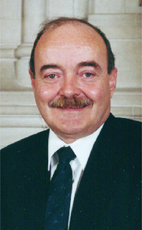
House of Commons photo

Crucial Fact

  • His favourite word was quebec.

Last in Parliament May 2004, as Independent MP for Chambly (Québec)

Won his last election, in 2000, with 50% of the vote.

Statements in the House

Tobacco Act February 21st, 1997

-13 per cent nicotine. There is not even a cigarette in there. All there is is nicotine and tar.

However, the government must still be honest. It has taken $3.5 billion in taxes out of the smokers' pockets, over the past 35 years; in a way, the government has been acting as a go-between. It is no nobler than pimps when it taxes profits from prostitution, for instance. The same principle is involved here.

The government gets $3.5 billion. The olympic stadium tax in Montreal, I have almost paid for it by myself with the taxes you have been taking on every cigarette I have been smoking since.

All this to tell you that you are not honest. You are dishonest. Have the courage of your convictions. Simply ban tobacco in this country. Then I might be more inclined to listen to you. I do not think I would vote for the bill, for personal reasons, but at least I would say: "This decision is based on logic, on a deep sense of justice and fairness, on the public's interests", and that would not be so bad.

But here, you take the profits in a roundabout way, you pocket every possible economic benefit, to the tune of $3.5 billion, and then you say no to the public. Your approach is illogical and dishonest, fundamentally dishonest, and this is why we are blaming you, the government members proposing this bill.

But there is worse still. Government members have now teamed up with the fundamentalists who are opposed to tobacco. These are professional whiners, like the hired mourners in ancient Greece, who resurface whenever an issue might be a little touchy with the public. These are people who used the École Polytechnique tragedy to promote their own ideology; they showed no respect in that case as well. We are confronted with the same people regarding this bill. They say: "Stop this; think about our health". It is true that smoking is harmful. I believe a member here once said: "Let us begin by putting money in this".

Some day, we may discover that smokers like me, who are unable to stop-I must have tried 15 times and never succeeded-have a disease. If alcoholism is a disease, it may be that smoking is also a disease. It is not by clobbering anyone stuggling with this problem, by literally robbing that person every time you table a budget, as you have been doing for nearly 35 years, that you will help that person get rid of the problem.

Try to enhance public awareness, try to put some money into detoxification, into information, and do as they do with children in elementary schools. I am pretty sure that my grand-daughters will never smoke, because it is always a big fuss every time I light up.

From an early age children are motivated against smoking, and I say it is good. But at least have the courage of your convictions. Do not try to collect $3.5 billion on the one hand, and then try to make us believe that you want to pass such a bill out of concern for public health on the other. You are much more concerned about your $3.5 billion that about public health.

This is another example of the neoliberal philosophy that prevails today. This is an ill-inspired bill that will give the Minister of Health poorly defined powers allowing him to implement regulations on a piecemeal basis depending on which way the wind is blowing.

Incidentally, these regulations may never be published. Bill C-25, which will be adopted soon, allows the minister to take everybody by surprise by drafting and implementing regulations without ever publishing them. That is what Bill C-25 is all about.

The parliamentary secretary may not know it, or if he knows he is not telling, but it is coming. This excessive regulatory power that the minister of raw cheese is giving himself-I am glad to see you here, Madam Speaker-is a raw deal; it is utterly irresponsible.

The minister will be able to play with the rules as he sees fit. The regulations may be good or bad, published or unpublished. And that is when the fun will really begin. The lawyers, who are the friends of the government, will have tons of cases to plead, all the way up to the Supreme Court of Canada. They will have cases and cases galore, all the way up to the Supreme Court. This is how the Liberal Party goes about rewarding the party faithful.

They are already listening and are anxious that this bill be passed so they can go to court and pocket hundreds of thousands, maybe millions, of dollars in fees to defend a law that, as we already know, will be challenged in court. To begin with, this does not even come under the government's jurisdiction.

Tobacco companies will be on the attack again. The money they will give to their lawyers will not go to sports or cultural events. They will enrich the Liberal Party. Three years from now, there will be a minister, a new one, of course, who like his predecessor will stand there aghast and say: "This is crazy. The Supreme Court has just dismissed our appeal". Basically, it is the same old story we heard a few years ago.

Madam Speaker, spare the rod and spoil the child is all very well, but it seems to me you are harder on me than on other members. However, I bow to the Chair.

All this to say I will not vote for this bill. Not just because of the impact on sponsorships. I will vote against the bill because of the principles you decided to ignore. First, the principles of constitutional jurisdiction, but also principles of civil law such as reversing the onus of proof, and this unlimited power to make regulations in the minister's office with his pals, the parliamentary secretaries and the rest, all smoking away. However, I will have no part of this.

There is also this cozy relationship with major lobbyists. On the weekend, the media published the names of members who were opposed to this bill. You would think we were in Iran. I will not be blackmailed. I will vote against your damned bill.

Tobacco Act February 21st, 1997

Mr. Speaker, I am happy to rise today to speak to this bill. It is the first opportunity I have because, at the second reading stage, we were precluded from doing so because of the squabbling between the Reform Party and the Liberal Party which was meant to keep the parliamentarians from debating democratically. It is unfortunate, in a Parliament which should be a forum for discussion and where truth should be sought as much as possible. So there is nothing to be happy about.

As far as Bill C-71 is concerned, I wonder if the Minister of Health was in good health when he introduced this bill. I doubt it, for various reasons. This is the same minister who, from one day to the next, had decided that raw milk represented a danger to human health and had drafted some kind of weird regulations which would have restricted our cheese consumption to Cheez Whiz and other products like it.

This to say that I am not impressed by the minister. The Liberals are arguing that their only motivation is the health and best interests of Canadians and Quebecers, but I, for one, do not buy it. You just cut $4.5 billion out of health expenditures, including $1.3 billion in Quebec. You did not even realize at that time how detrimental this could be to the health of Canadians. Strange that you should not have cared a bit about that.

Out of nowhere, the government introduced with a bill; health had become important overnight. If the impact had been the same in Toronto as it is in Montreal, I doubt that this bill would have been introduced by the minister. I think that members from the Toronto area would now be on the benches defending the bill, which is not what members of the government party coming from Quebec are doing.

Madam Speaker, I feel that you will agree with me.

There is more to it, there is something worse than the bill. I agree with everything my friends have said. Of course tobacco is harmful. I look at my package of cigarettes: 16 per cent tar-

Excise Tax Act February 11th, 1997

Mr. Speaker, I would appreciate it if you let the hon. member know that Quebec did not get rich with its own adjustment. Quebec made the adjustment to maintain some administrative and financial logic. It had to adjust to the conditions imposed by the federal government, which encroached on direct taxation in an area of provincial jurisdiction.

We are now being criticized for having moved to let the steamroller go by. It is the Liberals in Quebec that did that. The hon. member is wrong. Let him show us his criteria. Let him tell us why the maritime provinces were compensated, while Quebec was not. Let him do a point-by-point comparison between the two provinces.

Instead, the member is complaining, saying that Quebec is not entitled to compensation. But based on what? How could we be eligible if we are not? The member simply cannot answer that question. He should just answer it, instead of wasting hours of debate. When we are a little too blunt with the Liberals, they gag us, as they did today.

Excise Tax Act February 11th, 1997

Mr. Speaker, not at any cost. This is not harmonizing, it is a disguised form of welfare. The government calls it harmonization, but it is nothing short of a hold-up. It takes $961 million from the pockets of some taxpayers, puts it in the pockets of others and calls this harmonization.

Instead of giving it to the poor, to the fishermen to whom I referred earlier, the one receiving that money will give it to the businesses moving to his province, as the premier of New Brunswick did. You are using our money to compete with us and to attract industries, a sector so dear to the hon. member I was told not to look in the eye. But that is the problem.

Excise Tax Act February 11th, 1997

Mr. Speaker, I would like to reassure my learned colleague that, indeed, collection of the GST and QST is working well in Quebec. But the federal government did not have to fork out $961 million for it either.

The Government of Quebec willingly harmonized the taxes; it was not ordered to. It acted on its own, as it quite capable of doing, and as the maritimes, apparently, are not.

Under federal government schedules, the Government of Quebec should be entitled to fair compensation for the work it did on its home ground that benefits the federal government. As always, Quebec will not be compensated, but the maritime provinces will be.

Excise Tax Act February 11th, 1997

Mr. Speaker, I have nothing against the principle whereby governments have to dig into the taxpayers' pockets to maintain services. The hon. member for Nepean should realize that.

What I do have a problem with is doing it in a roundabout way that is not obvious to the people. It is a pity that she is not a member of my party, because she is criticising me for being against business, the business they are crushing under loads of paperwork.

Furthermore, not only will harmonization not help business, this harmonization proposal introduced today will have the exact same effect as the GST, except that you have changed the G for an H.

When I had my practice as a notary, people would come to see me and say: "The GST is going to put an end to the underground economy, you know. It will not be in anyone's interest to hide the GST because, in the end, they will collect over there". But look at what happened to jobs, jobs, jobs. The GST may well be the main reason for this mess. On account of the amount of paperwork and related administrative constraints, from the very beginning, people decided to work their way around the tax. When the government is unable to collect the GST at the front end, it is just too bad, as they say, but it will not be able to collect it at all. That is how, Madam, the underground economy is encouraged. In a word, I am against the underground economy and for business. And I hope you will too.

Excise Tax Act February 11th, 1997

Unfortunately, I know that Ontarians did not have that pleasure because Unibroue, which makes Blanche de Chambly, Raftman, Eau bénite and la Maudite, which are specialty beers, does not have access to the Ontario market: André Dion, my friend from Chambly, and I salute him, cannot sell his beer in Ontario.

It is sold in Australia, in France, in Belgium, in Germany, in Luxembourg. It sells like hotcakes in the United States, they cannot keep up with demand. I think it is sold in Japan too, but not in Ontario. None is sold in Ontario, because the big buddies of the present federal regime control the distribution of alcohol throughout Ontario.

So Unibroue, from whom astronomical sums were demanded for sales in Ontario, finally was never able to sell a single bottle there, was never able to get it displayed or promoted by the Liquor Control Board of Ontario, because it was a Quebec product. I see my Ontario friends over there are appalled, but they are nodding in agreement. What I am saying is the truth.

The Peace Tower has been restored. In my riding, there is an industry by the name of Ferco, owned by Armand Rainville. It could have been involved in the renovations to the centre block here. Mr. Rainville invented a platform with a retaining wall, which could have been moved up and down the tower. Use of this platform would have reduced the costs of renovations. This is a good product, the proof being that the company rented out their equipment to construct the Atlanta stadium for the Olympics. Their machines are in Thailand, and just about everywhere in the world except Ottawa. They could not place one to Ottawa, because they are not buddies of the regime, friends of the Liberals who paid $3,000 for the privilege of attending a little supper in Westmount where the Prime Minister would deign to look upon them and greet them. That is another way of giving the advantage to one's friends. That is what politics is all about.

People tell me that, deep down, ministers have a bit of a masochistic streak. They have to reveal their private life and all their assets and fight an election campaign. They often get their ears boxed. They get accused of this or that. You really have to want power to subject yourself to all these things and push to be elected and become a minister. I say they are not there for themselves but for their friends. It is their friends they can gratify, provide pleasure and accord certain honours to.

Consider the distilling industry in Canada. Try to start up a distillery in Canada-legally, I mean-to develop a recipe for a fine gin, rye, whiskey or what have you, try to set up shop, with a license and everything. You will never manage it.

Those who have the manufacturing monopoly in Canada are pretty much those we allow to run off with $2 billion in family

trusts. These are the little privileges that the major parties in power offer their friends in exchange for a contribution to election coffers.

The maritimes are no exception. They began to think about blowing off steam perhaps and letting it be known that they had had enough. I saw the Minister of Human Resources Development in a room trying to strut his stuff and being escorted out by police because there was a guy there who was a bit of a bruiser and who was threatening to rough him up.

They will be going after this guy's vote in the next election. We know it is coming. It will be in June. They want his vote and they think they will get it with Bill C-70. They cut his fishing quotas. They lowered his unemployment insurance and made him work longer to get it. They cut his pay. Still they will go after his vote. With $961 million, they are good until June. In the meantime, they will convince him to vote for the Liberal Party of Canada. That is the strategy.

This approach does not fool Canadians and Quebecers. They will make it very clear to the government that this kind of attitude, I might say, this sort of legislative scheming is not acceptable.

Canadians and Quebecers are no fools. In the next election, they will do as they did in October 1993: they will again sweep members of the Bloc into power. I add that, if we had members in the maritimes, they too would be re-elected.

Mr. Speaker, I know you agree with me, although I will not make you say so.

I add that the Bloc Quebecois will vote no, and especially the member for Chambly.

Excise Tax Act February 11th, 1997

Mr. Speaker, this is the first opportunity I have had to speak to the bill on the harmonization of the GST.

I have heard a number of noteworthy and notable speeches by the Liberals to justify the appropriateness of this bill. I cannot agree with them. This bill represents the Liberals' acknowledgement of failure to my mind. During the election campaign, and even before, when the Conservatives thought they had found the magic formula for getting out of hot water and halting the growth of the deficit, in short, for better selling themselves to Canadians, they came up with the GST formula. I recall the Liberals, who were in opposition at the time, being all in a lather over this tax, which was to be added to the Canadian tax system.

The current Prime Minister, who was then the Leader of the Opposition, did not want to outdone. He said: "I will scrap the GST. We hate this tax and we are going to eliminate it".

Recently, confronted with the remarks he made at the time, the Prime Minister tried, as we say, to put the toothpaste back in the tube and discovered that it was no easy task. First he denied, then he softened his denial increasingly and finally he said that Canadians had been a bit slow in not understanding, that it was not what he wanted to say.

However, if the words "I will scrap the GST" are given their usual interpretation, nothing other than "dump out" for "scrap" comes to mind. That was what the then Leader of the Opposition, who hoped to become and has since become the Prime Minister, really meant.

Speaking of failure, upon taking office, the Prime Minister gave its finance committee the mandate to look for a viable alternative to replace the infamous GST, the goods and services tax. The committee held hearings, heard witnesses, summoned accountants close to the Liberal Party of Canada and came up with a couple of alternatives before ending up with the HST. Since the first two options were rejected, we are left with the HST.

Let us look at why the government is trying so hard to distance itself from its election promises. Having put out feelers and considered various options, why come up with this HST?

Several answers can honestly be given to this question. First, we have seen that not everyone was happy with the human resources development reform in Canada, the employment or unemployment insurance reform. In fact, I dare say the hardest hit were seasonal workers in the maritimes. I personally visited the maritime provinces twice in the past two years and I could see that, in the fishing communities, boats were put away. In every backyard on Lamèque Island, there is a boat that has not been used once in the last two summers. This has caused discontent.

I can remember the hon. member for Beauséjour and the Minister of Human Resources Development going back to their ridings to try and sell their so-called employment insurance reform. They had to be placed under the protection of the RCMP. When a member or a minister needs a police escort to sell any bill or policy to their supporters, there is a problem.

The members concerned probably realized there was a problem and managed to convince the Prime Minister he should admit it.

This, I think, is where the reform and harmonization of the GST really originated. The government wanted to pay off the maritime provinces, where 32 of the 33 ridings are held by Liberals. The federal government wanted to preserve that, particularly in light of the fact that a maritime province just elected a Conservative government, something which was totally unexpected. So, the Liberals said: "We have to do something, otherwise maritimers might turn against us".

This is how the idea of harmonizing the GST came about. I listened to the hon. member for Scarborough-Agincourt, who said in his speech: "This harmonization is great. It means that, in some provinces, the combined federal and provincial taxes will go down from 19 to 15 per cent, a 4 per cent reduction. People will be pleased".

Sure. However, that 4 per cent represents the $961 million that maritimers will no longer pay, but that the rest of Canadians will still have to pay, that is to say, taxpayers from Quebec all the way to the Pacific. This $961 million represents what we will have to pay, because maritimers will no longer do so, thanks to their lower combined tax rate.

The government should admit this to Canadians from the other provinces who will have to make up for this $961 million shortfall. There is no doubt in my mind that Quebecers, like the others, will pay their share, if not more, because it can no longer be said that

this $961 million will be prorated. It is not true. We can already exclude three provinces that will not contribute. There are players missing.

Instead of dividing that $961 million by ten, since there are ten provinces, it will be divided by seven, because three provinces will not pay. Instead, they will benefit from that measure. Quebecers have traditionally paid around 23 or 24 per cent of federal taxes. In this case, their actual contribution could go as high as 30, 31 or even 32 per cent of this $961 million. This is what is so unfair.

This is probably an attempt to make people forget about the closure or downsizing of military bases in New Brunswick and Nova Scotia. In any case, the government wanted to redeem itself. I listened to the members opposite, particularly the hon. member for St. Boniface. These defenders of every possible Liberal cause told us that this HST was the greatest thing since sliced bread, that Canadians should rejoice forever, and that the Liberals would definitely make it to heaven now.

You will understand if I have my doubts, particularly when you never know who or what this tax is going to hit next, and when it makes no allowance for soft sectors such as culture, and other sectors such as restoration. These are sectors that need a break, if I may put it that way, sectors that need general and regular support from the government.

Fine. The minister made a compromise that he thought was commendable but that I call almost insignificant, by exempting universities and schools from paying GST on books. The GST on books was being paid by him, or by governments. So he was doing himself a favour, or at least reducing the amount he owed himself. This is not something that is going to help industry. A tiny part of the book industry sells books in schools or in municipal or public libraries.

But think of all these writers, all those who publish. I will give you an example. Take sheet music. Music is not a profitable field, and even less so when it comes to writing it down on paper. An entire printing process has to be set in motion in order to sell 60, 70 or 100 copies of a musical score across Canada.

It can easily cost $2,000 for the printing setup and perhaps 100, 150 or 200 copies in certain cases of the musical work in question will be sold. If we want to respect copyright, something which has not yet been recognized, the place where an artist may sometimes derive some sort of benefit or profit is on the performance of the musical work, not through circulation of the paper on which it is written. This is a way of publicizing the musical work, but it is generally more profitable when it is performed, when it is heard, when it is broadcast.

This is where the artist can make a bit of money, when it is performed by orchestras, be they chamber, symphonic or philharmonic. Printing music is expensive and often cuts into the profits of the composer, the person who wrote it, the author. But now they have decided to squeeze him dry, to make his life more difficult. If he sold 80 copies, the Minister of Finance would perhaps be jealous because he cannot sell his copies of the budget for very much. But you can be sure printing his budget costs plenty. What I can tell you is that the poor people are being put through the wringer. This is at the root of our cultural industry and the Liberals could care less.

They are much keener when it comes to doublecrossing people, as they did in the Peason affair. They cancelled a contract and, in the end, it is going to cost us just as much as if it had been honoured. And the promoter will not have any of the financial risks that are typical of this kind of undertaking.

When we had the debate in June 1994, I said as much to the minister, the current Minister of Defence who was then Minister of Transport and who was in charge of the Pearson airport case. At the time he said the hon. member for Chambly was exaggerating, and that is on the record. And all this was supposed to cost us $20 to $25 million, those were the figures he mentioned, but certainly not more. We are not going on a witch hunt, and we must look to the future, the minister said at the time.

Almost three years, or at least two and three-quarter years later, we see nothing, absolutely nothing has been done about the Pearson airport case. And now, the government is facing a law suit totalling between $650 and $700 million in damages.

Recently, we read in the media that there might be an out-of-court settlement, something like the offer they made to the former Prime Minister of Canada. I do not know whether apologies will be forthcoming this time. It seems that $70, 80 or 90 million is the offer they will start with, but negotiations are not over yet. Actually, the Liberals are delighted that they managed to do indirectly when they could not do openly, which is to take care of their friends. They argue that if they do not settle, it will cost the government a lot more, and they use this argument as a sword of Damocles. Quite some case. So how do people manage to do favours for their political friends when they are in power?

Take for instance in my riding, we have a thriving industry called Unibroue. Unibroue was established by people who decided to ignore the rules and regulations of federal and even provincial legislation and start brewing beer, good beer, outstanding beer: Raftman, Blanche de Chambly. I know my friends in the Bloc have sampled and enjoyed them all-

Excise Tax Act February 11th, 1997

They were bewitched by a magic potion.

Canadian Ambassador To France December 9th, 1996

Mr. Speaker, the Canadian ambassador to France missed a fine opportunity to remain quiet on Friday at a luncheon gathering in honour of Quebec deputy premier, Bernard Landry.

In defending his federalist ideal, the ambassador exploited the misfortune of the two Canadian victims of the bombing in Paris last Tuesday. According to him, Hélène Viel, who was killed, and her husband, who was wounded, illustrated what he described as the ability of anglophones and francophones in Canada to understand each other in a very special way.

It is distressing to find such cynicism and lack of judgment in Canada's representative. I ask him today to issue a public apology for having exploited the misfortune of the two families for his own partisan purposes.

The only respectful thing to be done is to offer, on behalf of the official opposition, our sincere condolences to the family and friends of Ms Viel and to wish her husband a speedy recovery.