I let the member for Vaudreuil speak when he had the floor. I did not interrupt, and I would ask him, through you, Madam Speaker, to return the favour.

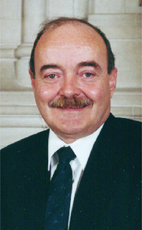 House of Commons photo
Won his last election, in 2000, with 50% of the vote.
Administrative Tribunals (Remedial And Disciplinary Measures) Act October 22nd, 1996
I let the member for Vaudreuil speak when he had the floor. I did not interrupt, and I would ask him, through you, Madam Speaker, to return the favour.
Administrative Tribunals (Remedial And Disciplinary Measures) Act October 22nd, 1996
Mr. Speaker, for the benefit of the hon. member for Vaudreuil, who seems not to have heard, I reiterate that he portrays Bill C-49 as the greatest thing since sliced bread. This is far from being the case.
As we can see, the hon. member for Vaudreuil, too, may benefit from bills like this one after the next election, because he will lose the only city in his riding where he received a majority of votes, so that the next member for Vaudreuil may well be a Bloc member.
The current member for Vaudreuil, too, will have to stand in line in front of the Prime Minister's office, and he will probably be appointed to an administrative tribunal, as suggested in Bill C-49. I think the hon. member for Vaudreuil has all the qualities required to do a good partisan job as a member of an administrative tribunal. I am not denying his skills and abilities.
But let us get back to serious matters. In his 10-minute speech on Bill C-49, the hon. member for Vaudreuil was very careful, and with good reason, not to refer to clauses 1 through 13, preferring to focus on the reorganization of administrative tribunals, which may be dissolved, merged or combined. I agree with this. If some of our administrative tribunals are ineffective, inefficient or obsolete, the government's first responsibility is to abolish them.
Except that the bill is much more vicious. This is not the real purpose of the bill. One just has to look at the calendar to understand why the bill was introduced in this House. Let me explain: the Conservatives were defeated on October 25, 1993. During that last month, in October 1993, they proceeded to make hundreds of partisan appointments. Just imagine the worst: they did it. It is true. They appointed about 500 people to various administrative committees.
But if we take a look at the list of Liberal candidates who were defeated in the 1993 election in Quebec, and there were a lot of them, we see that the Liberal Party always rewards its friends. It always manages to find a place for them somewhere.
That is what Bill C-49 does, because the Conservatives in many cases appointed their Conservative friends for five years, which means from October 1, 1993 until October 1, 1998, and thus outmanoeuvred the Liberals. In other words, the Liberals will have been in power for four years and a few months before the mandate of these people appointed by the Conservatives expires. So they have to find a way to get them out and appoint Liberals instead, and that is the role of Bill C-49. Through you, Mr. Speaker, I wish you would say this to the hon. member for Vaudreuil.
Of course, I never saw a government come here and say: "I am going to do some patronage, some favouritism, that is the purpose of my intervention". Of course not. It is always about the government's effectiveness and about restoring fairness and equity. It is like the ministers of finance. I never saw a minister of finance, although I am certainly old enough, come here and say: "My budget is not worth a damn. It is just garbage. Just throw it in the garbage, it is not worth a damn". They always presented the budget as though it were the best thing in the world, but all these goodies, and I have been following this for the past 35 years have led to a deficit of more than $600 billion.
Bill C-49 makes no difference. It does exactly what has always been done in this Parliament, in the name of equity and justice. But
that is not what it is all about. The Liberal philosophy is not as noble as all that. It is about rewarding our friends, about not abandoning friends who will have the courage to run in the next election and be defeated as we can expect to see happening in Quebec very shortly.
They are actually achieving the dream of tendentious legislation. This is extraordinary. I must admit that in this regard you have something to teach me and all other Bloc members.
Look at the first clauses, which the member for Vaudreuil refuses to debate, preferring to linger over cuts made here and there, the outdated administrative courts no longer necessary. Look at the essence of this bill. This bill actually contains 14 clauses, and not the 300 the member for Vaudreuil wants us to believe.
Those 14 clauses have repercussions on existing administrative courts. Take the CRTC, for example. If only we had had Bill C-49 when the minister of industry overturned the decisions of the CRTC regarding Power DirecTv, but the minister regretted he did not have this bill. If this bill had been in force, instead of having to bear the unbearable and having to overturn the decision of the CRTC, the minister could have simply fired the chairman of the CRTC. He could have asked the new chairman to review this decision. The minister did not do that. He could not, so he had to bear this odious decision and to take a decision which the public completely misunderstood. I can see why. Even we in this Chamber have still not understood it.
Let's take for example, clause 5. It says that "The Chairperson of an administrative tribunal may request the Minister-not a judge of a superior court-the Minister. Of course, if the Minister is looking for favours, he must have the upper hand. Therefore, the request is made to the Minister.
- The Chairperson of an administrative tribunal may request the Minister to decide whether any member should be subject to remedial or disciplinary measures for any reason set out in paragraphs 13(2)( a ) to ( d ).
It is not difficult to understand, paragraphs 13(2)( a ) to ( d ) read as follows: a )has become incapacitated from the proper execution of that office- b )has been guilty of misconduct; c )has failed in the proper execution of that office; d ) has been placed, by conduct or otherwise, in a position that is incompatible-
This is beautiful: incompatible. Remember this, Madam Speaker, you or the member for Vaudreuil can understand what incompatible means.
Anyway, the request is made to the minister, who is told: "There is on the committee a member whom we do not particularly like. First, he is not a true Liberal." This is already incompatible. He was probably appointed by a previous government. Automatically, he is incompatible for the very reason that he is not a Liberal.
The Minister is requested to do something about it.
Administrative Tribunals (Remedial And Disciplinary Measures) Act October 22nd, 1996
Did you say: "Resuming debate"?
Administrative Tribunals (Remedial And Disciplinary Measures) Act October 22nd, 1996
Mr. Speaker, I listened with great interest to the speech given by my brilliant colleague, the hon. member for Vaudreuil. I find him very optimistic. I notice however-
Bankruptcy And Insolvency Act October 22nd, 1996
Mr. Speaker, I am pleased to speak, and, through you of course, to tell my colleagues across the way, particularly the member from Saskatoon, for whom I have great respect and with whom I had the honour to sit on the industry sub-committee examining Bill C-5, the bill before us today, that I do not entirely share his optimism.
I must admit that while Bill C-5 meets certain requirements and restores certain situations, it is far from satisfying everyone. It is from this sort of bill that the party in power has the habit of hauling out vague and imprecise notions, not clearly spelled out in the text, when and where it suits them. The result is that we foist our problems off on the courts and tribunals and expect them to establish the jurisprudence.
But the primary role of a legislator is to try, in good faith of course, to produce legislation that can be interpreted in and of itself. Furthermore, it is stated early on in the Interpretation Act passed by this Parliament a number of years ago that every enactment shall be given such interpretation as best ensures the attainment of its objects.
This is described as being sui generis . Legislation must be interpreted with reference to its own contents. When a text is unintentionally ambiguous, and no one here, particularly no one in
this House, is above error or oversight, then the courts have a role to play.
When general principles are invoked, when we ask the party in power what happens in a particular case, and we are told that the courts will decide, the courts will rule, that is just adding to the backlog in the courts.
I would point out one, or a few, examples the member has just mentioned when, in reference to farmers and fishermen whose earnings come primarily from their agricultural or fishing activity, he said that they could not be declared bankrupt. That is what the bill says. However, if in the winter, for example, farmers, and I know some in my riding who do this, have large equipment and take contracts to remove snow from shopping centres, they therefore have an activity allowing them to keep operating, so to speak, and to get through the winter without doing too badly economically. Since they are then earning income from an activity other than farming, could they be declared bankrupt?
The member from Saskatoon tells us they cannot, or maybe, if the courts hold that the activity is not strictly related to farming. Or at least that is what I understood. But the fact remains that it is still the court that will decide. When new legislation is drafted, there is an attempt to include prior trends in jurisprudence, not to produce a legislative text that is often unclear and makes a further ruling necessary.
That is what I object to generally in this bill, some of whose principles, however, I find acceptable. An effort could have been made, in committee, if members of the party in power on the committee had had the latitude to accept the obvious. Not at all. To change even a comma, committee members know they have to refer to the minister who tabled the bill. Even in the case of a particularly obvious mistake, if they happen to be members of the party in power and sit on a committee where that party has the majority, they first have to refer to the minister and tell him: "Now, the members of the opposition want to change this comma. They may be right. We think they are right". They do not say yes. They cannot do that on their own. That is what is so frustrating in committee. We saw this many times during consideration of Bill C-5 by the industry subcommittee.
A number of stakeholders appeared before the committee at that time. We could name the whole range of socio-economic and social stakeholders, on the right as well as on the left. Everyone came to defend their particular points of law. And most people were struck by the ambiguous treatment in Bill C-5 of the nature of duties of a bankruptcy trustee.
Many people told us that more often than not, the trustee had a conflict of interest. I may add that these were people with a certain reputation, university professors from the University of Toronto, for instance, and people from across Canada. Even bankruptcy and insolvency experts came and told us the bill was in many cases sending contradictory signals, thus putting a trustee appointed to oversee a bankruptcy in a very awkward position. Quite often, his duties were not clear-cut.
The first Bankruptcy Act-as it was called at the time-which was passed in 1949, started by providing that the trustee represented the creditors. His role was clear. His role was defined. There was no problem: he represented all creditors.
In 1992, with the tabling of this new bill on bankruptcy and insolvency, which became the Bankruptcy and Insolvency Act, the trustee's role became a little more ambiguous. The trustee represented in certain cases the mass of creditors and acted on the advice of the inspectors, but he also had to consider certain dispositions that might benefit the trustee himself or his family. It is not immoral, and it is not unthinkable, that the trustee could, and I think it was good legislation, represent both the creditors and the bankrupt.
However, it would have been even better if the legislation had contained a provision saying that the trustee was a public officer, like a notary in Quebec or like a surveyor-they have those in other provinces too. When a surveyor surveys a property, he does not work for the benefit of the person who is paying him but to establish the truth, the real state of affairs. He draws lines where they should be drawn, even if he would rather not, even if he would rather help his client. Under the legislation that regulates his profession, in Quebec and elsewhere, he is obliged to be neutral. Therefore, he assumes impartiality.
In Quebec, notaries conclude transactions. They represent neither party and I know something about this, since it happens to be my profession. He does not represent either of the parties involved. His duty to be neutral is part of his code of ethics. The trustee is careful about that, and if a notary-this does not happen often, thank goodness-fails to be impartial, the order would intervene and make him realize he should not benefit either contracting party, but maintain a strictly neutral position.
That is what I would have liked to see in Bill C-5. Of course, that required the minister's permission. I am not even sure if committee members went to see the minister, but I will not question their good faith. Let us assume they went to see him, but nothing happened and clause 13 or 14, I think, was left unchanged.
Other provisions in this bill could have been amended. A case in point in clause 13.4. The CNTU opened our eyes in this regard when it presented its brief. Clause 13.4 in this bill reads as follows:
(1) No trustee shall, while acting as the trustee of an estate, act for or assist a secured creditor of the estate to assert any claim against the estate or to realize or otherwise deal with the security that the secured creditor holds-
And here is the hitch:
-unless the trustee has obtained a written opinion of a solicitor who does not act for the secured creditor that the security is valid and enforceable as against the estate.
The CNTU told us, either one is neutral or one is not. You can see the kind of message that is being conveyed to the trustee. We made representations when we asked questions, when we discussed among ourselves. We said: "Why not accept reality?" If a secured creditor in a bankruptcy case feels wronged, he can appeal to regular law courts, to the civil courts in his province or, in case of fraud, file a complaint under criminal law.
But why should the trustee be given the message that, yes he is neutral, but not exactly, if he has obtained a legal opinion? We saw what happened in the case of Mr. Sirois, who prepared the 1992 act. He went totally bankrupt, and we then realized that the very father of the bill that became law was not beyond reproach. It was easy at the time to take him to task, at least for his vested interests.
This should be avoided, we told the party in power. They then do everything that follows from this. As the hon. member for Saskatoon clearly explained, the bankruptcy act makes it possible for someone to get a fresh start after a financial misadventure or misfortune, the kind of thing that can happen in life. But in doing this, we sometimes fail to realize that we are penalizing ourselves in another respect.
Let us take for example clause 14.7, I think, which provides that the money needed to remedy any environmental damage to the land must come from the bankrupt individual's general assets. I asked that specific question of experts and professors from a Toronto university who testified before the committee, and nowhere in this clause is it said that the trustee acting in a bankruptcy case who faces decontamination expenses must recover the money from the proceeds of the sale or resale of the contaminated building. Nowhere in this bill is it specified that the money must come from there. It can come from other sources. The trustee may liquidate assets, sell the car, the house, anything, and use this money to decontaminate the land.
A priority may be applied to the real property in question, and this is a fact, as provided for in section 14.7, which takes precedence over any existing rank of hypothec under civil or provincial law and the trustee may assert his decontamination claim that way. This is allowed, there is a statutory warranty on that. But the money does not have to come from there; it can come from elsewhere.
So, it would not be unthinkable, especially on the basis of clause 13.4 regarding the secured creditor, which I referred to earlier, since the trustee's decontamination claim will take precedence over that of the secured creditor, that, if they are on good terms and do not hate each other too much, the trustee may be tempted to say: "Very well, I will have the land and surrounding property decontaminated, but the funds required will be taken from the body of realized claims. I will pay for decontamination out of there". The secured creditor is happy. Because of his rank of hypothec, he gets his decontaminated property back, free from everything, and realizes the security. He can resell it, recouping his equity, his mortgage. Of course, good faith must always be presumed, and you can vouch, Mr. Speaker, for that fact that everyone here is acting in good faith.
But this can nevertheless invite criticism, raise suspicion, lead to questions. One wonders why the wording is not clearer, and why the trustee is not required to recoup his decontamination costs on the property in question first. I am trying to understand why. Sometimes, what appears to be a good turn can have unforeseen negative effects.
Take section 14.7 for example and this creditor that has a mortgage on a property, or is not yet a creditor. Let us say I want to start up a business, or young people want to start a business on the premises of which chemicals, not necessarily highly toxic chemicals, will be processed. There will be a potential environmental impact involved.
We would go to our bank manager and ask him to lend us money so that we can buy the property on which we want to build our pork manure treatment plant or whatever. The creditors will say they do not want to have anything to do with that because dangerous substances are involved. They will argue that, should our business fail and the property have to be resold for them to realize their mortgage security, they will first have to have it decontaminated and that could cost a pretty penny. Hence their unwillingness to lend money.
The idea was to recover for decontamination, but-and this is not from me but from various financial interests who came and told the committee-lenders will be much more cautious when lending money to businesses that could handle toxic materials. It is believed that it will now be almost impossible to finance a gas station. No one will want to lend money to a gas station, unless the major companies-and this is surely what will happen, since they provide the raw materials such as gas, oil, etc.-are prepared to finance their franchisees.
The mechanic interested in opening up an independent service station will have a hard time getting financing. A good intention may end up having perverse effects. We have to seriously think about this. A number of stakeholders came before the committee and said: "This clause 14.7 scares us". Several asked that it be
removed or at least that some guidelines be provided, because it does not affect only the contaminated land, but also the adjacent lots and those connected to the operation.
The lots connected to the operation are not necessarily the ones immediately adjacent to it. It could be a lot located further away. It could even be a lot located in another community. It could be the site of the head office. This becomes dangerous. It is dangerous for the person who lent money for the head office lot, and for the one who lent money for the lot where the economic and business operations of the company take place.
There is another thing which really bothers me as a Quebecer and which I find very hard to accept. I tried to stress it in committee. I was told this is not an amendment to the bill that was introduced. I did not agree, but I did not argue more than necessary, because they formed the majority. However, I want to raise the issue here.
In committee, we realized that, to a large extent, the assets that can be seized and those that cannot depend on provincial legislatures, because they determine what assets can be seized or not. For example, we know that in Ontario homesteads are unseizable. From what I understand, because I am not very familiar with the Ontario land register, a homestead is a farm that has been owned by a family for generations. It is unseizable and its value can be very high. In Ontario, someone who becomes bankrupt can have his or her homestead worth half a million or a million dollars exempt from seizure.
In other provinces, the value of the property liable to seizure is pretty high. In some provinces, it is much lower. For example, in the Quebec Code of Civil Procedure, in the former section 553 I think, the value of the property not liable to seizure was set at around $2,000. In order to respect the provincial areas of jurisdiction, the bankruptcy act had always gone by these classes of property exempt from seizure.
This is why section 49 of the former act and sections 93(1) and (2) of the new act, provided and still provide that any settlement in consideration of a marriage-and when we talk about marriage, we are talking about a provincial area of jurisdiction-published and made before the marriage, because it often takes the form of a donation between spouses at the time of the marriage, is not void and cannot be revised. This is still the case.
Except that paragraph 177( a ) of the current act that is being amended by clause 104 of the bill stipulates that, in the case of a bankrupt who has abided by section 93, an order of discharge will be refused. Pursuant to paragraph 177( a ), an order of discharge can be refused and conditions can be set.
I do not understand. How can someone act legally pursuant to section 93 and be treated as if he or she broke the law under section 177( a )? We are directly infringing upon provincial areas of jurisdiction: civil law, marriage, marriage contracts. People are told: ``You have abided by the provincial legislation, we know it, so there was no fraud. However, as far as we are concerned, if you want to be discharged, we will set more expensive conditions than if you had not respected the provincial legislation and if you had not benefitted from the legislation in force in your province''.
This is sheer nonsense. This is just one example. The hon. member for Saskatoon-Dundurn, to whom I have mentioned this problem in committee, did not answer me directly-he was sitting with me on the committee-but the chairman told me than repealing section 177( a ) made no sense and did not come under the purview of our committee, but I still have my doubts about that.
I would also have liked to put forward other amendments in committee. When I think about Bill C-5, I would have liked to see, after subsection 90(1), a new subsection 90(2) that would have amended paragraph 136(1)( d ) of the existing act to raise the value of non-seizable assets from $2,000 to $3,653. And I will explain why, because this figure has not just come out of the blue.
In 1949, 47 years ago, when the first Bankruptcy Act was introduced, the value of non-seizable assets was $500. With inflation, what was worth $500 in 1949 is now worth $3,653. I am not talking about improving the fate of the bankrupt, but if we want to give the bankrupt the same level of protection, the value of non-seizable assets in section 136 should be raised from $2,000 to $3,653, an amendment that was moved in committee but was defeated. Do not ask me why, I have no idea. But this refusal was certainly not dictated by common sense. That much I know.
We saw that all amendments to the bill that made sense were systematically refused when they came from an opposition member sitting on the committee. It is unfortunate because, right now, the Bankruptcy Act is a source of problems, questions and bitterness for creditors as well as for bankrupts.
Often, following their generally recognized principles, the Liberals put forward ideas that are sometimes eccentric, include them in a bill and say: "We have fulfilled our red book promise and now we will let the courts decide". I think the Liberals are blatantly misusing their parliamentary majority, as they have always done. When, as legal practitioners or as experts in this field, we proposed amendments to correct certain contradictions such as those in sections 93 and 177, we were told that it is not within the committee's mandate. My colleagues who sit on other committees tell me that it is almost always the same.
The government wants to hold the opposition in check no matter if it is right or wrong. It will stick to its bill and will not budge, except for obvious punctuation mistakes, or should I say without being disrespectful to the House, for trifling matters.
In my view, they have missed a great opportunity to do something productive about bankruptcy and insolvency. They could have tried to make people a bit happier.
There is poverty in Montreal. It is said that Montreal is the poorest region in Canada, that it has the highest rate of poverty right now. It is also the city with the greatest numbers of homeless people, a happy bunch according to the Prime Minister, who would prefer to be on the move and sleeping outdoors, often in a puddle, that in an institution being treated for schizophrenia or other similar ailments. The Prime Minister told us that he has spoken to them and that they are perfectly happy. But there are also people who are not homeless, who honour their obligations, in so far as their incomes permit, but it is becoming increasingly difficult to do so because they are unemployed, not something the government has knocked itself out finding a solution to so far.
As well, some people are casualties of the economy. I have had visits from people in their fifties, in charge of human resources in a very large company that merged. From $100,000 a year, they have found themselves on welfare, after selling their homes and spending the proceeds. This is happening now to a great many people, people who used to live with dignity and earned a good living.
You have all undoubtedly seen the American movie about the electrician with a wife and two children who loses his job. Finding himself unemployed, he puts off paying his fire insurance. And since misery always plagues the poor, his home burns down. He moves to another city in search of work, and finds a part time job, a few hours a week, which does not even cover his move. To make a long story short, we see him at the end of the movie reduced to living with his wife and two children in the basement of an uninhabited and condemned building, in with rats and mouldering boxes, stuck with no hope for the future. The movie ends with the reminder that in the United States there are three million Americans living in similar situations, situations we are now beginning to see in Canada.
I know people who were once proud, who used to have good jobs. Times got tough and they found themselves on welfare, which is shrinking with decreasing transfer payments, which means they will be even more destitute. The homeless will not just be happy schizophrenics, as the Prime Minister was saying, but people who have gone from a life of dignity to one of extreme poverty. We will see more and more of this in Canada.
This government has no compassion for the dignity of these people. Right now, $2,000 will buy, for a family with four children, not much more than sheets, beds, pillowcases, and certainly not a large refrigerator and a small, two-burner, 110 amp hotplate. That is about as far as it will stretch.
I find it hard to believe that people are using bankruptcy to their benefit. There is a tendency to blame them, to view them in a critical light, but in reality do they have a choice? They have only one life to live, as do we all, and they realize that, unless they take a risk, unless they go out on a limb, they will have spent their lives in poverty and misery.
This is what the bill could have tried to address, but once again, they have failed. It is for this reason that my party and I will be voting against this bill.
The Pearson Airport October 4th, 1996
Mr. Speaker, my question is for the Minister of Transport.
The government is still facing lawsuits on the order of $660 million following cancellation of the Pearson airport contract. And this is all because the Liberals, since coming to power, have refused to listen to the official opposition, which is asking them to get to the bottom of this political and financial scandal. The minister obviously has no intention of taking any action.
Is the minister not admitting that the federal government is sitting back and doing nothing while it waits for the courts to decide how much Canadian taxpayers will have to pay for the mistakes of this government, which is trying to protect its friends involved in the privatization of Pearson?
Supply September 26th, 1996
Madam Speaker, honestly, I cannot say that I am happy to speak today on the motion tabled by the official opposition. This is not the first time that I have criticized apparent conflicts of interests, flagrant iniquities against ordinary taxpayers by the current government.
I need only mention the Pearson Airport episode. There was even one Liberal, alleged be the revenue minister's father, who said that there were plenty of apparent conflicts of interests and shady dealings that should be investigated. And this is not from a Bloc member but from the father of the current Minister of Revenue, a very well-known Liberal named Nixon, who had made that recommendation to the government. The government did not pay heed. It was as if he had not said anything.
I remember the then Minister of Transport, who said that it was no use to dig up such things. And yet, they dig up things when they
find a low income earner who defrauded unemployment insurance of $200. They will pursue him even into his grave. It is worth their while to dig up such things. But matters involving billions of dollars is only wheeling and dealing.
The Pearson deal is not the only example. Do the members across the way remember Power DirecTv? A decision was reversed even though it had been taken by the authorities responsible for overseeing these things. The Cabinet changed it. It just happened that there were people at Power DirecTv who were close to the Prime Minister and his entourage.
In the case of Ginn Publishing, they did not even wait for the lawyer's report to again return things to friends of the government party and its leaders.
I could go on and on. I remember a minister who was in Los Angeles at one time and who came to ensure that Canadians had truly taken control of a film distribution company. He was ready to swear and put in writing that this company was really a Canadian company.
There are many examples, and everything leads us to believe that there will be others.
The Standing Committee on Finance. I was watching the Liberals pull out their hair earlier: the Standing Committee on Finance has decided this; the Standing Committee on Finance does not want to know anything, it does not want to find anything, as in the case of Pearson Airport. There is none so blind as he who will not see. This is the case of the Standing Committee on Finance. If the members opposite can convince other Canadians of this, it is their problem. But, as the member for Saint-Jean said, I am not sure they will not get their comeuppance royally in the next election, as other parties that have done similar but not such bad things as this, I would say. With some 177 seats, a government can devise laws benefiting the wealthy, and the opposition, official or not, can do nothing about it. That is what has happened in the three years since the government came into power. It is a shame involving everybody.
We come here to implore the common sense of independent experts, of six independent experts who probably were involved in a series of decisions, the one taken on 23 December 1991 in particular. They were at the party held on December 23, and we are asking them if, in their opinion, everything was done according to the rules. My colleague called that a just application of tax equity. The government is not even trying to give an appearance of clearness and cleanliness. It does not care. "We are too strong, they will never dare to destroy us, because we are the ones who decide in the end." And even the Minister of Finance said: "I do have a family trust." Indeed, and it is made up of taxable Canadian property. The day he sends his ships for a trip in the South with the intention of not bringing them back, how will we look, since he is the Minister of Finance?
That is almost what happened with the $2 billion. Can you imagine how much tax $2 billion represents? "No, we cannot do it because this is a friend. Scratch my back, I will scratch yours". That is how it works across the way.
At one point, Canadians will have to realize that they are being bamboozled as they have never been in the history of Canada. We have already seen governments making timid attempts, but today, we are seeing people taking the cash and laughing all the way to the banks-overseas. Two billion dollars! It does not make any bloody sense at all.
Still today, I thought that the haemorrhage had been staunched, but no. Today, we saw in the auditor general's report that there is still $630 million worth of loopholes of all kinds. We are not talking about petty thieves, but about big tobacco companies. It is all the same gang. When we dig a little bit, we can find the connections. People will attend a $3,000 a place fundraising dinner to have a look at the Prime Minister and have the opportunity to rub shoulders with him in the men's room.
It is terrible to say, but when you are on the government's side, no threat of any kind can rattle you, not even from the auditor general. That man was demolished. It is as simple as that. If you do not like the message, just shoot the messenger.
Not only must laws be implemented in a fair and reasonable way, but they must appear to be implemented in a fair and reasonable way, just as with justice. We operate under the rule of law, like the justice minister said this morning, and the courts established the rule of law long ago. Not only must justice be administered, but it must appear to have been administered. But appearances do not matter in this case. Old chums received a little help, and I would not be surprised if not many family trusts were left.
A provision that was reasonable and, in a certain way, logical was used ill-advisedly, it was used in a way not intended originally. It is all a sort of institutionalized misappropriation of funds with the wealthy members of society, who make off with the money, the next one with his boats, no doubt, it is probably one of the last remaining, but an inquiry must be called.
When the truth is what you want, you do what is necessary to obtain it. An independent inquiry, a royal commission if necessary, must be called, and independent experts brought in, not those who took part in the ruling. The RCMP should be involved, and the bank accounts of those who had anything to do with this ruling scrutinized closely.
When you want to find something, you look for it. In this case, they do not want to find anything, and so they are not looking. They are saying: "This is just a bunch of separatists who have stumbled over something. Nothing to worry about. The people of Newfoundland, westerners and easterners will never dare to believe separatists, so the way is clear. We can have the rink to ourselves and do as we please". That is what is scandalous about this affair, and the Liberals can tell me what they like, but it is not going to wash. It will not wash. Something stinks in this business and we will not let up until we find out what it is.
Supply September 26th, 1996
Madam Speaker, I am somewhat disappointed with the remarks made by the hon. member for Renfrew-Nipissing-Pembroke, whose career as a politician is coming to an end. I am sad to see him make remarks that can only bring shame on parliamentarians.
I wonder if the hon. member, as a former chair the Standing Committee on Public Accounts and a senior member of this House, with 36 years of service, could tell us what message he thinks he is sending the Canadian people with remarks like that. When he chaired the public accounts committee, would he have let the auditor general's report be torn to pieces along with the auditor himself, who simply did his job and nothing more?
Why was this issue, which was before the public accounts committee, referred to the finance committee, an obscure committee controlled by the Liberals? The Liberals are the majority on the finance committee. Right there, there is cause for concern, there is something fishy.
A member with 36 years of experience in politics just does not lend himself to this kind of thing. Either he stays put or, better yet, he stays home because these goings-on were downright unacceptable. He mentioned experts, tax experts, the same experts who participated in the making of the December 24, 1991, decision.
In what way were the rules of law adhered to and the wish to get to the bottom of this issue respected, this issue raised by the auditor general, who, thankfully, is not working for the Liberal Party but as an agent of this House.
They shot the messenger with red hot bullets to shut him up. They tried to discredit him. Why is the ruling party doing that? Could it be that the auditor general has uncovered something he was not supposed to uncover? Did he express suspicions he should not have expressed? What need was there to attack the auditor general and deal with this matter on the quiet in a finance committee controlled by the Liberals, who are, as we know, the major players on these committees?
Does the hon. member, who has 36 years of experience in politics, take pride in what he is trying to have Quebecers and Canadians alike believe? He should not have a hard time convincing them, seeing that the scandal was revealed by sovereignists, members of the Bloc Quebecois. It is easy to convince the Canadian public, terrified of the BQ, that it was a bad thing the BQ uncovered. But the auditor general is not a member of the Bloc. He is probably the man with the highest moral authority in all of government. This is the man that they have tried to tear to pieces for possibly putting his nose in something he should not have put his nose into.
I urge the hon. member to make amends and acknowledge the fact that the Standing Committee on Public Accounts should have given the matter full consideration, reported to this House and recommended an enquiry.
Criminal Code September 24th, 1996
Madam Speaker, I am not at all sure that we can put a price tag on human life, as does the Reform Party. When a person dies in a freak accident, it also causes grief to the family. If we try to establish a link between one's grief, the prejudice that is caused and the person responsible for this grief, we are bound to make miscalculations or mistakes. It goes without saying that everyone is sad, particularly when we are the victims of a heinous crime. Our purpose is not to protect those who commit heinous crimes.
Earlier, I referred to the current dangerous offender legislation. A few days ago, we kept hearing about the Bernardo case and the case of the serial killer in western Canada who was eligible after 15 years, whose name escapes me for the moment. Reform Party members lump it all together and this is where they are wrong. Justice that is just, the word says it all, and unbending, yes, up to a point, must not allow itself to be flouted and ridiculed, which is very often the case in criminal trials when lawyers get to plea bargaining. But once the sentence and the rules of the game are clearly set out, justice itself must abide by the rules. That is what we are saying.
In our view, 15 years is not automatic. Reform Party members think that, on the morning of the fifteenth anniversary of someone's sentence, the prison warden brings the keys, opens the cell door and says to the inmate: "Off you go, now". That is what they would have Canadians think in the current debate. This is quite simply not what happens. Inmates already have to go through an involved process, which will be even more involved with the new bill, and Reform Party members paint a picture of prison walls coming down. I do not agree.
Criminal Code September 24th, 1996
Madam Speaker, we must not confuse justice and vengeance, as reformers seem to do. I do not think they are acting in bad faith, but I do believe they confuse the notions of justice and vengeance.
An uncle of mine got killed. It was an accident. There was no malicious intent. He was killed in a car accident and it was not clear whether the driver involved was under the influence or not. This was in 1952. In those days, a driver who had had just one beer would automatically have been sentenced to life in prison. It was considered a very serious offence. Finally, a pardon was granted, and the driver involved spent three years in prison. Our family saw him again, because he was a friend. This person never relapsed. He led a perfectly normal life. He was much more a victim of circumstances than anything else.
Had we let our frustration get the better of us, this person would probably have spent 10, 15 or 20 years in prison, at an enormous cost to society. This person would not have made a contribution to the community, while today he is rehabilitated. He is the father of several children who work and who make a contribution to our society. This is an example of rehabilitation and this is why I believe in it.