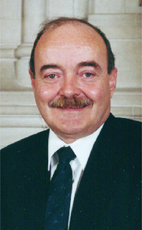
House of Commons photo

Crucial Fact

  • His favourite word was quebec.

Last in Parliament May 2004, as Independent MP for Chambly (Québec)

Won his last election, in 2000, with 50% of the vote.

Statements in the House

Supply June 13th, 1996

Madam Speaker, I thank the member for Vancouver Quadra who is trying to drag me into the constitutional quagmire of 1964.

I can tell you that the territoriality of Quebecers stops at their present borders. One of the consequences of the quiet revolution was, for instance, that French Canadians, francophones who saw themselves first as French Canadians, dropped this expression nearly overnight, to identify themselves with their territory, thus becoming Quebecers.

We let English Canadians, who wanted it and were more numerous, have the term Canadian, For the second time in 200 years or so, we retreated into our territory. This is the reason why today we call ourselves Canadians.

We even let you have our national anthem, which was first written in French. You never sing the second and third verses, you would look too silly. You sing the first one because it is neutral enough and applies to everybody. If you ever sang the other verses, you would change the national anthem post haste.

But when it comes to territoriality, as the member for Vancouver Quadra said-I have a lot of respect for him; in those days, he was quite a distinguished advisor on such matters, including to Quebec premiers; I have nothing against him, he understands a lot of things.

If only all the anglophones in Canada and in the present government could understand as much as he does, we would not have as many problems and we might even be able to reach some kind of partnership agreement without too much trouble. Unfortunately, their frustrations and the blinkers they have on both sides of their heads prevent them from seeing the way. They can only see the ruts in front of them.

In closing, I come back to the notion of utilitarianism. The British government maintained its presence in the colonies by granting privileges. As the hon. member for Vancouver-Quadra knows, it was not allowed to take legal action against an anglophone in Quebec after the conquest, in 1760. It was not possible to take a case to court. A francophone could not bring legal action against an anglophone.

In 1808, Ezékiel Hart, a Jew, was elected to the Quebec Legislative Assembly as the member for Trois-Rivières. They forbade him to take his seat, in 1808. This came straight from London. It is his son who defended the Patriotes in 1837. There were anglophone patriots, but there were also francophone patriots.

Few people wonder today how it came about that two brothers, the Nelsons, anglophones, fought with many others alongside the Patriotes in 1837.

They wanted a responsible government, something the British Crown denied them because of its utilitarianism. Amusingly, they got a vertically striped flag almost identical to the ones of the Italian or French republics.

Supply June 13th, 1996

Madam Speaker, I just heard what the member for Glengarry-Prescott-Russell, a francophone, had to say, and I can tell you that it would be less painful to swallow razor blades than to hear his remarks. He is a token francophone who has spent all his life in the wings of power, who has been taking advantage of the system, who has been eating tasty little dishes prepared by the Governor General's chef for the past 15 years.

However, in return, since any privilege requires something in return, he has to reassure his people, restrain them, make them admit that their situation is enviable after all. We have always had French Canadians of this calibre since Étienne Brûlé, and we still do.

In 1742-43, La Vérendrye and his two sons left to explore western Canada. The expedition split at the Great Lakes head. They scattered over a territory ranging from west of the Appalachians to the Rockies and from the Mississippi to the far north.

These few Frenchmen are the ancestors of what became the Metis people of North America. They are the ancestors of Louis Riel, Ovide Mercredi, Chief Fontaine and possibly several members of this House, including the Secretary of State for Training and Youth and the member for St. Boniface.

Between 1880 and 1910, about 2 million Quebecers, facing an unbearable financial situation, decided to leave Quebec for New England. The number of their descendants is estimated at about 10 million today. Let us try to imagine what Quebec would be with a population of 17 million.

Meanwhile, hundreds of thousands of immigrants from Eastern Europe were given lands and what they needed to start a farm in the Prairies and in western Canada. Each time the official opposition has raised language issues in this House, the government has asked its francophones from outside Quebec to do its dirty work. The member for Glengarry-Prescott-Russell has just given us the best example of that.

When we refer to these historical facts, these token francophones tell us that it is in the past. True. However, how can we rectify a situation if we are not allowed to refer to history? Did the Governor General himself not say last week in this House that those who choose to ignore the past risk repeating their mistakes?

This morning, the Minister of Citizenship and Immigration gave us a list of various programs designed to help francophones outside Quebec. As if money rules everything. With her money, the minister thinks she can strike a balance, break the phenomenon of assimilation.

That is not where the problem is. Assimilation will stop when francophones have understood their origins are as noble as the anglophones', that there is no shame in being of French origin. The government should, in translating its good faith into action, promote the notion of pride, somewhat as it does when it pours millions of dollars of public money into promoting national unity.

In part VII of the Official Languages Act, the federal government of the day made a commitment to enhance the vitality of the English and French linguistic minorities in Canada. What has it done in this regard. Zilch. Subsidies and injections of funds will not advance the cause of French in Canada; it will take a resurgence of pride in one's French origins.

Let us start by putting a stop to changing place names to erase all trace of the French presence in North America, and one that came before the English presence. Why not give the Peace River its old name of rivière de la Paix and the Red River, its original name of rivière Rouge? If I asked the members of the Reform Party and perhaps three quarters of the members of the party in power where the rivière Rouge got its name, they would not be able to tell me. How many names like Grand Portage, lac Lacroix, rivière à la Pluie, lac à la Pluie, portage du Rat, île de l'Élan still exist in western Canada?

The problem with the francophones outside Quebec is that most of them have lost respect for their language. A combination of disdain, derision and intolerance have made many francophones feel second class or inferior because of their French heritage. Many francophones outside Quebec suffer from the victim syndrome. Psychologists agree that women and children who have been sexually assaulted end up feeling guilty for something or some failing and turning the aggression they suffered on themselves.

The only Reform member of French origin is the only one of his party to have never, in close to three years, even tried to say a word in French.

The member for St. Boniface speaks French and a very good French at that, but he reserves this language for instances when he is called upon to do a number on his colleagues from the Bloc Quebecois.

This phenomenon also exists inside Quebec, it is not particular to the rest of Canada. A francophone called Leduc, in my riding, who used Canadian flags in huge amounts, told me during a discussion we had in my office: "All my life I have been ashamed of being a francophone. It hindered me in every endeavour. I was passed over because I was a francophone. Wolfe should have"-and he was quite adamant-"kicked all them damned Frenchies off Cape Diamond in 1760, and there would be no more French in Canada". This is what he said in my office, in front of a witness.

A resident of St. Boniface told me something similar last summer, as I was meditating on Louis Riel's grave during a stay in that town. He was French speaking and derived tremendous benefits from the fact, from what he told me. He could go to Ottawa two or three times a year, all expenses paid. He had fun. I incurred the wrath of somebody who was really feeling second rate inside.

If the government wants to maintain French as a common language, it must take vigorous means to revive in the minds of French Canadians the pride it tried for so long to extinguish. This is really the meaning that must be given to Section 41, Part VII, of the Official Languages Act.

Contrary to what the member for Glengarry-Prescott-Russell has suggested, members of the Bloc Quebecois have no political advantage in proposing the motion introduced today. No Bloc candidate is running for elections outside Quebec, not even in the riding of the member for Glengarry-Prescott-Russell. What we want to do is stop francophones outside Quebec from being anglicized, slowly but surely.

The survival of francophones in Quebec, like the survival of anglophones outside of Quebec, is contingent upon measures that will be taken in order to protect them, or at least to protect themselves. This is the true meaning of the motion of the Bloc, introduced by my friend, the member for Québec-Est. We will not let ourselves be pushed, we will not let ourselves be told stupidities like those I heard earlier, in the name of what, nobody knows, but inspired, we believe, by the possibility of profit, of privileges.

I see the member for Vancouver Quadra. I would be surprised to hear him disagree, if I were to tell him what the word "utilitarianism" means. It is a theory developed by the British monarchy as a means to maintain itself in its colonies. "The King can do no

wrong", do you remember that, my hon. frind from Vancouver Quadra?

"The King can do no wrong", in other words, the King can do as he pleases. Everything was allowed, including turning a man into a woman, almost. The member for Vancouver Quadra agrees with me. According to this utilitarianism principle, colonies were set up, privileges were created and people became what were called "white niggers of America". There was always a foreman, someone who dominated the others. This has been the case in South Africa, in India, everywhere, here too.

Privileges were granted in order to maintain their presence. I am sure I will be asked a question on that. I will conclude my explanations in my answer.

Supply June 13th, 1996

Of Quebecers.

Supply June 13th, 1996

Madam Speaker, I simply wanted to tell the member who just spoke that he is giving a strange view of history when he says that Italians, West Indians and all ethnic groups that came to this country are independent, develop their own culture and do not ask anything from the state.

I must remind him that the situation of the French people is very different. The French people occupied the region where you are now living, sir. They were there 200 years before your ancestors. The French were there and you dislodged them. This situation cannot be compared to that of a West Indian who arrived here last week, decided to form a group with other people from his country and friends and to live according to his own culture with those who share that culture. You are altering history shamelessly, dear colleague. Such an attitude is inappropriate for a member of this House. You should go back to your history books.

Regulations Act June 12th, 1996

I was referring to the priest.

The regulatory process can be very onerous at times, but democracy has a price. All of us would like everything to be democratic, but we would rather not pay for that. Unfortunately, human beings will be human beings, Mr. Speaker. I know from your silence that you agree. I am sure my remarks are accurate, and I can assure you I have the best intentions. Even the Prime Minister would not stand up to contradict me. And the hon. member for Papineau-Saint-Michel will not do so either, because they know I am right. These people know that governing a country is important, and that the implications are enormous. Sometimes, when we make miserly economies, we run the risk of stalling the economy and doing more harm than good.

I let the hon. member across throw me off track, but I will now go on. I was commenting on a few clauses in the bill. The hon. member for Fundy-Royal has praised incorporation by reference.

It is not that simple. Clause 19 or 20 of the bill, I believe, deals with incorporation by reference. The hon. member for Papineau-Saint-Michel will no doubt agree that this procedure can be interesting when you need to incorporate things like automobile standards. Instead of putting them in regulations, it is more simple to say that we accept the standards set in such and such a book of specifications by General Motors on such and such a date. That is fine, but incorporation by reference can also have unwanted consequences.

You will recall an incorporation by reference involving the number 6803, which states that calculating pension income for someone who has worked in the U.S. for some years and might be entitled to a pension requires reference to American Government Order no. 6803 to determine the amount of pension. Order 6803, however, may be cost of living indexed, and we who have referred to it, to an authority outside of Canada, attempt to comply because we are not the ones to decide, a foreign government is.

It might have been wise to state, and I am in agreement with the government on this, that when there is incorporation by reference, this may include a foreign government such as the U.S. Government. This is not done, however, and so we find ourselves before the courts, who will tell us that it is unacceptable for a regulation passed in the United States to be applied by reference to Canadians.

There will also be another problem. Some will say that the regulation was adopted in English only in the United States. Does that not contravene section 133 of Canada's Constitution? This is going to be another problem. The intent was to lower the standards,

and then we will be forced to increase the number of justices on the Supreme Court from 9 to 27 overnight.

So you see, in an effort to make savings, we are going to find ourselves with additional expenditures. Thus, although we start out with good intentions, when laws are badly written, we end up with legal monsters of a sort. It does not look like anything. We cannot make head or tail of it. We do not know what it is. After all, it probably does not amount to much. This could, however, reward and benefit friends of the party, who, thanks to vague and ambiguous documents, could end up getting some kind of norm applying only to them.

One of my constituents, for whom I have the greatest respect, told me he had heard that the post office in Chambly was for sale. It could have been. When you do not need a post office any longer, you sell it. He was interested in bidding for it. So, I called Canada Post to ask if the post office was for sale. I was told that, no, they had not decided to sell it. So I ask for an assurance that if ever it is put up for sale there will be a public call for tenders. They replied: "Oh, no, Mr. Lebel, we cannot give you that assurance". If they wanted to, the post office could even be given away. They are not under any obligation to follow the regulations of the House of Commons, to call for tenders, etc. If they want, they can give it away even if people are willing to pay a good price for that post office.

The only rule Canada Post Corporation has to abide by is that it must come before the House of Commons every year to say it is making profits. As long as there are profits, nobody complains. That is what I was told and I know these people are acting in good faith. They will not give the post office away. However, I know that legally they could do so because they do not come under the control of the House of Commons.

All we are doing here is giving them some appropriations when they are in the red. However, we do not ask them anything when they are making money. In this way, it is always the taxpayer who pays.

What I just said pertains to incorporation by reference. There is another aspect to this bill. It also deals with the publication of bills and regulations. The rules are changed by saying: "The Governor in Council may, by regulation, exempt from the application of the regulatory process a regulation or class of regulations that was prescribed under- the- Act as exempt from examination, registration or publication under that Act immediately before its repeal". There was none. There were not many, but there were still a few.

It says a regulation may be published, but also that it may not be published. No one can be convicted on the basis of the publication of that regulation, if means had not been taken to make it known appropriately. But this provision is rather vague. It says that people should know about a regulation even though it was not published. They should have realized that; they are smarter than that. There is no strict rule. That is the bill's greatest flaw.

I said at the beginning of my speech that the hon. member for Fundy-Royal should not have been so full of praise; I wonder if he did read the bill.

The Prime Minister is still sitting; he is not rising to his feet because he knows I am right. He will not rise. The leader of the opposition agrees with me on this. The hon. member for Papineau-Saint-Michel will not rise either for the same reason. As for the Prime Minister, he is not rising because he agrees with me and will probably send you back to the drawing board since, as you know, this kind of wording makes it impossible to save money.

Mention is made of defence mechanisms. "No person may be convicted of an offence or subjected to a penalty for a contravention of a regulation". The hon. member for Papineau-Saint-Michel, who is responsible for international affairs, should listen. He should pay attention to clause 11. The Prime Minister may even step in at this time. Listen to this: "No person may be convicted of an offence or subjected to a penalty for a contravention of a regulation that was not published in accordance with section 10 on or before the date of the alleged contravention".

We are reasonable people. We do not want to convict someone who committed an offence unwittingly, someone who did not comply with unpublished regulations, regulations hidden in the minister's office. Fortunately not in the office of the hon. member for Papineau-Saint-Michel.

However, it says here that this person can be convicted of an offence if it is proved that, on or before the date of the alleged contravention, the person had actual notice of the substance of the regulation or reasonable steps had been taken to bring its substance to the notice of persons likely to be affected by it.

Again, what constitutes reasonable steps? Whatever seems reasonable to us invariably seems unreasonable to them. I guess the opposite is also true: What is reasonable to them can seem unreasonable to us. How can an agreement be reached then, if not through a tribunal, which will have the unenviable task of determining what is reasonable and what is not? I say to the Minister for International Cooperation that this is what I call poorly designed legislation. And I know that his department would not go for this kind of an enactment. He could not show up in Europe with something like this; they would send him packing, and I know he can do better than that.

I must tell the minister that we, the humble people living in Canada, do not find it easy to submit to such legislative imperatives. It is not easy, especially when we are told that, from now on, the regulations will be hidden and will be administered in such a

way that the taxpayer will not even know what is happening. It is their friends who will benefit. It reminds me of what family trusts did with $2 billion and was discovered two or three years after the fact.

In any case, I can tell you that my father did not benefit from these $2 billion. Look elsewhere, but not in our house.

There is something wrong in all this, and yet it is still going on. And this is nothing, just think of Bill C-62. I wonder if we are not having the same problem with Bill C-64, or Bill C-25 as it is now called, as we did with Bill C-62 regarding the standards of practice, since what is not prohibited in a statutory instrument is permitted.

So, there was a general outcry. The media were quick to react, saying that this was not possible, that it was impossible to pass a measure such as Bill C-62. The minister backed off. He could no longer go ahead. He was knocked out, if I can put it that way.

I wonder if, with Bill C-84, we are now once again facing the harmful effects of Bill C-62, but in an even more insidious way. This would really be dangerous. We would be missing an opportunity to reduce costs and all that, setting absolutely unbelievable precedents and leaving the door wide open to astronomical legal costs to correct these situations through the courts.

Therefore, the Bloc Quebecois will vote against this bill. We could not vote in favour of it, despite the fact that initially I detected some rather interesting ideas in it, but there are too few good ones as opposed to bad ones.

My mother, who is not as young as she used to be, was very well brought up. She did not want us to use certain words. One day, I got a nail through a foot and the wound looked real bad; my mother, not wanting to call a spade a spade, said that the wound was full of rust and bad stuff. Well, this is it: your bill is full of rust and bad stuff. You should amend it and put forward something palatable, reasonable and transparent. I am sure that this time the Prime Minister, even at this late hour, will jump up and applaud his ministers' initiative.

Regulations Act June 12th, 1996

Mr. Speaker, this is the first opportunity I have to speak to Bill C-25, entitled Regulations Act. This bill had been introduced in the House last fall under the number C-84. Before that, there was the famous Bill C-62, the Regulatory Efficiency Act. I think the hon. member for Fundy-Royal remembers it. Bill C-62 died on the Order Paper and, as he was saying, Bill C-84 was introduced last fall.

I believe the hon. member for Fundy-Royal should remember the saying that the bird that sings best does not always sing the longest. He would certainly have heaped less praise on Bill C-84. I would just like to remind him that I was a member of the sub-committee he mentioned. That sub-committee convened once to set up and, a second time, for about half an hour, in the building facing us, to meet the officials who came to explain the bill to us. Unfortunately, that meeting was interrupted by the bell calling us in. We came to vote and, after that, we never heard about the sub-committee on Bill C-84.

We had made some recommendations to the justice department, particularly to the solicitor general of Canada. We had told him it would be worthwhile to examine that bill in committee, before second reading, because of its effects on the daily lives of businesses, of citizens, of all Canadians. That committee should have been made up of members of the Joint Standing Committee on the Scrutiny of Regulations.

As you know a committee was created some 20 years ago, pursuant to Standing Order 90, I believe, namely the Joint Committee for the Scrutiny of Regulations, which I co-chair with Senator Lewis. The main purpose of this committee is to scrutinize all regulations under federal legislation. The work load of the committee is staggering. Every year, we must study between 800 and 1,000 statutory instruments. We report to the House and make recommendations to the department concerned. We have a team of lawyers working for the committee.

This committee of experts would have been in the best position to give advice to the House. We know what happened last fall. The House adjourned for the Christmas recess. In February, the session was prorogued to the end of February. All the bills which had died on the Order Paper reappeared on the legislative agenda under a different number and Bill C-84 became C-25. In spite of these cosmetic changes, the content of the bill is still the same.

When I told my colleague opposite that sometimes the bird that sings best does not sing the longest I meant that, if I were him, I would not have dared to praise this bill and present it to the House as if it were the best thing since sliced bread. On the contrary, I believe the member should think twice about it, and I am going to give him arguments which hopefully will make him change his mind.

Mr. Speaker, your silence tells me you support my approach. Silence gives consent, obviously. Through you, I will make my arguments known to the member for Fundy-Royal. Regulation is defined as a series of rules established and enforced by the state to limit or clarify the nature of a society's economic and social

activity. Regulation is made following the adoption of a law. That is our rule, the one we know now, the one that has always prevailed in this Parliament.

In practice, most regulations are drafted and adopted by Cabinet. There are an average of 800 new regulations each year. They deal with all kinds of things, some very significant, others less significant, from the diameter of dimes to the fission of the atom. Regulations are always important and must be consistent with the spirit and letter of the enabling act. So, in practice, regulations are proposed by Cabinet and adopted by the governor-in-council.

Regulation has become the most common form of public intervention. It would be unthinkable to monopolize the House and its 295 members every time a regulatory change is needed. If the House was called upon to make these changes, it would soon be completely paralysed. The regulatory process is something useful that we all want.

It is governed by the Statutory Instruments Act. The revision process was initiated in January 1993 when the finance committee called for a comprehensive review of the regulatory process. Bill C-25 is the final result of this reform undertaken more than three years ago.

As I said earlier, it is almost identical to its predecessor, Bill C-84, which was introduced during the first session of this 35th Parliament. In December 1993, the subcommittee on regulations and competitiveness of the Standing Committee on Finance of the House of Commons released its report entitled Regulations and Competitiveness , in which it included the results of its analysis of the impact of regulations on competitiveness.

The then Conservative government gave the report a rather good reception. The Bloc Quebecois does not deny the fact that the current process can sometimes, and I would go as far as saying quite often, lead to delays and thus additional costs. So, it was in everyone's best interest to try to review the regulatory process so that our corporations which rely on it could benefit from it, by reducing their production costs or simply their operation costs.

The objectives of the parliamentarians were to develop a regulatory system that could produce a high quality product while eliminating all the garbage by improving the drafting, implementation and evaluation of regulations.

Since several recommendations found in the subcommittee report support a more comprehensive framework for the regulatory process and for the role played by the Treasury Board president and secretariat in that process, the government should have included in Bill C-25 additional obligations at some other stages of the regulatory process.

For instance, the government could have racked its brains a bit more-although that is not its forte-and tried to elaborate some more on the decision to regulate. It could have asked parliamentarians or the appropriate authority to hold hearings and consultations, to develop the regulations and do a cost-benefit analysis of the regulations.

It could also have defined the powers of the Treasury Board president and secretariat. Thus the government would have respected the will of the elected members of the last Parliament and put into place a more restrictive legislative framework for the civil servants. Remember this: the legislative framework is the watchdog of the subdelegation of powers as we see it.

If we let the civil servants do as they want, without any legal restriction whatsoever, we may after a while find ourselves with legal monsters, a court overload never ever seen before and administrative costs a hundred times higher than those we wanted to avoid in the first place with this defective regulation.

What I understand also is that, since the administration of justice is a provincial responsibility, the federal government keeps its money and sees to it that others foot the bill. It legislates on principles but never on anything more definite. It says: "The courts will decide." But the provinces are the ones who pay the courts. They are the ones who pay the judges. That costs a bundle.

What is saved with one hand is spent with the other. The hon. member for Fundy-Royal did not dwell on that because he is not known for helping taxpayers or the provinces save money.

As it is, Bill C-25 does not provide any framework for the regulatory powers of the Treasury Board. Several stages of the regulatory process, that is, the decision making, the preparation of the regulation, the consultation of all those concerned and the cost-benefit analysis, remain the responsibility of the civil servants pursuant to Bill C-25.

The President of the Treasury Board is under no legal obligation to develop such directives and the regulatory agencies are under no legal obligation to respect them. This is swell.

I will take Bill C-25 as is but I will not examine it in detail.

I will not do a clause-by-clause review. However, I must admit there are some good things. First off I said we must try to reduce costs associated with the regulation process as well as the repercussions it can have on businesses.

Section 2 of the old Statutory Instruments Act gave an ambiguous definition of statutory instruments or regulations. It was confusing. Sooner or later, lawyers from the department or the

private sector take the matter before the courts. Then people complain about the cost.

Therefore we have grouped under the word "regulation" general implementation texts established under a federal law and creating unilaterally binding rules of conduct. This is fine, but we must still take into consideration the way the government sees privatization.

It happens on a regular basis. Airports are privatized. We have autonomous Crown corporations like Post Canada, Atomic Energy of Canada, Telesat Canada and numerous other agencies which are creations of the federal government but still have powers of their own. Their enabling act empowers them to adopt standards and to legislate.

These people, companies, interests, are not touched by Bill C-25. This was a concern for the Standing Committee on scrutiny of regulations, of which I am a joint-chairman. We received complaints from people affected by the regulations. We could easily see there was something wrong. The legislator's intent had not been respected.

Since their regulation did not stem from a statute of Parliament but rather from an independent agency, we could not check it or make recommendations to the House. Bill C-25 does not change that; the situation will be the same and could even get worse. We talked, for example, about the corporation created from scratch by the federal government to provide air navigation services. That corporation, like others, will be exempt from control under Bill C-25.

Already Bill C-25 has the pernicious, and I almost said perverse and secret effect of excluding all parliamentarians from the decision making process. This is again a new approach, a Liberal type of neo-federalism whereby management is all done behind closed doors. They make regulations which, more often than not, give preference to major contributors to their slush fund.

They can adopt standards that apply only to them, that are profitable only for them. They can do it secretly, without publishing the information so the adversaries will not know about it, so that the Tories will not know that Mr. Bronfman gave to both the Liberals and the Tories. Nothing is published, all is kept secret so everything looks fine.

I can see where they are going. They come here and sit down and say that the past can vouch for the future. It is easy to say that with a $600 billion debt. It was not the Bloc Quebecois that invented all those standards. My great-grandchildren will still be paying for that debt.

They can very well brag and say that if God had not created them, the world would be coming to an end, but I disagree. It might be the beginning of a better world, since the debt might not be so huge.

I listen to the member for Mount Royal- You know, I think I preferred the great Groulx to Pettigrew.

Oceans Act June 12th, 1996

Madam Speaker, this is the third opportunity I have to address this bill and the amendments in Groups Nos. 11, 12 and 13.

Before beginning to seriously address this bill, I want to voice an objection against what the member for Vancouver Quadra said, despite the kind words he had for me. He said the last Bloc Quebecois speakers were running out of arguments. True, this is a political arena and we play the game. The member for Vancouver Quadra came to politics after an outstanding university career and he is fast learning the political role in this House.

However, he must recognize that the role of MPs, especially those of the party I represent, is to express their views and that this role is inalienable. Members of the Bloc Quebecois, at the risk of repeating themselves, properly exercise their parliamentary right to speak. It is about the only thing we have here.

I would like to point out to the member for Vancouver Quadra that we have been debating this bill, its inherent nature, for two days and that there are also Quebec members in his party. There are about 20 Liberal members from Quebec and they are absent from this debate. I do not mean they are not in the House. What I mean is they do not show any interest whatsoever in this debate. They are invisible on this matter. They are not taking to heart the interests of their constituents because they might be at odds with the national caucus of their party.

This is not the first time. It has happened on several occasions. I remember when Ontario Liberal members tried to quash, annihilate and have declared ultra vires the regulations under the Drug Patent Act. Quebec Liberal members remained quiet then also so as not to go against the impressive representation of Ontario Liberal members which had won 98 seats out of 99.

I would like to bring to the attention of my colleague from Vancouver Quadra that Bloc members have not only the right but the duty to speak up on this bill, to take it completely apart to try to explain what is at stake to people who voted for the Bloc Quebecois but also-this is politics-to those who, in Quebec, voted for the Liberal Party, which is not doing a very good job at defending their interests in this matter. Of course, they would have to forget partisanship and realize what the dangers of this legislation are.

The fees are arbitrary. The minister in charge, a former professional soldier, is the only one in his army who marches in step. He knows it all. He is the one who decides what is good for his government and his department.

I will give you an example. Clauses 25 and 26 deal with regulations concerning fees and extraterritorial fishing zones. I would like the member for Gaspé, through you, Madam Speaker, to allow the member for Vancouver Quadra to listen to the important remarks I am going to make. I know you agree, Madam Speaker, since you are not saying anything. Silence gives consent. I assume you have recognized how right I am.

All this to tell the member for Vancouver Quadra that when you write, in clause 25, "The Governor in Council may, on the recommendation of the Minister of Foreign Affairs-"

A little further it says: "The governor in council may, on the recommendation of the Minister of Fisheries and Oceans". This may seem harmless. The hon. member for Vancouver Quadra, who is also an expert in administrative law, will understand that this would deprive the House of its only power in the decision to legislate or regulate.

As the hon. member for Vancouver Quadra knows, the old wording was: "The governor in council may, by order", that is to say, after the House of Commons has made a decision to that effect. But this government, as it is wont to do, is now trying to make the presence of members representing all the regions of Canada irrelevant, because bills like this one affect everybody.

Therefore, if the minister can decide with his friends, in a Sparks Street restaurant, to regulate, to raise fees, to designate or eliminate an area, to redefine boundaries, he can do so. It used to be said that the only thing he could not do was to turn a man into a woman, but even that is possible today.

Through you, Madam Speaker, and with all the respect I have for my colleague, I wish to say that the hon. member for Vancouver Quadra is nonetheless a not-so-young man-no offence-who has been left with the burden of defending this bill to save his Liberal friends and colleagues from Quebec, who are hiding behind the curtains or in the lobby on the other side.

They have nothing to be proud of, unlike the hon. member for Vancouver Quadra, who, at his age, had the courage and the heart to stoically rise in this House to defend what I would not have defended, but at least he is doing so with conviction and intellectual honesty. Such is not the case for the Liberal members from Quebec.

I would like him to suggest that his minister defer third reading of this bill until the fall and finally listen to reason and realize that this bill will have a disastrous, unspeakable impact on the Quebec economy, and on transport in particular.

Are the senior members of the Liberal Party currently deciding to do to maritime transport what they did to rail transport, that is to say, deprive Quebec of most of its traffic, leaving only pleasure boats to sail without hindrance on the St. Lawrence? Did they decide to favour other means of heavy transport, even if this benefits our American friends' eastern ports? We have a right to ask this. I would like the hon. member for Vancouver Quadra, in an ultimate effort to be fair and honest, to set the record straight and be fair to Quebecers in this matter.

Oceans Act June 11th, 1996

Mr. Speaker, it is a great pleasure for me to comment on the motions Group No.11, on Bill C-26, a group of motions concerning the schedule of charges. Hearings were held and 75 per cent of the interested parties came to tell the Minister of Fisheries and Oceans that he should suspend the application of his new fee schedule until general economic impact studies had been carried out.

I am very familiar with the St. Lawrence River region, in particular the lower north shore. I worked for 15 years for Iron Ore in Sept-Îles. When I left the company, in the mid seventies, it had annual exports of 15 to 29 million tonnes of iron ore that were loaded on 300,000 tonne supercargoes.

Of course, the cost of iron ore was not excessively high, it was 1 cent per tonne. However, Iron Ore employed thousands of people through its two entities, the mining company and its subsidiary Quebec North Shore and Labrador Railway, and in this way it sustained the whole economy of north shore, an economy that was working well.

Let us come back to the measure advocated by the minister. He does not seem to realize what impact a fee increase would have on users on St. Lawrence River. In the port of Sept-Îles and Port-Cartier for example, this would mean $5 million for each buoy.

That is hard to understand. Even though the government wants an exorbitant price for a buoy, I am sure the mining companies, Iron Ore Corp., Wabush Mines and Quebec Cartier Mining in Port-Cartier could all afford hundreds of buoys. But the current price of $5 million a year for installing a buoy they do not need is too high. The big ocean going cargoes all use satellite positioning. They do not need the minister's small buoys that are much more useful for windsurfers than these supercargoes.

That is somewhat reminiscent of the highwaymen of the last century. They would hide behind a bush, wait until someone came by and, on whatever pretext they could think up-La Fontaine was good at doing that in his fables-they would jump on him and rob him. They would relieve him of all his belongings. That is what the government is doing.

You know, this ultimately has an impact. I am sure the mining company, Iron Ore, does not even ship 10 million tonnes a year, while from 1970 to 1975, it shipped almost 20 million tonnes. It employed between 10,000 and 12,000 people in its best years. At the present time, it employs about 2,000. But the others are all taxpayers who do not pay taxes any more, because they no longer have a job.

That is what happened. That explains the $600 billion deficit. The Liberals sometimes remind me of the man who will not feed his cow yet wants it to give more milk. After a while, it does not work any more. You cannot kill the canary and ask it to have chicks. You must think logically and realize that policies such as these are bad for the economy of Quebec in general and the north shore in particular.

However, the minister is going about this in a haphazard manner. He does not have a buoy, and it shows. He is going around, rudderless, and has decided to hike user fees. You know, we already pay taxes in our society. Life is not free in this society. As far as individuals are concerned, the minister can always say they sometimes get sick, receive hospital care, unemployment insurance or welfare. Sometimes, they travel and we open the roads for them.

However, mining or paper companies pay taxes, but do not get sick very often. When they get sick, they shut down. The same goes for mining companies. They cannot receive welfare when things go wrong. They pay taxes to begin with, like all of us, as well as a surtax in accordance with the user pay principle. It say it is nonsense.

There are deep water ports, in Halifax, Vancouver and Victoria for example, where buoys are not required. These users get off lightly, as they use services without paying since they do not have buoys.

I think that $5 million per year, just to have a buoy at the mouth of the bay in Sept-Îles and Port-Cartier, is excessive. The minister should take notice because this is the kind of thing that happens little by little, insidiously. Before you know it, the number of workers has gone down from 2,000 to 1,500, then from 1,500 to 1,000 and from 1,000 to 300. When the minister finally wakes up, he says that he does not understand, that the people in that region have not been paying taxes. How could they, when they are out of work?

Over time, small things have added up and they are now having a disastrous effect on the regional economy, if not on the whole province. But that, the minister does not care two hoots about. I am still directing my remarks, through the Chair, to the hon. member for Vancouver Quadra, who does not seem the slightest bit perturbed by what I am saying, but this member, whom I salute,

should try again to make the fisheries minister see reason to ensure that adequate regulations are in place.

How competitive will be our ports, as compared to those in the northern U.S. states? Take for instance a transatlantic liner coming from Europe. It goes in the St. Lawrence River estuary, makes its way up the river, bypassing Saint-Lambert, ends up in the Great Lakes and heads straight for Pittsburgh.

It pays nothing, even though it used the channel, the water and the St. Lawrence. It pays for the locks in Saint-Lambert, but it is getting the rest free. On the other hand, the small coastal trade carrier on the North Shore, or on both shores of the St. Lawrence will be hit hard.

We mentioned earlier the carrier crossing the Atlantic and unloading its cargo in Sept-Îles; it costs a fortune, whereas the carrier unloading in Thunder Bay has nothing to pay even though it went 3,700 kilometres further down a waterway maintained by Canada. Sometimes, as far as this upkeep is concerned, one wonders if Canada has not bitten off more than it can chew. If it cannot afford to look after such a large country, why does it not leave a part of it to Quebecers? We could take care of it and manage it, if Canada cannot do it.

I know this is not easy, but we will not get out of the situation by adopting such measures, nor by acting like highwaymen. Companies do talk to each other. They realize that ore is not expensive on the North Shore, but they must pay an additional cost. Moreover, they are being squeezed dry with navigation costs after having invested billions in a region that was not really developed before they came. Once they are grabbed by the throat, fees are raised any which way. They respect their commitments on iron ore tonnage, but as far as using ports and wharves is concerned, the sky is the limit. They are asked $5 million for one buoy. Really, this is nonsense.

Has the government yielded to the pressure of the lobby representing eastern interests? These people from down east, from Halifax and Newfoundland, have a great influence on the government. When military bases are closed in that region, the government gives them $17 million. By comparison, when a base was closed in Quebec, our province only got $1 million. In any case, given their small number here, MPs from the maritimes are particularly effective. Everything generally turns against Quebec. This bill is yet another illustration of that.

Through the Chair, I ask the member for Vancouver Quadra who is listening so carefully to what I have to say, to try to influence his minister and make him realize that, even if Quebec is a distinct society, the waters, rivers, docks and ships are no different. Even if Quebec is a relatively rich province with its iron deposits and other minerals, such as the bauxite found in the Lac Saint-Jean region which is transformed into aluminum ingots, this is no reason to try to choke Quebecers by depriving them of their economic infrastructure, unless it is a current Liberal strategy.

The hon. member for Vancouver Quadra is looking at me and seems surprised that we could think of such things. You know, once we get used to hearing the current Prime Minister, we realize that words do not have the same meaning for him as for the rest of us; we are speaking in good faith. When the Prime Minister talks about a chair, it is not a horizontal seat with four legs. In the Prime Minister's mind, a chair can have two horizontal legs, two vertical legs and a tilted seat. That is a chair or a table for the Prime Minister. Now we have learned not to trust him. The hon. member for Vancouver Quadra might find it very funny, but such is the sad reality in Quebec. The Prime Minister makes promises to us, but we learned many moons ago that we have to be cautious and examine what he means because one never wins against him. There is always a meaning nobody had thought of.

I think it is in the interest not only of Quebec but also of the whole of Canada to try to make the Prime Minister understand and reconsider this bill and its fee structure. As suggested by mayors of municipalities and by various other interested parties, before doing something irreparable, we should wait until we at least get impact studies and know what disastrous consequences such a bill could have.

So there is no point hurrying to shoot ourselves in the foot, to chop a hole in the bottom of the boat. Let us proceed slowly and await the results of studies.

Oceans Act June 10th, 1996

Mr. Speaker, once again, and believe me, very reluctantly, I pass through you to address the hon. member for Vancouver Quadra. In administrative law, it was always stated in legislation "the Governor in Council may, by order", meaning an order from the House. This House could, therefore, ask the Governor in Council to adopt or promulgate this or that regulation.

Listen well-speaking to the hon. member for Vancouver Quadra, Minister of State for Fisheries, via the Chair who is himself listening to us most attentively: "the Governor in Council may, on the recommendation of the Minister of Foreign Affairs-" This is clause 25. It does not say "on order of the House" but "on the recommendation of the Minister of Foreign Affairs". Clause 26(1) has the same effect, except that it reads "on the recommendation of the Minister of Justice, make regulations".

As you are aware, the Statutory Instruments Act was not passed by either the Bloc, the PQ, the Government of Quebec, or the former Leader of the Opposition, but by all of you together here. It is your legislation, you are the originators of it. Not you personally, Mr. Speaker, but the House. The Statutory Instruments Act is passed over, and we enter the spirit of, and follow in the wake of, the late lamented bills. By that I mean C-62 of last spring, which was never passed, and C-84 which came back to us in the guise of C-25. The minister is taking over the powers of this House.

So much for the Statutory Instruments Act. From now on, the minister may, on his own initiative, just wake up one day on the wrong side of the bed, and there we are, he can just pass regulations, any regulations. He tells the Governor in Council "pass this for me this morning". The House is not informed, no one is.

Worse still, the icing on the cake, as they say, is clause 26(2). Somebody was mixed up, somebody goofed, a regulation has been poorly applied or announced. No problem. It is not necessary to publish the draft regulation again, even if modified.

For example, it is written that large vessels are no longer entitled to ply the St. Lawrence, when what was meant was small vessels, but that is not published. The first small vessel they catch in Du Moine Channel or in my buddy's riding of Saguenay, is told he is breaking the law. He replies that he has seen nothing to that effect, and we tell him that there is nothing to see, it was not published.

We had published one; it was no good. We prepared another; it was not published. Ignorance of the law is no excuse, and my colleague for Vancouver Quadra should certainly know this maxim. Now, however, he is changing it to: guess right. That is what it will be from now on for clause 26(2), especially: guess right.

Earlier on, he was criticizing me for trying to do indirectly what the law did not permit directly. Here, it is the opposite. He is doing indirectly what the law requires him to do directly. So everything is topsey turvey. You tell the member for Vancouver Quadra, since I cannot tell him myself. As we said: "A word to the wise is sufficient".

All that to say to the member for Vancouver Quadra: "Try it-" I see the member for Glengarry-Prescott-Russell getting in a state. He is chic. I am not sure whether he has understood the technique. The member for Vancouver Quadra could explain it to him. I am sure he will do it well. He is a famous prof.

I will ask him one last time to intercede with his leader, his officials or the Minister of Fisheries and Oceans. There is even a clause to the effect that it is possible to fish if it is done in good faith. I saw that somewhere. I have never seen such a law.

In any case, as for the passage of regulations, I would ask the member for Vancouver Quadra, if he could exercise his authority in the matter a bit and try to line their eyes up with the holes. They need it.

Oceans Act June 10th, 1996

So, Mr. Speaker, I cannot even do directly what I cannot do indirectly; this is complicated. As for integration, I will quote something that was written recently. There are two types of integration to provide for in a political entity if we want to guarantee its stability and coherence: economy and politics.

Economic integration implies that all aspects of the economic activity can be pursued within the entity, without tariff constraints or other trade barriers, and that there is considerable economic interaction within the whole area.

So, when we talk about the economic entity that we must have to stand up politically, here it is: relations with fishermen, those who operate in the area, who manage the area and, most of all, who make a living from the area since they are the ones most directly concerned. That is the first aspect, economic integration. Through you, Mr. Speaker, I say to the hon. member for Vancouver Quadra he does not want to consider this.

One must also consider political integration, which means that the people in the political entity share many values and beliefs and identify with the political institutions, laws and government policies through which these values are expressed. The people living off fishery resources are told not to get involved in this, that it is none of their business. In fact, they are told to go back to their boats and fish as much as they want. They should not be concerned about whether or not there are any fish left, about whether or not our oceans are being restocked. The water and the sea belong to us, but you must still register your boats.

Can you understand that these people are dependent on your policies? They will have to live with your policies. For some, it will be a tragedy. I am convinced that the exhaustion of underwater fishery resources will probably lead to tragedy, but they should at least have an opportunity to express their views and to be heard.

We were talking about fishery resources. According to some studies, if seals and sea lions had been eliminated from the St. Lawrence estuary, fish stocks might not be as low as they now are. When they said so 20 years ago, no one listened to them. Politicians were above all this; they argued that the problem lay elsewhere.

We now see that the level of fish stocks and other resources in the ocean is only about 5 per cent of what it was in 1974. Before we lose forever this remaining 5 per cent, the federal government should wise up and start consulting the provinces as well as the fishermen and other people concerned. But they prefer not to do so directly. Forget about the Constitution.

What are we doing here, Mr. Speaker? I wonder. I simply want to tell the hon. member for Vancouver Quadra that I also wonder what he is doing here. We must talk about the Constitution. If they do not want to take direct action, fine, but they should still proceed indirectly so that the goal is achieved. As Balzac said, the bottle does not matter as much as the drunkenness. To the hon. member for Vancouver Quadra, I say I will not take offence at the means used, as long as the goal is achieved. That is all I ask.