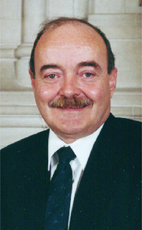
House of Commons photo

Crucial Fact

  • His favourite word was quebec.

Last in Parliament May 2004, as Independent MP for Chambly (Québec)

Won his last election, in 2000, with 50% of the vote.

Statements in the House

Oceans Act June 10th, 1996

He muddles so well that he just drowns himself in rhetoric.

In the Liberal Party's red book, they mentioned decentralization and administrative agreements. That is what we are talking about here. This area comes under federal jurisdiction, so now is the time to conclude administrative agreements with the provinces. You are good at making administrative agreements when you want to intrude in provincial jurisdictions, so let us try to reverse the trend and make administrative agreements in your jurisdictions. It is not so funny, this is not the place to do it. We cannot do that here. You cannot not do indirectly what you cannot do directly.

You were talking about economic rights-

Oceans Act June 10th, 1996

Mr. Speaker, for the second time tonight I must express disagreement with the idol of my youth. He should not see it as a personal attack, far from it.

When the member for Vancouver Quadra tells us that the House of Commons is not the place to debate the Constitution, I have difficulty with that. I know, as he does, that traditionally, constitutional debates are held in the Chateau Laurier, and that real changes are made at night, between midnight and 6 a.m. This is where the 1982 Constitution was hatched, and René Lévesque was tricked, during what has been known since then as the night of the long knives. I know all this, the member for Vancouver Quadra is not telling me anything new. I am aware of this.

Except that, what were we doing here before Christmas, when we voted on the distinct society motion? What were doing and what was the government doing, the government of the member for Saint-Maurice, the little guy from Shawinigan who said during the referendum campaign that we could have administrative agreements? The leader of the official opposition in Quebec is building his career on administrative agreements. If they do not emanate from this Parliament, where are they coming from then?

I do not agree when they say that the House of Commons must not be the place where we do indirectly what cannot be done directly. I must remind the member for Vancouver Quadra that the few times we did act directly it would have been better for us to act indirectly, because the results were nothing to brag about. The member must not forget that the Quebec premier has not yet signed

the 1982 Constitution and the Quebec National Assembly has not ratified it.

I agree that fisheries, oceans, navigation, security and overview of marine areas come under federal jurisdiction so to speak. It is true and we do not deny it, the member is right. But, I am making a suggestion because, really, I am not convinced this is the way it should be.

Yesterday, I listened to the Prime Minister on the French network of the CBC; he was on the program Le Point . He was ready to do indirectly what the member just blamed us for trying to do. He was willing to conclude administrative agreements and to discuss these things here in the House. He was ready to accept anything yesterday. Before the cameras, the Prime Minister is always ready to accept anything and everything.

Oceans Act June 10th, 1996

Mr. Speaker, this is my first opportunity to speak to Bill C-26, the Oceans Act. I must admit however that I am a little disappointed. As you know, I studied law at Laval University where, in the very first classes on constitutional law, the hon. member for Vancouver Quadra was quoted daily.

What a small world, given that, 20 years later, I am now sitting across from the hon. member for Vancouver Quadra whom I always admired and still admire for his rigour and the principles he followed throughout his life. There is no doubt about that. I have seen Supreme Court decisions quoting the hon. member. I recall that Bora Laskin and Brian Dickson, two outstanding Supreme court judges, highly respected the professor who now represents the riding of Vancouver Quadra.

I meet him today, some 20 years later, and cannot help being surprised to hear him advocate the exact opposite of what he used

to espouse when he was a university professor. Politics is demanding for all members, including the hon. member for Vancouver Quadra. I would have been very impressed if, once again, he had been an exception, but such is not the case, unfortunately. Even the strongest structures have limits, and I think it is the case with the hon. member for Vancouver Quadra. This said, I do respect him immensely and I hope he will not be offended.

However, when the hon. member for Gaspé presented what I would call a neo-constitutional approach to the bill, to the legislative agenda before us, I recognized that, as the Reform member said and as the hon. member for Vancouver Quadra is saying, navigation, fisheries and oceans are under federal jurisdiction. In 1867, the Fathers of Confederation cared about navigation, about protecting fishery and marine resources, about safety, international transport and marine transport. It is probably true that they decided to give the federal government responsibility over this aspect of Canadian geography.

However, the provinces never-and the member for Vancouver Quadra can say so if he does not agree-considered renouncing their historical presence on that portion of the oceans and seas that was adjacent to or, as in Quebec's case, inside their territory.

The hon. member for Vancouver Quadra is aware of that. For example, Walker's flotilla ran aground at Pointe-aux-Anglais, on Quebec's north shore. This is part of our historical heritage and we, Quebecers, respect it. Every year, thousands of divers come to explore these relics at Pointe-aux-Anglais.

When they decided to give the federal government responsibility over navigation, safety, etc., the Fathers of Confederation did not have in mind shipwrecks at the bottom of the ocean. The view expressed by the hon. member for Gaspé is that, yes, federal jurisdiction can be maintained. However, in our modern era it might be appropriate to follow the American example and to resort to joint action in this area. Indeed, there could be shared jurisdiction over the seabed and marine subsoil or, at least, some consultations.

From now on, with Bill C-26, the federal government will act unilaterally. Everything will be ploughed under, weeds and grain alike. That is what the hon. member for Gaspé is saying. We might as well scrap everything, put aside the infamous constitutional quarrel of 1991-92, civil law in Quebec, navigation and fisheries coming under the federal government. In light of the distinct society resolution that was passed just before the holidays, we should review the most ambiguous areas, where the general interpretation of the Constitution gives rise to some speculation.

Since the hon. member for Vancouver Quadra is more knowledgeable than I am in this field, he will recognize that in some cases past decisions led to quite ridiculous situations. For example, when it was determined, in 1906, that Montreal trolleys were to be considered a work for the general benefit of Canada, I think the decision was wrong. That is not what the Fathers of Confederation had in mind when they established that works for the general benefit of Canada were to come under federal jurisdiction.

When dealing, for example, with the content of television programming, they started by talking about the vehicle, the broadcasting method, towers, wires. All that was linked to telegraphy to finally conclude one day that television, radio, whatever, was an area of federal jurisdiction.

One thing lead to another, but it was always in favour of the federal government, which made Maurice Duplessis coin his famous line to the effect that "the Supreme Court of Canada is like the tower of Pisa: it always leans toward the same side".

The time may have come for parliamentarians, cabinet ministers and the powers that be to try to restore some balance by giving the provinces, if not an absolute decision making power, at least a say in the development of joint policies. In other words, the government should respect and recognize the existence of the provinces, and vice versa.

But politicians here refuse to do so. This is what is upsetting, and not only for Quebecers, because I imagine British Columbians also wonder about all this. This is not a linguistic or historical issue. We are talking about the management of resources, in this case the oceans, the seas, the Atlantic, the Pacific and the Arctic. We are talking about partnership.

This is a perfect occasion for the government to show that it really means what is says when it makes nice promises and speeches. The government tells us we will get along and discuss things together. Well, now is the time to do so. It may already too late this fall. If what we hear from all sides is true, the government will have missed its last chance to meet the wish of its provincial partners. The hon. member for Vancouver Quadra should try to influence his government and make it use common sense once and for all. I know you do have a lot of common sense.

Petitions June 5th, 1996

Mr. Speaker, 73,300 people have signed a petition asking the Minister of Health not to go ahead with his plan to amend the regulations on importing raw milk cheese into Canada.

To avoid cluttering up the House, I am tabling a list of 45 signatures requesting the minister not to amend the regulations. I will send the remaining signatures to the minister directly.

Committees Of The House May 30th, 1996

Madam Speaker, pursuant to Standing Order 123(1), I have the honour to present, in both official languages, the second report of the Joint Standing Committee on Scrutiny of Regulations.

Pursuant to Standing Order 123(3), I would point out that the report contains a resolution recommending that the government issue an order under section 23 of the Financial Administration Act so that all persons who had obtained a corrected certificate prior to June 8, 1992, following the amendment to the Canada Business Corporations Regulations, SOR 91-567, under section 261 of the Business Corporations Act, shall be remitted the fees payable under the Canada Business Corporations Regulations. A copy of the minutes and relevant testimonies is also being tabled.

Impaired Driving May 29th, 1996

Mr. Speaker, for two people in my riding of Chambly, Félix Patenaude and Marie-Pier Parent, the daughter of Renée and Pierre Parent, Director of Park Canada, Montreal District, life came to an abrupt stop on May 27 in Lake Louise, Alberta, when a drunk driver brutally shattered their dreams.

That long-awaited trip, a graduation present planned as a journey of discovery, will always remind their loved ones of a dream that went unfulfilled.

Once again, death and alcohol, which often go together in such circumstances, struck indiscriminately.

Because their memory will live longer than the screeching of tires, the shattering of glass and the clash of metal, it is important to tighten criminal laws so as to reduce as much as possible the number of regrettable accidents like the one that killed these young people, who had their whole lives ahead of them.

On behalf of all my colleagues in this House, I wish to express my heartfelt condolences to the grieving families.

Supply May 28th, 1996

Mr. Speaker, since the House of Commons, the Lower House, is responsible to the Canadian electorate for the funds it commits here, while the other House has to answer to no one for the sums allocated to it, there is one part of the federal government's budget that cannot be justified to the public. This is the primary concern of Reform Party members.

Since we are holding the cheque book, we ought to at least be told what the cheque they are writing over there will be used for. That is the primary purpose of today's motion.

Supply May 28th, 1996

Mr. Speaker, not surprisingly, the opposition motion tabled by the Reform Party brought back to me on my way here this morning how much I was opposed to the very existence of the other House, given the present state of affairs in Canada. Furthermore, with what I have heard so far, I cannot help but have more questions.

What were the Fathers of Confederation thinking when they created the Senate? Were they not hoping for some sort of safeguard, a watchdog over democratic constitutional guarantees, all the guarantees that could be included in the Constitution, particularly the distribution of legislative powers and all that?

With the emergence of regional parties, when there is talk of an elected Senate. What worries me is that a senator elected in a given division will be a clone of a member elected to the House of Commons, an exact replica of an MP representing a riding, in my case, for example, the riding of Chambly. There is a good chance that a senator elected in the riding of Chambly would be pretty much my duplicate. For democracy, this would definitely constitute a risk.

The problem, when you come right down to it, is that, with the emergence of these regional parties, with the responsibility of elected senators to get elected, they are open to compromise, they have to bend, a bit like certain judges in the United States who are elected. We have seen the abuses that led to.

When we look at the budgets, I agree with members of the Reform Party that the amounts spent are astronomical, but before handing the Senate a death sentence, I would like someone to suggest an alternative to us, and I am not entirely convinced that an elected Senate is the best one.

What I wanted to ask the member who has just spoken is, if he is not worried about abuses, and I know about abuses, I know them as well as he does, I know that Bill C-22 on Pearson Airport is still languishing in the other place, and is not ready to be sent back to us, giving rise to costs, of course, for the Department of Transport or for the department concerned, in the form of additional compensation for those who invested in Pearson, except that two wrongs do not make a right.

I am not sure where the Reform Party is headed with its motion. Are they criticizing the very foundation of our British parliamentary system? Do they have better solutions to offer than saying that a senator must be elected to be effective? I know that in my case, with respect to the regulatory question, for example, I needed the senators at one point and they did their job of representing the regional interests they are there to represent. I would therefore ask the hon. member if he could edify me. Is he in the process of reviewing the Canadian parliamentary system?

Supply May 16th, 1996

I am told that the hon. member is not Armenian, please forgive me.

At any rate, not so long ago, the Armenians were mentioned, and the hon. member for Saint-Denis also mentioned Macedonia, Serbia and other countries in that part of the world. It is strange how individuals from an ethnic group, members of an ethnic

minority in Canada, claim elsewhere the very thing they are denying us here. I have a great deal of trouble with that.

I would like to ask the hon. member, who nevertheless made an excellent speech and professed his faith in Canada, if he could help me understand what would be the point of having a Canada in which Quebec would be forced to stay against its will, after voting for sovereignty, all because of some legal texts, a Constitution it never signed or entered into. Do you think this makes for a healthy country? Is that healthy?

Do you think the great and beautiful country you refer to three times every half hour in this place will be able to keep projecting the same image internationally if it forces seven or eight million people to stay in your great and beautiful Canada? That is my first question.

As for the second one, I was listening earlier to the members who spoke before the hon. member for Parry Sound-Muskoka. They talked about a Canadian nation. I have a very hard time understanding how they can talk about a single nation when we have two languages and when the central part of this country does not understand its neighbours on either side, in the east and the west. They talk about a country with a single nation but two different languages. That is not easy to understand. As someone pointed out to me earlier, it is like an egg with two yolks, it does not give two chicks. Only one develops.

Please help me understand how a single nation can have two languages. Yet the concept of nation and the use of a given language are closely linked. One nation, one language, I can understand, but one nation, two, three, five languages, I cannot. The Prime Minister denied the existence of a Quebec nation. That is probably what the hon. member for Parry Sound-Muskoka was referring to.

Anyone who considers that Quebec does not exist in the first place will obviously have a problem admitting that it could leave. Could you clarify this point for me please?

Supply May 16th, 1996

Mr. Speaker, I listened very carefully to what the hon. member for Don Valley North said and I cannot help wondering how an Armenian man of all people can question the right of Quebecers, as a people, to self-determination.