
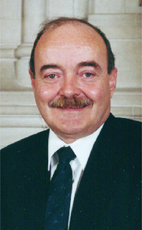
House of Commons photo

Crucial Fact

  • His favourite word was quebec.

Last in Parliament May 2004, as Independent MP for Chambly (Québec)

Won his last election, in 2000, with 50% of the vote.

Statements in the House

Excise Tax Act December 5th, 1996

I would invite the member for Beauséjour to breathe through the nose. I do not know who will take over his riding after the next election, but he may have to let it go given the performance of his party over the past three years.

The member for Beauséjour should stop shouting at the official opposition, his peers who still live on Canadian soil after all, and are looking for ways to improve the taxation system, increase public revenues without choking people to death. I could very well make some suggestions.

I will offer one suggestion, if he is considerate enough to listen to me; the idea just came to me.

Take the example of a worker. First, 57 or 58 per cent of his paycheque is deducted at source. On his paycheque stub he can see the word "net". What it means is that his paycheque is trimmed down to the minimum, because there is not much left. He then goes home with the 42 or 43 per cent that is left, but he is not out of the woods yet. The government thinks, dreams, racks its brains and says: "How could we grab most of the 43 cents on every dollar earned that actually he brings home?" It thinks about all kinds of things and talks about harmonization, but it never thought that, because of the economic multiplier, the less money people have, the less they will contribute to making the economy work, the less they will invest in our society and the more this economic multiplier will tend to move toward zero, towards nil.

Then, the government ponders and finds that it is not getting enough revenues. It must trap people again, somewhere else. That is the Liberal philosophy.

I will give an example. If it were willing, one day, to see things differently. We are all taxpayers and, at some point, we have to paint the interior of our house. What do we do? On a nice Saturday, we go out and buy gallons of paint, two rollers and one pole. With our wife and children, we do the painting ourselves. It takes one weekend. This has cost us $300 or $400 in paint and we have saved money on a job that would have cost $800 in total.

If the government had examined that sort of thing and had allowed the taxpayer, instead of wearing himself out on the roller one weekend, to officially give the contract to someone else, thus thwarting the underground economy, the taxpayer could say: "Instead of wearing myself out on the roller, I will give the work to my neighbour who does not have a job. He has a social insurance number and will declare his income. In reality, this will cost me $800, but I will get a tax refund of about $200 and the paint will have cost me $400. Fine. It is worth my while to spend a whole weekend painting my house to save $200? Perhaps I would have given the contract to someone else." To save $800, it is worth it, to save $400 also, but not to save $200. This is the kind of thinking they are incapable of doing.

This might mean at the outset some kind of tax break, which is unthinkable for those on the other side. They prefer to raid the piggy bank greedily, a bit more every day, and they will go almost as far as the highwaymen of the last century, who would lay in ambush for travellers and rob them. Whether the hon. member for Beauséjour likes it or not, this is the situation we are facing today. These people show no sign of compassion for taxpayers nor any willingness to provide some relief and get the economy rolling. We could get rid of the underground economy; it could yiled interesting results, but they refuse to do so.

Even if I suggested such a thing, I would be afraid that they would turn around and tax capital gains from the sale of a residence. That shows are crooked they are.

Personally, I expect nothing from this government but I hope it will be able to tell the truth to the people and tell them it paid out $920 million to the maritimes to buy the support of voters there and make them forget the terrible things it did there. But we cannot be sure of that, because we have just seen one province change governments unexpectedly.

Their bill contains nothing which allows them to pat themselves on the back. We see how well they are holding promises made in 1993. We should expect nothing from these people, not even the honesty to admit that they broke their promises and that their word is not worth more than the ink of the red book.

Excise Tax Act December 5th, 1996

Mr. Speaker, it funny the way things change over time. Today, the Liberals are being quite touchy. Reform members are telling them that during the 1993 election campaign, they openly condemned the GST. Liberals are now raising questions of privilege and using every tactic in the book, suggesting it is unparliamentary to remind them that they condemned the GST during the election campaign.

But we have seen a minister in this House, the Deputy Prime Minister at that, who was forced to resign or felt she had to resign because she had stated that if the GST was not abolished, she would resign.

She did resign, and she was re-elected. It is as if I, a sovereignist member, said: "If Quebec does not secede some day, I will get re-elected as a Liberal member". God forbid. It would be unthinkable. If I did that, you would say I was dishonest. I do not mean to apply this word to my colleagues. I simply want to remind you that the Deputy Prime Minister said during the election campaign: "If this tax is not abolished, I will resign".

During the 1993 election campaign, the Prime Minister said: "We will scrap the GST". Then, on May 2, 1994, he said: "We hate this tax, and we will get rid of it".

The bill before us today is even more underhanded than the scheming of those who claimed they would abolish it. Not only are they keeping it and pushing it in the western provinces, they are redeeming themselves for the next election by harmonizing it in the maritimes.

The hon. member for Beauséjour is puffing up his chest, but he was not so proud, not so long ago, when the people in his riding were angry. I even saw on television someone roll up his sleeves and invite him to step outside the assembly hall. He was not puffing up his chest then as he is doing now. He let that guy speak, I am telling you, I saw it on television.

But if we dig a little deeper, we see that this government is trying to buy back the maritimes after closing some military bases there. That decision was not very well received. Now, they are giving them a present valued at $920 million for a start. That is to buy the coming election, to try to buy relative peace, because the people there nonetheless understand to a large extent that the government is trying to pull the wool over their eyes. This gift is a sort of Trojan horse, but for many people, it is something that seems, for the moment, acceptable.

I listened to the parliamentary secretary who just spoke. She presented the GST as something completely harmless; she said it was simply replacing the old manufacturers' sales tax. Yet they did call it the goods and services tax, since it not only replaced the old 9 per cent federal manufacturers' tax but extended it to other economic sectors that had not been affected until then. The new tax now applied to legal services, for example, or to any other kind of service for that matter.

That is probably why, acting in good faith that proved short-lived, the Prime Minister, then leader of the official opposition, rose up against this tax. He expressed outrage in public, as he did in his red book and during the 1993 election campaign.

This famous tax shows that the government in place, just like its predecessors-and it is a Liberal government that was responsible for the first deficit in our history-claims that cutting the heart vein just before the blood gets to the heart is good for the taxpayer and for all aspects of our economy and allow the patient to live longer. In so doing, the government is revealing its inability to find other ways of collecting taxes and generating government revenue, which is disastrous. It is tragic.

Canada Elections Act November 26th, 1996

Madam Speaker, I have a question for the hon. member who just spoke. I agree we could save $120 million or $130 million, but the maximum could have been higher.

The government could have saved $150 million, in other words, an additional $20 million or $30 million, if it had agreed to use electoral lists prepared in the province of Quebec, for instance. This list, which is quite recent, does not meet the 12-month criteria but only just.

So why do the Liberals not stop their nitpicking and adopt the electoral list that has just been drawn up? This list is pretty recent, in fact so recent it would be impossible to have one more up to date because it takes so long to compile the data.

My question is the following. Is it not just to give Liberal organizers in the ridings a chance to go door to door and fill in the list at 75 cents or $1 a shot, so that the legislation will be used as an excuse to give more money to the friends of the Liberal Party in Canada?

Committees Of The House October 30th, 1996

Mr. Speaker, I have the honour to table, in both official languages, and pursuant to the order of reference made under section 19 of the Statutory Instruments Act, the third report of the Standing Joint Committee on Scrutiny of Regulations.

Pursuant to Standing Order 109, the committee is asking the government to table a complete response to this report.

Credit Card Interest Calculation Act October 30th, 1996

Mr. Speaker, I ask for the unanimous consent of the House to table a committee report.

Administrative Tribunals (Remedial And Disciplinary Measures) Act October 22nd, 1996

Madam Speaker, I simply wanted to assert my rights. As I was saying to the hon. member for Vaudreuil, who is still

listening and who certainly, through the Chair, agrees, I ask him to rise and to tell me whether what I am saying is false.

David Berger was appointed Canadian ambassador to Israel and he is not a Bloc member. He is a well-known Liberal. All the names I have here are those of well-known Liberals.

There is a lady, who ran in Laval East but was defeated. Her name is Raymonde Lacour and she was just appointed on an immigration committee with an annual salary of $84,000. I say to the Liberals that they have become masters at looking after their friends.

Going back to the original question, the Conservatives were not far behind the Liberals. By early October 1994, the Conservatives had filled just about every available and unavailable position with Conservative appointees, usually for a period of five years.

Now, the Liberals will call an election before the five-year terms of these Conservative appointees is over. Consequently, they feel cheated because they cannot postpone it, they cannot distribute the patronage goodies the way they would like to. So, with Bill C-49, they will show the door to just about all the Conservatives who hold these positions, by invoking of course the provisions contained in clauses 5 and 6. They will thus be able to fill the positions left vacant by appointing long-time friends and new ones as well.

I am even told that in the Quebec city area, an old Conservative MP was just appointed to a very lucrative position and is considering, as a way of thanking the government, running under the Liberal banner at the next election. This is quite something and it is even worse considering it is in Quebec.

This is why I was saying to the hon. member for Vaudreuil that, when it comes to patronage, we have nothing to teach the Liberals. They are the undisputed champions of patronage, and they have been since the early days of the Canadian federation. No, we will not try to compete with them in this area.

Administrative Tribunals (Remedial And Disciplinary Measures) Act October 22nd, 1996

Madam Speaker, I would like to know if I still have some time left to finish my reply.

Administrative Tribunals (Remedial And Disciplinary Measures) Act October 22nd, 1996

Madam Speaker, the hon. member says the Bloc has nothing to teach him. We have indeed nothing to teach them about patronage. Let me just name a few names: Gerald Allbright. Do you know him? He is a true Liberal who has been appointed to a court in Saskatchewan. Lucie Blais. She has been appointed to the National Council of Welfare. She was defeated as a Liberal candidate in Abitibi.

Claire Brouillet, defeated in Terrebonne. Rémi Bujold, a loyal lobbyist is well rewarded. Yves Caron, appointed to the Canada Pension Commission, another former MP from 1972 to 1979 and secretary to the Minister of Agriculture for a while. Guy Chartrand, listen to this, defeated in Longueuil, appointed to the staff of the defence minister.

Caroline Chrétien, no comment, her family name says it all. Denis Coderre. This guy tried on approximately five separate occasions to get himself elected under the banner of the Liberal Party of Canada in ridings in Montreal's east side. He went as far as to claim, after a former member for Laurier-Sainte-Marie whose name I forget died, that he was a buddy of his, when in fact he could not stand him. There is also a certain René Cousineau, a former member of the Liberal Party of Canada and member for Gatineau.

I must agree with the hon. member for Vaudreuil that, on the whole stinking subject of political patronage, they are indeed the winners, there is nothing we can teach them.

A message was delivered by the Gentleman Usher of the Black Rod as follows:

Madam Speaker, the Honourable Deputy to His Excellency the Governor General desires the immediate attendance of this honourable House in the chamber of the honourable the Senate.

Accordingly, the Speaker and the House went up to the Senate chamber.

And being returned:

Administrative Tribunals (Remedial And Disciplinary Measures) Act October 22nd, 1996

I would be surprised too, but you never know. This is the problem with Bill C-49. It was given a very impressive title: an act to authorize remedial and disciplinary measures in relation to members of certain administrative tribunals, to reorganize and dissolve certain federal agencies and to make consequential amendments to other Acts. Is it not great! A better title would have been: an act to profit the friends of the Liberal Party of Canada. It would have been more to the point and more accurate, truer and franker. Of course they would not have the guts to do that, but this really is the spirit of the bill.

When, for example, the chairperson of an administrative tribunal realizes that refusing an application to the CRTC from a member of the family of the Prime Minister would be synonymous with loss of job, he or she says yes. Should that chairperson have the misfortune to be honest and fair, after all he or she is exercising the duties he or she has sworn to perform and deny the application-as it happened with PowerTv Direct-the minister, by the powers he has provided for himself would-

The hon. member for Vaudreuil will understand it is not enough that justice be done. I said the hon. member for Vaudreuil, Madam Speaker, looking at you of course. I tell you that the hon. member for Vaudreuil-even if you tried to psyche me out, but I recovered-should understand that it is not enough that justice be done there should also be a perception that justice has been done. There should be an appearance of justice, no matter what the hon. member for Vaudreuil might say. That is what will not come out of decisions now. That is what will ensure we will always be-You know, with the opinion the public has of politicians, this is not going to improve matters.

There are some rules within an administrative tribunal. The administrative tribunals have been called, it is not I who say it, but a journalist, and it is true, because we can find the same definition in Dussault, René Dussault, a former Liberal candidate in Quebec and a superior court judge. Recently, the president of the bar in Quebec was very clear on that when she said, and I quote: "The lack of employment security could have unsuspected psychological effects on the decisions of a person who might be more concerned with pleasing the authorities than doing justice." This is self-explanatory.

As hard as the Liberals may try to defend that, they are defending the undefensible, and the public will hold it against them. When justice will no longer be meted out by an administrative tribunal unless a Liberal Party membership card is displayed, the Liberals will have to give some explanation and then live with the consequences.

Administrative Tribunals (Remedial And Disciplinary Measures) Act October 22nd, 1996

Then, a request is submitted to the minister from a good Liberal sitting on the same committee. You can imagine any committee in this case. The government has decided to beseige administrative tribunals. The minister will refer the case to a judge of the Superior Court, who will determine if the case is worth it. But the minister may even do something as soon as he receives the request. Even before he submits the case to a judge, he could "obtain [. . .]in an expeditious manner".

This is quite something. To go as far as to take advantage of its majority in the House to slip words like "expeditious" in a bill, the government must be bold. In fact, it must have lost all sense of decency.

Nothing can stop it. "-obtain, in an informal and expeditious manner, any information-" means that the job of a guy is at stake and the minister may act "in an informal and expeditious manner". He may oust a guy who may carry on his duties in an able and honourable way, except for the fact that he does not think the same way as the minister.

He may also refer the case to mediation, which would be quite similar to what the minister of defence-I was about to say the minister of war. It was not so bad as a name, "minister of war", because it is more or less what he is doing now-the minister of defence referred the case to mediation. How? He mediated with Jean Boyle and, apparently, we ended up with a bill of half a million dollars, which means we can as well just forget about it, the guy simply lost his job. In such a case the minister can negotiate the leave in order to appoint a friend because two cannot sit on the same chair.

6( c ) request of the Governor in Council that an inquiry be held under section 7;

or, at the next paragraph: d ) advise the Chairperson that the Minister considers that it is not necessary to take further measures under this Act.

Paragraph ( d ) may be interpreted as saying to a member of an administrative tribunal criticizing a colleague before the Minister: ``No, no, you are wrong, this is a good Liberal just like us. We will keep him. Do not touch him''. They are keeping that road open, because even between themselves they do not always recognize each other, they do not always know who is who and what they are

doing. Therefore the Minister is wise enough to reserve that way out. What if someone comes to report a good friend of his, he does not want to be stuck, he is not foolish enough to do that.

On the other hand, if the member being denounced is a Tory or a Reform member, or, very improbably, a Bloc member, then of course it will no holds barred. They will stick it to him; his case will be brought before a higher court judge, probably a good friend of the party, like the judge recently appointed in Alberta, a Liberal, Justice Gerald Allbright. This is exactly the type of person whom such a case would be referred to because he has a Liberal background. I do not doubt his integrity, I would say that one would trust this judge, he would do the dirty work and get rid of the administrative tribunal member.

Now, you are going to ask who is going to get rid of the chairperson of an administrative tribunal, since the chairperson is the one who blows the whistle on the members. Who can blow the whistle on the chairperson? A member does not have the power to do so. The minister, who is not crazy, has understood all this. He has made it his business to appoint a chairperson who will side with him, decide for him, agree with him. In other words, a chairperson who will not abide by the ethics rules of the administrative tribunal.

This will be to the glory of the minister, who will be able to remove from office a chairperson appointed by the former Prime Minister, to appoint his own. Should there be an electoral defeat, he wants to be able to fill positions with his chums. The issue of contracts has been dealt with. The opposition is on the look-out. There are still some contracts without tender, but in fewer numbers. The government can no longer say: "Here is the purse, run with it". We are in the hole, we have had it up to here with the deficit. What it is saying is: "I cannot give you too big a reward, but at least I will give you a little job. You will have it for five years and, with luck, we might be able to renew your mandate two or three times. You will not have to work too hard and you will have a nice pension. But never cross me". This is what perverts administrative tribunals.

In Quebec, we have looked into this problem, which is common place throughout Canada. I will tell you what I know from personal experience with the Commission de protection du territoire agricole, for instance. One thing leading to another, the Commission de protection du territoire agricole reached a point where it was having to defend the Quebec act to preserve agricultural land. It was acting as a defender of the act, as if it had passed it itself. The situation was rectified, sure, but the danger remains that an administrative tribunal could lose the neutrality it should have as a tribunal and devote itself entirely to enforcing the law as its mandate requires.

There is an important nuance here, which I hope the hon. member for Vaudreuil will grasp.