
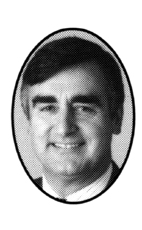
House of Commons photo

Crucial Fact

  • His favourite word was quebec.

Last in Parliament April 1997, as Bloc MP for Lac-Saint-Jean (Québec)

Won his last election, in 1993, with 76% of the vote.

Statements in the House

Transfer Payments May 10th, 1995

Mr. Speaker, if I were the minister, I would feel somewhat embarrassed about alluding to equalization payments, given that his first act in January 1994 was to cap equalization payments thereby depriving the provinces of $1.5 billion over the next five years.

The minister acknowledges that the federal government is hastening its withdrawal from transfer payments for social programs. Under these conditions, how can he talk seriously of a cost effective and flexible federal system, when he will be depriving Quebec of $2.5 billion over the next two years and when Ottawa will no longer pay a cent to fund social programs by 1999, all the while maintaining its tax base and claiming to set national standards in Quebec?

Transfer Payments May 10th, 1995

Mr. Speaker, I am not surprised by the deficits we are running up, because the Minister of Finance seems unable to count. He continues to deny figures that are perfectly clear, figures arrived at through his own budget calculations.

Would the minister acknowledge that, as of 1999, in four years' time, Quebec will no longer receive any transfer payments for social programs, but will in fact have to send a cheque to Ottawa for the Canada social transfer paid to other provinces?

Transfer Payments May 10th, 1995

Mr. Speaker, yesterday in his budget speech, the Quebec Minister of Finance brought home the negative impact of the massive cuts to the federal transfer payments used to fund social programs, which were announced in February's budget. While hastening its financial withdrawal, Ottawa intends to maintain its national standards, indeed impose new ones.

The Quebec Minister of Finance said yesterday, and I quote: "By the end of the decade, the federal government will no longer be making any transfer payments to Quebec for social programs. In fact, Quebec will be making payments to the federal government".

My question is for the Minister of Finance. Would the minister confirm the conclusion reached by his Quebec counterpart to the effect that the massive cuts made in his most recent budget to transfer payments to the provinces to fund social programs will mean a shortfall of $650 million next year for Quebec and of $1.9 billion in 1997-98, if the federal government continues its practice of allocation on a per capita basis, as he himself has said?

Transfer Payments May 9th, 1995

I would refer the minister more specifically to page 17 of his budget speech, where he announced that he was prepared to fund social assistance the same way the government funds transfers for health and post-secondary education, in other words, on a per capita basis, as opposed to real need.

Consequently, would the Minister of Finance agree that based on these criteria, the main victim of the cuts in his latest budget will be Quebec, which in 1997-98 will be saddled with 41.7 per cent of the cuts or $1.9 billion, and that this is why he refuses to discuss these cuts publicly within the framework of a federal-provincial conference to be held before the referendum?

Transfer Payments May 9th, 1995

Mr. Speaker, I must say I understand why the Minister of Finance is too embarrassed to admit that these figures were taken directly from his own budget.

Transfer Payments May 9th, 1995

Mr. Speaker, I challenge the minister to deny what I am going to say, considering what I just said. Under the item "transfer payments to the provinces" Quebec's loss, for this year alone, will be $650 million. That is what was said, Mr. Speaker.

And I would ask the Minister of Finance to confirm that over the next three years, additional cuts announced in his first two budgets will mean, in the case of Quebec, a total shortfall of more than $3 billion in funding for health care, post-secondary education and social assistance.

Transfer Payments May 9th, 1995

Mr. Speaker, in its first budget in February 1994, the federal government announced it was cutting an additional $2 billion from its contribution to provincial social programs in 1995-96 and 1996-97. In its second budget, it hit the provinces a second time by offloading its deficit in the form of new cuts that will total $2.5 billion in 1996-97 and $4.5 billion in 1997-98.

My question is directed to the Minister of Finance. Would he confirm that according to the distribution formula for the Canada social transfer in Bill C-76, the latest budget's additional cuts in transfer payments to the provinces will, next year alone, result in a shortfall of $650 million for Quebec?

Job Creation May 8th, 1995

Mr. Speaker, the government always quotes statistics for a full year. I would ask him to check his figures for the past five months.

Since the federal government has shown it is incapable of fighting unemployment creatively, and since the problem has taken on such proportions, particularly in Quebec, where we have over 800,000 people on welfare now, how does the Minister of Human Resources Development explain the federal government's stubborn refusal to give the Government of Quebec jurisdiction in matters of manpower training, when it alone can establish the appropriate and integrated measures that will really create jobs?

Job Creation May 8th, 1995

Mr. Speaker, the minister talks enthusiastically of job creation, but he is forgetting to mention that no jobs have been created in Canada in the past five months.

Instead of focussing on creative measures, talking about regional development and committing to defence industry conversion, will the minister acknowledge that all he is doing at the moment is considering a project that would reduce the number of Canada employment centres from 100 to 30, as proposed in a document produced recently by his department?

Job Creation May 8th, 1995

Mr. Speaker, on Friday, Statistics Canada reported a decline in the unemployment rates for Canada and Quebec. There is, however, a sad truth behind its report, since the decline can be explained, not by an increase in the number of jobs, but by the departure of 38,000 people from the labour market. If the level of unemployment is dropping, it is because the unemployed are giving up trying to break into the job market and are abandoning all new efforts.

My question is for the Minister of Human Resources Development. With the lack of job creation measures and with cuts of more than $6 billion to unemployment insurance, does the minister realize that the sole effect of his government's action in the past 18 months is to hide the actual number of unemployed, rather than reduce unemployment?