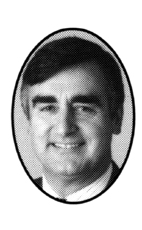
House of Commons photo

Crucial Fact

  • His favourite word was quebec.

Last in Parliament April 1997, as Bloc MP for Lac-Saint-Jean (Québec)

Won his last election, in 1993, with 76% of the vote.

Statements in the House

Supply May 2nd, 1995

Second, we are being told that we are wasting the time of the House by discussing Bill C-76. What an undemocratic attitude. Have we reached the point-because we are sovereignists, elected as such by the people of Quebec, democratically, 53 of us out of 75 seats in Quebec when the governing party only got 20-where we can no longer express the reasons for our being here?

Have we reached the point, now that the government is imposing new national standards in the context of an unusual legislative framework, where we no longer have the right to say that this does not make any sense, where we can no longer speak on behalf of the provinces or the poor, where we can no longer say that, yes, we are here to promote Quebec sovereignty, because we believe this is the only possible solution to extricate ourselves from the current mess, the kind of deception we are witnessing today?

I can tell you that there is not one member here who is not proud to assume this historical role, and we are confident that in the fall the people of Quebec will prove wrong those who have not yet understood the Quebec reality.

I have a question to ask the minister. He knows Quebec and, as a rule, he is quite democratic. I do not think his speech today was really democratic, but as a rule he is. He knows very well that in Quebec there is a consensus on the issue of manpower training.

We talk about a lot of things, administrative arrangements in every possible area, but there is one thing that everybody agrees on in Quebec and it is that manpower training programs and the resources devoted to them should be in the hands of the Government of Quebec.

This would do away with a lot of arguing, would prevent the neutralization of efforts and the wasting of energies. We could have better designed programs, specifically geared to Quebec needs. Everybody in Quebec thinks like this, including the leading federalists, including people like Ghislain Dufour, president of the Conseil du patronat. There is general agreement on this in Quebec.

Being a democrat and seeking the best for Quebec, as he said, what is he waiting for to convince a reluctant Prime Minister-I know he is most reluctant-to convince his government to transfer all manpower training activities to Quebec with the necessary resources?

Supply May 2nd, 1995

Previously, the Liberal Party and the NDP assumed that role, but the former now is the government and the later has all but disappeared. We are the only ones left in Canada, not only in Quebec but in Canada, to speak in this House for the poor, those who are the victims of this minister, the victims of this government. No ministerial or prime-ministerial speech in this House will make us forget that these people are persecuted by the federal government.

Supply May 2nd, 1995

Mr. Speaker, we just heard the Minister of Finance, the one person responsible for cuts in this government. He was the one who cut unemployment insurance, social programs and transfer payments. Then he has the nerve to tell us: "In the budget speech, one can see that the government does not intend to impose anything on the provinces". Has he forgotten already that he cut social programs and education by seven billion dollars for the next three years? It takes some nerve, Mr. Speaker.

It takes nerve also to say that the important issue is job creation when this government has failed completely in this area. This government has done nothing for job creation. The only job creating program mentioned in the red book, municipal infrastructures, was reduced by 200 million dollars in the recent budget.

So I believe people will have to be careful to sort out reality from inflated patriotic language and repeated protestations. Reality is extremely harsh and inescapable; it shows this government has taken a turn to the right and has decided to attack the unemployed, the have-nots of our society. It did impose 100 million dollars of additional temporary taxes on banks but, at the same time, decided to take 700 million dollars from the unemployed. This government has launched the worse attack ever against the have-nots of Canada.

So when the Bloc speaks in the interest of those people it is talking in true legitimacy. We are very proud to say what we say in this House. If we were not here, nobody else would defend social programs and the right to strike.

What we represent in this House is legitimate all across Canada.

Supply May 2nd, 1995

Mr. Speaker, we will all agree that it is a purely hypothetical question.

We only have to look at the Liberals opposite; they are petrified at the thought that these issues might be raised in the House. The track record of the Liberals, the federal government, the federal system and the efforts made to renew the Canadian Constitution and federalism has consistently been dismal.

I will be frank with the the member; I would have been delighted by such an offer when I was a federal minister and I would certainly have accepted it since I was ready to accept the Meech Lake accord, which did not even go that far. But, since we could not have the absolute minimum, we will never have the maximum. We will not settle for anything less than Quebec's sovereignty .

Supply May 2nd, 1995

Mr. Speaker, first, I want to make two comments on the hon. member's preamble regarding a winning referendum. Indeed, there is a fundamental difference between Ottawa's federalists and us, Bloc members and sovereignists in general. The difference is that we want a winning referendum, so that Quebecers can be a fully sovereign nation, like a normal people. We know full well that federal Liberals want a losing referendum.

The federal government hopes that Quebec will once again go down on its knees, so that it can satisfy its centralizing needs and finish the dirty job started in 1982.

As for social groups, the member tells us that they come in droves on Parliament Hill to urge the federal government to impose even more standards on the provinces. First, we did not see much of these groups and, second, I think the member is mistaken.

These groups are not asking the federal government to set bureaucratic rules and increase its bureaucracy to control the provinces. They are asking the Liberal government to pursue its efforts, so that provinces can maintain civilized social programs which make sense. This is what people are asking the federal government.

I have a suggestion for the Liberal member who just made that statement. When he meets with social groups making such complaints about the provinces while extolling the virtues of the federal government regarding social programs, he should provide them with figures indicating what the Liberal Party has done to them in the last two years. He should tell these groups that this Liberal government made drastic cuts in the UI program, that it also made cuts in social programs through transfer payments, that the situation will get worse year after year, and that his government is also about to target old age pensions. If the member tells these facts to social groups, they will go back to their provinces, because that is where their interests are best served. Indeed, the effort is primarily made at that level, thanks to the generosity and compassion of Canadians and Quebecers, not at the level of federal bureaucrats and politicians, who are constantly finding new ways to stop contributing to that effort.

Thirdly, the child care program goes back to 1988, which is some time ago, but I clearly remember it. The legislation included provisions giving full scope to the provinces, while respecting their jurisdiction. It is the Liberal Party which instructed its majority in the Senate to block this $5 billion initiative designed to set up a true child care program.

Supply May 2nd, 1995

So now things have to be glossed over, kept hidden, and the best way, in the government's mind, to do so is to use new terms. So we have a marvellous new term: the Canada social transfer. It was preceded by trial balloons announcing the government's withdrawal from provincial jurisdiction, its confinement to its own jurisdictions and its transfer of money to the provinces to enable them to meet their responsibilities, and the rabbit that popped out of the hat was the Canada social transfer.

We might have wondered what was happening at the beginning, but now we know, because it is in black and white in Bill C-76. The bill lets us know very clearly what it is all about. It is about a centralizing assault, the likes of which we have not seen since the shameful patriation of 1982. For the first time in 15 years, the government is charging ahead, visor raised, along the route of massive and unequivocal centralization. It says so in the bill.

Now the federal government will not be content just to encroach on provincial jurisdiction. It will not be satisfied with legal opinions from the Department of Justice. It will not be satisfied by merely appeasing its appetite for power. It is going to set up a legislative framework for itself to achieve its end. This framework is known as Bill C-76, legislation that is a charade as well, because it is one of the ways the federal government is concealing the fact that it is dumping its poor management onto the provinces.

It is also charade, because the government is using it to mask the extent of the cuts it is imposing on the provinces. And it is an even greater charade, because it is claiming falsely to eliminate national standards. The fact of the matter is that no bill has ever given the federal government so much power to impose national standards. This does not apply just to the traditional social programs; it is throughout the bill. For the first time, a bill explicitly provides for the federal government's imposition of standards in post-secondary education, an area that is clearly under provincial jurisdiction.

For the first time, the federal government is empowering itself to say: "I do not like this educational program. You will do it this way, or I will cut funding". Same thing for social programs. Do not just take my word for it. Many observers and analysts have noted and seen very clearly that the aim of the exercise is to confirm the $7 billion cuts announced for the next three years and to give the federal government the power to dictate the set-up of the provinces' social programs to which it will be contributing less and less.

I said authoritative voices have said this. I will quote, for example, Lise Bissonnette, who wrote the following in an editorial in Le Devoir last week. She said: According to Bill C-76, post-secondary education is now comparable to a social program. The bill allows Ottawa to apply national standards, in this area, as in others. The provinces, whose jurisdiction over education is as clear as it can be in the Canadian Constitution, are at best assured of consultation''. <em>La Presse</em> agrees with <em>Le Devoir</em> . It may reassure the Liberals to know that in the March 31, 1995 edition of <em>La Presse</em> , Chantal Hébert writes,With the bill tabled in the Commons to implement its February budget, the federal government opens the door to the unilateral imposition of new national standards in areas such as post-secondary education, child care, etc. In fact, Bill C-76 now restricts the provinces to the role of mere consultant in this exercise. The bill has no provision requiring the provinces' prior consent to the introduction of new national standards for social programs''.

In Le Devoir of April 21, Conrad Yakabusski himself writes, ``Although Ottawa boasted in its February 27 budget of having freed the provinces of Canadian standards in the management of social programs, the Chrétien government now wants to make them adhere to a whole series of new national principles that would apply to a wider range of programs. And although it claims it wants the provinces to comply voluntarily with these principles, the federal government is about to give itself the powers it needs to impose them in case the provinces refuse to do so''.

In closing, I will also quote Giles Gherson, principal secretary to Mr. Axworthy, the Minister of Human Resources Development, who said, "What would occur after the failure of negotiations aimed at setting national standards remains ambiguous".

The bill that is the subject of today's motion clearly shows what will occur if the announced negotiations between the federal government and the provinces do not result in an agreement. Without an agreement, it is clear that the government will find in this bill all the latitude and power it needs to impose its standards. I am very concerned when I hear that it is preparing to tell provincial governments like that of Quebec that if they do not comply, their funding will be cut off.

Meanwhile, a historic, essential process is unfolding in Quebec: the preparation of a referendum on sovereignty. It is not every day that a people can decide whether it should face its future as a sovereign people or a province. Quebec will do this in the fall. The federal government, which has the nerve to tell us it will propose a type of flexible federalism after the referendum, is clearly showing us today what Quebec can expect if it stays in the Canadian federation.

If Quebec stays in the Canadian federation, we can expect to live under the boot of the federal government, to let federal bureaucrats and politicians set standards for Quebec's social and education programs. They have the nerve to say this to us now, when we are on the verge of making our decision. I can tell you

that Quebecers are taking note of this and that this will weigh heavily in the outcome of the Quebec referendum.

Supply May 2nd, 1995

moved:

That this House denounce the will of the federal government to restrict the provinces to the role of mere consultant by imposing on them new national standards for all social programs through the introduction of the Canada Social Transfer, which will enable the federal government to interfere even more in such areas as health, post-secondary education and social assistance, all of which come under exclusive provincial jurisdiction.

Mr. Speaker, this motion is presented by the official opposition as part of a very important debate that started recently with the tabling of Bill C-76 by the federal government.

We are accustomed to seeing all sorts of things in politics, but I must say that in this case, the discrepancy between what the government says and what is actually going on is beyond belief.

Last Sunday, at a meeting of the provincial wing of the federal Liberal Party in Trois-Rivières, the Prime Minister made an extremely aggressive speech-and this is an understatement, considering the tone and the content of what he said-in which he accused the present Government of Quebec of ignoring the acute poverty problems of Quebec. The Prime Minister based this accusation on the fact that Quebec has a very substantial level of poverty, borne out by the announcement the week before that more than 800,000 people in Quebec were living on welfare.

The Prime Minister exclaimed, to the sound of thunderous applause by his supporters, that the Government of Quebec was to blame, the government of Mr. Parizeau who was so obsessed with the referendum question on sovereignty that he ignored his basic duty which was to deal with the issue of poverty in Quebec.

Personally, as I listened to the news Sunday night on television, I had the impression that I was watching an arsonist accusing firefighters of doing a poor job, because in this particular case, the government that is most at fault, a government that, since it came to power, has been totally aggressive in its treatment of the vulnerable and unemployed members of our society, a government that has done more than any other to aggravate poverty in Canada and Quebec especially, since Quebec is still part of Canada and is still in a position to be treated this way by the Canadian federal system, by decisions that are made in Ottawa, that government has hit hardest at the unemployed.

We had an election campaign in which the Liberal Party of Canada very skilfully read the mood of the people and realized that Canadians and Quebecers had serious concerns about jobs, maintaining social programs and maintaining the federal government's contribution to the implementation of its own programs. The Prime Minister managed to get elected on the basis of three words, which were always the same: jobs, jobs, jobs. All this is in the so-called red book which contains the Liberal government's promises.

However, for some time now there have been no more references to the red book. I remember that during the first year we were here in the House, practically every speech by a Liberal minister or member ended with an enthusiastic reference to the Liberal Party's commitments in the red book. The red book has now become invisible. All we have now is a black list of social program commitments abdicated by the Liberal government.

The facts are there. The figures are eloquent and irrefutable. What has this government done to alleviate the problems created by poverty? What has it done? In fact, every action taken in the budget, every policy is aimed at aggravating the situation.

Let us go back to the beginning. In January 1994, the Liberals tabled Bill C-3 which extended the ceiling on equalization payments, so that the provinces would receive $1.5 billion less during the next five years. We have no figures for this year, but experience has shown that when equalization payments are cut, Quebec has to pick up at least 40 per cent of the slack.

There is more. This was a good start, but there is more. In February 1994, the federal government's first budget did what? It started by cutting $5.5 billion at the expense of the unemployed, which means the UI system had to do without $5.5 billion, while an additional $2 billion was cut at the expense of welfare recipients and the education system, all in the same 1994 budget for the years 1994-95 to 1996-97.

Furthermore, according to an internal document of the Department of Human Resources Development, in 1995-96, Quebec alone will be stuck with 31 per cent of the cuts in unemployment insurance benefits made in the Liberals' first budget. This is stage two of the federal Liberal plan to aggravate the situation of the poor and the vulnerable in our society.

Now, Mr. Speaker, we come to the February 1995 budget, a federal budget carved out with a really sharp axe. It reduced program funding transferred to the provinces by an additional $7 billion, and this translates into a reduction in benefits for people on welfare, for students and the sick. In addition, funding for the unemployment insurance system was cut by another $700 million. You may say that is quite a sum. I just hope that enough is enough. But no, I do not think that the Liberals will stop at

that, because one group has not been hit hard enough in their opinion, and that is seniors.

Obviously, in this case, they realize how sensitive the issue is, that it is particularly despicable and that they are walking a fine line between what is acceptable and what is unacceptable. Nevertheless, they will not hesitate to make the move because they have already announced it. They said in the February 1995 budget that they were going to re-examine the old age pension plan. Who could be so naive as to think that a government which has done nothing but cut social programs since it came to power will actually increase old age pensions when it scrutinizes that program? Nobody.

Therefore, why the review if they are not going to increase pensions? The answer is quite clear. They are reviewing them in order to axe them. Obviously, old age pensions will not be spared by the Liberals, who realize that after cutting funding for the sick, recipients of welfare and students, another potential target for cuts remains: pensioners.

They accuse me of demagogy. But, after citing all those facts and figures, I challenge any Liberal member to stand in front of me and deny even by one iota what I have just said, because I have just given a truthful rendition of the Liberals' actions. It is recorded in the public accounts, it is written in the reports to the House. It is part of the harsh, day-to-day reality of all those who suffer the consequences of this reprehensible attitude towards social programs.

I regret that the government decided to hit old age pensions. It is obvious that the government is initiating a far-reaching operation, but it will encounter an opposition blockade when push comes to shove.

At any rate, they have already cut the net income of seniors by $500 million through the tax increase they imposed on them in the 1994 budget. And the same Prime Minister leading the same government stepped up to the microphone one fine Sunday at the end of April in Trois-Rivières in Quebec, in an area hard hit by this problem, to say to hundreds of people frantically waving small Canadian flags that the Government of Quebec and the sovereignists are to blame for this.

Quebec is not yet a sovereign state. Our current state of affairs and all of our problems and social traumas are the federal regime's doing.

To refresh the memory of Liberal members, the truth is that for the next three years, if we add up all of the cuts contained in the last two budgets, Quebec will be deprived of close to $10 billion in social program financing for those years. It will be deprived of $9.7 billion, I repeat, $9.7 billion. That is what the arrival of the federal Liberals in Ottawa has brought.

We can look at all of this in terms of percentages, one simple figure to sum up the past 15 years. We all well know that the federal government has justified its existence and seen its role in relation to its contribution to social programs for a long time now. This used to be one of the federal regime's good points, which, we recognize, helped to make this country more civilized and a place in which wealth was more evenly shared and the less fortunate were treated with compassion. But for 15 years now, this has no longer been the case and the government has been moving away from these principles at a dizzying pace.

Take Quebec for example. In 1980, the federal government's share in funding for Quebec's social programs was close to 50 per cent. In 1997, the government's share will be only 28 per cent. This represents a drop of close to half of its contribution, an amount that will continue to shrink because we know that the federal government is leaning towards withdrawing its share of funding for programs, although they are essential.

Figures do not lie. We are talking about statistics, amounts of money, resources and percentages. And other figures are so much more telling, more dramatic: they are about people. In the end, it is not a matter of things being left up in the air, of things being left at a level of an academic discussion or of things not going beyond debate in the House. No, in the end, it is a matter of people getting it in the neck, and this is what the Liberals do not understand. But they used to understand, and that was one of the grand traditions of the Liberal Party, which set it apart from the Conservative Party and from the Reform Party. Now, they are all one and the same, because it means nothing to them anymore. They forget, for example, that, in Quebec, since the Liberals came to power, the number of people on welfare has increased by 53,590. Almost 54,000 more people now live on social assistance in Quebec since the arrival of the Liberals.

We are well aware that the new social assistance recipients, those new people on the welfare rolls, come from the ranks of the 40 percent of former UI claimants whose benefits were cut off. This too is one of the fine achievements of the Liberal Party in Ottawa. Not only did they reduce unemployment insurance benefits, they raised unemployment insurance contributions. What is more, they tightened restrictions so that fewer and fewer people can access UI benefits. Conclusion: people have stayed on welfare.

When the Prime Minister, whom I might call the social arsonist, arrives in Trois-Rivières and blames the Government of Quebec for the increase in poverty, there is no doubt in our minds that he is the one responsible for the growing numbers on the welfare rolls through his hateful restrictions. The Prime Minister of Canada is turning people into welfare cases.

Social Assistance May 1st, 1995

Mr. Speaker, job creation is the best way to fight poverty.

That being the case, the federal government is hardly in a position to blame Quebec, when that same government refuses to get involved in the conversion of Quebec's defence industry, refuses to help MIL Davie, cuts off regional development assistance and manages to chop $200 million from the infrastructures program, the only tangible job creation measure announced by this government since it came to power.

Social Assistance May 1st, 1995

Mr. Speaker, 40 per cent of new welfare recipients in Quebec are unemployed workers who have exhausted their unemployment insurance benefits. Who is to blame? Blame the man who launched those tirades on the weekend.

How can the federal government accuse the Government of Quebec of ignoring poverty, when the federal government, through cuts in unemployment insurance under Bill C-17 and reductions in federal transfer payments for social assistance, has aggravated the circumstances of thousands of people who, in Quebec, are already living below the poverty line?

Social Assistance May 1st, 1995

Mr. Speaker, in his speech to the Liberal party faithful in Trois-Rivières yesterday, the Prime Minister accused the Government of Quebec of ignoring poverty, adding that Quebec had more poor people than anywhere else in Canada.

My question is directed to the Acting Prime Minister, and I imagine it will be the Minister of Human Resources Development.

Would the minister agree that it takes a lot of nerve to accuse the Government of Quebec of neglecting the poor, when his own government, in its first two budgets, launched an attack on the poor and the disadvantaged in Quebec and Canada, thus putting thousands of people on welfare?