
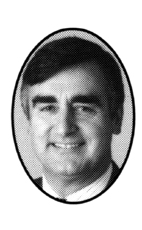
House of Commons photo

Crucial Fact

  • His favourite word was quebec.

Last in Parliament April 1997, as Bloc MP for Lac-Saint-Jean (Québec)

Won his last election, in 1993, with 76% of the vote.

Statements in the House

V-E Day May 8th, 1995

Mr. Speaker, exactly 50 years ago the war ended in Europe and the end of the world conflict, which came on August 15, 1945 with the surrender of Japan, seemed imminent.

Today we celebrate the triumph of freedom and democracy. But we also commemorate the sacrifices made by those to whom we owe this victory and this legacy of freedom and democracy.

The road to victory was a long and arduous one. From Italy to France, from Belgium to the Netherlands, tens of thousands of our soldiers gave their lives to liberate Europe from its oppressors.

Today we want to thank them, all those who served on the front, the sailors and airmen from every part of Canada, the merchant seamen, the nurses, all the men and women who risked or lost their lives in order to defeat tyranny.

We must never forget that more than a million of our fellow citizens enlisted in the Canadian forces during the second world war; 100,000 were wounded and more than 45,000 made the ultimate sacrifice.

Although far from the conflict, the whole of the American continent was profoundly touched by the war that had inflamed Europe. As thousands of young people left for the front, thousands of other citizens contributed to the war effort on the home front in the factories, on the farms and in the militia.

I would like to recall the particularly heroic role played by thousands of soldiers from Quebec who fought in the Netherlands, side by side with their fellow citizens from other Canadian provinces. There was the Régiment de Maisonneuve, the Fusiliers Mont-Royal, the Royal 22e Régiment and the Régiment de la Chaudière.

The extent of human loss and the horror of the suffering inflicted on nations during this endless war are beyond belief. The figures themselves which refer to thousands of dead are shocking but fall far short of expressing the grim facts. For instance, they do not reflect the horror of the concentration camps and the genocide of the Jews.

And at home, who can adequately describe the sorrow of mothers and fathers who lost a son in the flower of his youth? What can we say to widows and orphans, brothers and sisters, bereft of a loved one who went overseas and met a hero's fate on the battlefield? The most eloquent and authentic memorial to those who died is the silence that prevails among the little crosses that mark the grassy graves, row on row, in cemeteries spread over Northern France, Belgium and the Netherlands.

These people went into battle and these lives were sacrificed so there would be no more wars and so future generations would be spared this horror and suffering. Unfortunately, many bloody conflicts are raging throughout the world.

And now, consider those who have accepted the responsibility for maintaining peace in the world. I am thinking of the UN peacekeeping force and especially our Canadian soldiers now on peacekeeping missions. Every day they witness acts of atrocity against civilian populations.

The ceremonies being held today hold out some hope that the world will remember the horrors of the second world war and learn the lessons it teaches us.

Mr. Speaker, we must continue to thank those who died and those who survived this monstrous tragedy. Let us honour their memory.

Canada Social Transfer May 3rd, 1995

I am sure it comes as no surprise that we are not reassured. If the Prime Minister believes the provinces have nothing to fear from the new national standards, why then is he still refusing to call a federal-provincial conference to debate publicly, first, the distribution of the cuts to the transfer payments announced in the budget and, second, the new national standards he wants to put forward, particularly in health and social assistance?

Canada Social Transfer May 3rd, 1995

Mr. Speaker, in other words: "Trust my ministers; everything will be fine".

Canada Social Transfer May 3rd, 1995

A fine competition. Yesterday, the Minister of Finance told us that an upcoming amendment, not yet tabled, would provide for mutual agreement in establishing the criterion for the imposition of the standards. The expression is very vague. I would ask the Prime Minister to tell us what he means by mutual agreement. Does the government mean the necessary approval of all the provinces or, as with the patriation of the constitution in 1982, will a majority of the provinces suffice?

Canada Social Transfer May 3rd, 1995

Mr. Speaker, the head of the government is even more ambiguous than his Minister of Finance-no small feat.

Canada Social Transfer May 3rd, 1995

Mr. Speaker, in announcing yesterday the amendments to Bill-C-76, the Minister of Finance tried to play down the motion tabled by the official opposition denouncing the federal government's intention to impose new standards on the provinces for social programs. I would point out that, with this bill, Ottawa is limiting the provinces to assuming a mere advisory role in the process of defining the national standards.

My question is for the Prime Minister. Would he acknowledge that the most concrete way to show his government does not intend to impose new national standards on the provinces is by amending Bill C-76 so that these new standards are submitted to all the provinces for their approval?

Seagram May 2nd, 1995

Mr. Speaker, would the minister confirm that two of the guests of honour at his lunch on April 10, Mr. Wesserman and Mr. Sheinberg, the two top executives at MCA, were actually having lunch in the room next door with Edgar Bronfman senior and junior?

Seagram May 2nd, 1995

Indeed they have.

Will the minister admit that he went to Los Angeles at the invitation of Allan Karp, president of Cineplex Odeon which belongs to the Bronfman family and MCA and is a party to the transaction concluded the day he arrived in Los Angeles?

Seagram May 2nd, 1995

Mr. Speaker, I knew that Foreign Affairs was cutting down on spending by ministers abroad, but making them have lunch in cafeterias is going a bit too far.

Seagram May 2nd, 1995

Mr. Speaker, early in April, the Minister of Canadian Heritage made a discreet trip to Los Angeles, on the very day Seagram's took over MCA. He went to Los Angeles accompanied only by his executive assistant, without any senior officials and without any advance briefing by his department, which is customary prior to a minister's trip abroad.

My question is directed to the Minister of Canadian Heritage. How can he say he did not talk to the people at MCA and Seagram's in Los Angeles on April 10, when according to the Hollywood Reporter, he was MCA's guest of honour at a dinner the day after MCA was acquired by Seagram's?