
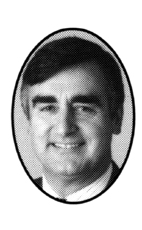
House of Commons photo

Crucial Fact

  • His favourite word was quebec.

Last in Parliament April 1997, as Bloc MP for Lac-Saint-Jean (Québec)

Won his last election, in 1993, with 76% of the vote.

Statements in the House

Foreign Affairs May 10th, 1994

Mr. Speaker, my question is directed to the Minister of Foreign Affairs.

Yesterday, after condemning the UN's decision to withdraw its peacekeepers from Rwanda, the minister said that in fact reinforcements should be sent to that country. However, on May 5, the Deputy Prime Minister, who disagreed with the minister, said that she refused to consider the feasibility of sending reinforcements and acting on the request made by the UN Secretary General.

In the case of Haiti, yesterday the minister seemed to support the U.S. proposal to send a UN force, although on May 4 in the House, the minister rejected out of hand the possibility of armed intervention.

My question is this: How does the minister explain this about-face by the government, this change of policy in its approach to the events in Rwanda and Haiti, and are we to understand that in the case of Rwanda, Canada not only supports the secretary general's request for additional peacekeepers but intends to participate personally?

Unemployment May 9th, 1994

Mr. Speaker, the Prime Minister would have us believe that economic indicators are positive. He claims it is a positive sign that people are returning to the job market, that they are regaining some confidence.

However, there are those who are able to work and cannot find a job. They are called the unemployed, and their numbers are increasing because of the policies of this government.

How can the Prime Minister, who says he is concerned, justify his government's decision to renege on its red book commitment to put forward a strategy for converting defence industries from military to civilian purposes when it is a known fact that this is the only strategy that would give dignity and hope back to people, as the Prime Minister said during the election campaign?

Unemployment May 9th, 1994

Mr. Speaker, there is nothing encouraging about this response in that it does not reflect any willingness on the government's part to change the situation. The government seems to find these statistics positive, whereas the fact of the matter is-and these are not merely statistics but the reality of the situation-that if we compare the unemployment rate in November when this government came to power with the rate today, we see that there are 15,000 more people out of work.

On the other hand, the government's only initiative, the infrastructure program, is clearly inadequate in terms of creating lasting jobs. Instead of taking it out on the unemployed, is the Prime Minister prepared to commit this time to implementing a real job creation strategy for the high-tech sector based on concrete initiatives?

Unemployment May 9th, 1994

Mr. Speaker, my question is for the Prime Minister. Last Friday, Statistics Canada reported that the national unemployment rate rose to 11 per cent in April, while the rate in Quebec increased from 11.7 per cent to 12.6 per cent. According to this latest report, 65,000 more people have joined the ranks of the unemployed. These figures which are, to say the least, disconcerting, contradict the optimistic news that we have been hearing from the Prime Minister for the past month about lower unemployment and job creation.

Will the Prime Minister acknowledge that six months into his mandate, the unemployment rate continues to increase and his government has reneged on its promises, given that 65,000 more people have joined the 1.5 million who are already out of work?

Rwanda May 5th, 1994

Mr. Speaker, while we are making speeches, while we are speaking and expressing our feelings, hundreds of thousands of people are being killed in that country, a country that is very close to Canada because of our international policies and aid programs. We have had a presence in that country for close to 100 years. What are we doing to prevent this slaughter? Some rivers are now jammed with the bodies of the people killed. We must go beyond words.

I ask the government whether the presence of an intervention force would prompt the rebels and the Rwandan army to negotiate a ceasefire that would end these barbarous events which require our intervention.

Rwanda May 5th, 1994

Mr. Speaker, beyond concern and disappointment, I think that Quebecers and Canadians expect the government to indicate clearly what it intends to do, especially with regard to a very specific proposal from the UN Secretary General himself.

So what is Canada's position on this request: is it yes or no? In particular, I would ask the Deputy Prime Minister whether she admits that, without a UN intervention force, it is totally impossible to set up any medical or humanitarian operation that Rwandans so urgently need.

Rwanda May 5th, 1994

Mr. Speaker, my question is for the Deputy Prime Minister.

Violent fighting continues between the Rwandan army and the rebels. This massacre which has already killed at least 200,000 people must stop. However, the UN assistance mission to Rwanda, now reduced to some 449 soldiers, is completely overwhelmed. Faced with his humanitarian responsibilities, the UN Secretary General has asked the Security Council to send peacekeeping reinforcements to Rwanda.

Can the Deputy Prime Minister tell us whether Canada intends to support the request of the UN Secretary General and make a direct contribution to the reinforcements requested by Mr. Boutros Boutros-Ghali?

Restoration Of Democracy In Haiti May 4th, 1994

Mr. Speaker, according to the dispatch I read, President Clinton went further than what the minister said. He did not simply say that he was not ruling out any option, he specifically said that he was not ruling out the option of armed intervention, which is an important distinction when a U.S. president makes statements on such vital issues.

I therefore ask the Minister of Foreign Affairs whether he can tell us today if his government received assurances that the proposed reinforcement of trade sanctions will not lead to an increase in black-market activities controlled by the military junta and the Haitian police.

Restoration Of Democracy In Haiti May 4th, 1994

Mr. Speaker, we know that the Canadian policy is to suggest and try to convince the allies to impose a tougher military embargo. So far, however, the American president had not clearly stated his position, in particular on increasing the pressure he wants to exert on Haiti, since he is now hinting at armed intervention.

I ask the minister whether the Canadian government endorses the idea of armed intervention as proposed by President Clinton in case the Haitian military rulers refuse to comply with the proposed ultimatum.

Restoration Of Democracy In Haiti May 4th, 1994

Mr. Speaker, my question is for the Prime Minister. This week, the UN is to consider a draft resolution proposed by the U.S. to issue a 15-day ultimatum to the Haitian military junta and reinforce the trade embargo. At the same time, President Clinton took a tougher stand by clearly evoking the possibility of armed intervention to depose the military rulers he rightly accuses of killing innocent civilians.

My question is for the Minister of Foreign Affairs, who has just arrived. Can the minister give an update on the negotiations at the UN concerning the ultimatum proposed by the American president and can he indicate whether Canada supports this proposal?