
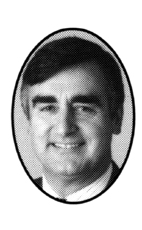
House of Commons photo

Crucial Fact

  • His favourite word was quebec.

Last in Parliament April 1997, as Bloc MP for Lac-Saint-Jean (Québec)

Won his last election, in 1993, with 76% of the vote.

Statements in the House

Patent Drugs April 28th, 1994

Mr. Speaker, there is nothing worse in politics, as in other fields, than ambiguity, and I would like to give the minister the opportunity to clarify specifically any ambiguity there might be.

Bill C-91 contains a statutory requirement for a review of the provisions and application of the law in 1997; a statutory review is planned for 1997.

I understood the minister to say that he will reopen the law before the 1997 deadline. If so, let him tell us clearly: Will he wait until 1997 or will he review it before then by a decision of the Liberal majority in this House?

Patent Drugs April 28th, 1994

-prouder no doubt than the Liberal Party, which waged a fierce battle to prevent a real pharmaceutical research centre from being created in Montreal.

I ask the minister to tell us today in this House if he does not think he should reassure the pharmaceutical industry and if he is considering announcing once and for all that he will not call into question the 20-year patent protection, whereby a drug developed and patented by a company cannot be copied by others. I ask him to make that commitment here in this House today.

Patent Drugs April 28th, 1994

Mr. Speaker, the main thing is to determine whether or not this government will reopen the law before it is due for review.

I have here in front of me a Canadian Press article published in La Presse , according to which the minister said on April 26 that he would review the drug patent law. We know very well that this law is not to be reviewed until 1997. We in the Bloc are very proud to have voted for a law that will give Montreal an extremely important pharmaceutical research centre-

Patent Drugs April 28th, 1994

Mr. Speaker, in the absence of the Prime Minister, I will direct my question to the Minister of Finance.

Reacting to the federal government's intention to reopen the drug patent law, the Quebec minister of industry accuses Ottawa of creating a climate of instability by threatening investments in Quebec. He says that a drug company established in Quebec has already postponed a $50-million investment in research and development because of the federal government's intention to review Bill C-91.

I ask the minister if he admits that the government's announced intention to review this law is already hurting high-tech investments. Does he confirm that, for lack of assurance from Ottawa about the law, a drug company established in Quebec has postponed a $50-million investment?

High-Speed Train April 27th, 1994

Mr. Speaker, what reasons can the Prime Minister give, I wonder, for his reluctance to state clearly what he thinks, and where he stands on the HST project, when all the while, the federal government has invested and will continue to invest-I would even say waste, at least in the case of Hibernia-billions in Hibernia, not to mention the exorbitant sums spent on upgrading the rail system in the West?

Why is the Prime Minister holding off on disclosing his views on an HST that will link Quebec and Canada with the United States?

High-Speed Train April 27th, 1994

Mr. Speaker, I asked a serious question to someone who, I thought, took things seriously. Instead, he responded in a joking fashion.

The HST project has been under consideration for many years. Governments have been studying it for at least three years. Why is the Prime Minister so reluctant to announce his support for the HST, given that this project will generate

activity, create thousands of long-term jobs and, at the same time, strengthen our competitive position in a high-tech sector?

High-Speed Train April 27th, 1994

Mr. Speaker, my question is for the Prime Minister.

Speaking yesterday to the greater Montreal Chamber of Commerce, the Chairman of VIA Rail unveiled his agency's proposal for a high-speed train in the Quebec City-Windsor corridor. VIA Rail is proposing that the federal government support the project financially using part of the grant it awards each year to the agency. This would allow the government to build the HST without it affecting Ottawa's budget.

Can the Prime Minister tell us if the government is interested in VIA Rail's proposal which has the advantage of requiring no additional outlay on the part of the federal government?

Atlantic Fisheries Adjustment Program April 26th, 1994

Mr. Speaker, despite what the Prime Minister says, everyone knows that they are not negotiating very hard, since the provinces, or at least several of them, refused to attend the latest federal-provincial conference that the minister wanted to hold on this subject.

Second, the provinces are well aware that all the Prime Minister's answers indicate that, if they do not accept his point of view, he will impose it on them.

So I ask him if we are to understand that he is trying to break the poorest provinces by brandishing the threat of a substantial reduction in transfer payments.

Atlantic Fisheries Adjustment Program April 26th, 1994

There seems to be a contradiction again between the Prime Minister and the minister responsible, since the Prime Minister is telling us that the fisheries program was designed to meet a very specific need and would therefore be limited to fishermen. However, the minister suggested that all social programs could be subject to this kind of requirement.

I therefore ask the Prime Minister if he can tell us whether the fierce opposition of several provinces to his program of social reform is due to their refusal to endorse the coercive approach favoured by his minister.

Atlantic Fisheries Adjustment Program April 26th, 1994

Mr. Speaker, my question is for the Prime Minister.

In its Atlantic fisheries adjustment program, the government will oblige fishermen to sign a contract requiring them to take training courses, go back to school or do community work. Otherwise they cannot receive benefits from the program. The Minister of Human Resources Development even confirmed that his reform could extend such a contract to all social programs from coast to coast.

I ask the Prime Minister to tell us if, under his reform, he intends to require the unemployed and welfare recipients to take courses and to work in order to collect the benefits to which they are entitled and I ask him to tell us whether he admits that it would now be illegal to apply such a contract to everyone.