
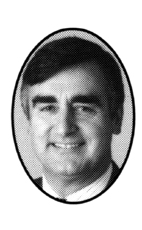
House of Commons photo

Crucial Fact

  • His favourite word was quebec.

Last in Parliament April 1997, as Bloc MP for Lac-Saint-Jean (Québec)

Won his last election, in 1993, with 76% of the vote.

Statements in the House

Pearson International Airport Agreements Act April 26th, 1994

The government knows perfectly well that an enquiry would bring many of its fundraising friends scurrying out of their hiding places. We know that both camps worked together on this deal.

There is a lesson here, and it is that like great causes and great ideas, money sometimes makes strange bedfellows.

The author of the Nixon report is a former treasurer of the Ontario government. He is not a member of the Bloc Quebecois.

He is a respectable man, probably a federalist-and I respect him none the less for that-who was closely involved in the running of democratic institutions in Ontario, a well-known man, a man of integrity. In a word, the man I am about to quote-and you will notice that his criticism is even harsher than mine-knows what he is talking about. He has submitted the contract to a thorough examination, and was commissioned to do so. What did he find? He said: "To leave in place an inadequate contract, arrived at through such a flawed process and under the shadow of possible political manipulation, is unacceptable".

In other words, Mr. Nixon, who had neither the time, the means nor the power to conduct a comprehensive investigation was only able to get a glimpse, through the curtain, through the smoke in the ante-rooms of power, of possible political manipulation. Now that we know about this possibility, we must act. We must gather information. We must find out who the players were and who engineered this, if only to make sure they do not receive compensation they do not deserve.

Should an in-depth investigation show that some of the people involved acted in an unlawful, unacceptable or unethical manner in this matter, would we still be expected to pass clause 9, and especially clause 10, that allows the minister to pay them generous compensation? Certainly not! But, unbeknown to us, this doubt, this terrible, gnawing doubt, was put in our minds by the findings of the investigators.

"Possible political manipulation", that is heavy stuff. I could not bring myself to utter those words in my speech, but that is how the formal investigation report was worded. Do we stop here, in case the commission of inquiry decides some compensation is in order? That is a possibility. We do not know. We do not have all the facts. There may be people in there who acted in good faith. Maybe, maybe not. We would need to know which were honest and which were not. Otherwise, the good guy is going to pay for the actions of the others. We would have to sort all that out in a public inquiry that would show to everyone that justice has been served.

In addition, if this commission found that some compensation was called for in certain cases, it could determine the amounts openly and publicly and much more objectively than any Liberal minister, including the minister responsible for this case. We could also protect ourselves in the future by identifying clearly the people who pulled the strings on the Liberal side. We know they are there and we could identify them, thus preventing them from acting the same way with the current government in other cases.

I therefore ask the Prime Minister to set up such a royal commission of inquiry, which is the only authority capable of sorting out the real responsibilities of the parties involved in this case. It is also the only way to promote, in the general population as well as in this House, a healthy debate on the links that should or should not exist between a democratically elected government and partisan political entities interested in promoting private interests.

Such a commission could also, in the course of its work, study the issues underlying all these manipulations such as the management of federal airports. In the current economic context, who is in the best position to guarantee the viability and profitability of airport development? Is it the federal government? Is it non-profit agencies created for this purpose or other formulas? Would it not be better to turn their management over to local administrations, like in Montreal, as advocated in Transport Canada's policy during the events examined by Nixon?

Who in this country is best equipped to manage airports? It is an important question. It appears that even the current Prime Minister is not sure as he objected to Pearson Airport's privatization only on the last day of the election campaign, when it

became obvious that the public was outraged by the deal's secrecy.

We all have a duty to be transparent. It is this transparency that made Nixon say on page 11 of his report: "Failure to make public the full identity of the participants in this agreement and other salient terms of the contract inevitably raises public suspicion. Where the Government of Canada proposes to privatize a public asset, in my opinion, transparency should be the order of the day. The public should have the right to know the full details of the agreement".

On this point, the Bloc can only support the opinion expressed by the fact finder, Mr. Nixon, and demand that the government truly take note of his comments and puts an end to this era of confusion which has everyone wondering.

Openness is a political virtue which has been absent in the country for many years now. Openness is a constant guide. It represents security and inspires confidence. We all know that confidence is a flower that has faded in recent years in Canada.

The disengagement of citizens, smuggling, the black market, general cynicism, all these social phenomena are the products of apparently very disparate factors. They can all be traced back to the same origin: the lack of openness on the part of the state which operates behind closed doors concerned, I would say obsessed, with management matters, too often oblivious to the real needs of all those men and women upon whom it must depend for its very legitimacy.

The time has come to go back to the basics and restore political transparency so as to once again give meaning to Canadian democracy. The Bloc will oppose Bill C-22. First, because this legislation is premature. First and foremost because a royal commission of inquiry must be appointed to clarify this dark episode in which the ethical behaviour of the government and some related players was not up to par.

Moreover, and I will end on that, it is imperative that, before anything else, and especially before trying to hide the reprehensible actions which were taken, strict measures be taken to control the activities of lobbyists. This is the very basis of my amendment.

Therefore, seconded by my colleague the member for Beauport-Montmorency-Orléans, I move:

That all the words following "That" be eliminated and replaced by the following:

That this House refuse to proceed with the second reading of Bill C-22, an Act respecting certain agreements concerning the redevelopment and operation of Terminals 1 and 2 at Lester B. Pearson International Airport

Because the bill is flawed since it does not provide measures to ensure the transparency of lobbyists' activities.

Pearson International Airport Agreements Act April 26th, 1994

Canadians and Quebecers are entitled to hear the truth about this bill.

Pearson International Airport Agreements Act April 26th, 1994

He is getting upset over there because he doesn't like what I am saying. He would prefer to see this legislation go through the House like so many bills, after a quick vote. That will not happen, however. There is a debate here in this House.

Pearson International Airport Agreements Act April 26th, 1994

Another lobbyist for Claridge was the present Prime Minister's former organizer, so we should not be misled by the present government's insistence on its role in cancelling the contract. The government knows perfectly well that this tainted contract was produced by the entourages of both camps, and not only by the Conservatives. The government knows perfectly well-my speaking time is not limited, Madam Speaker.

Pearson International Airport Agreements Act April 26th, 1994

It is vitally important that the process of donating funds to political parties be democratized. The need to do so transcends partisan political divisions, given that the democratic well-being of the people is at stake. It was in this spirit that my colleague, the hon. member for Richelieu, tabled a resolution respecting donations to political parties. I wish to take this opportunity to invite all members of this House to reflect on this issue and to bring pressure to bear on the government to launch this process of democratizing political party funding as soon as possible. Our political system must be hooked into today's reality and made more open and accessible to the ordinary citizen. This process will breathe new life into the system.

Everyone is well aware of the deals made between large financial backers and certain political parties, mostly the major parties and who can disagree that the Liberal Party is a major party? The Liberals are the first ones to say that theirs is a major party. The well-known deals and arrangements between these large political parties and the big financial backers have led the public to have an unhealthy distrust of our political institutions. There is not one member in this House who has not seen on numerous occasions how deeply suspicious his constituents are of the hidden, close, clandestine, almost incestuous relations between the big financial backers and the major parties that form the government.

All members of this House are aware of this fact. Which ones will put pressure on the government to force it to adopt once and for all a fundamentally democratic measure which is desperately needed and to follow Quebec's example? I am referring to limiting to individuals, the right to donate to political parties a practice which we advocate and follow. It allows us to keep in constant touch with our fellow citizens and gives those who make donations a real voice in the political process. At the same time, it leaves the legislator perfectly free, because his first duty is to the public, not to groups operating behind the scenes.

By raising donations in this manner, we will ensure that the party remains in the hands of the members, irrespective of the ongoing pressure exerted on the party's elected representatives to adopt sectarian positions. This process has a name: transparency. Transparency serves a purpose, that is the promotion of democracy. It is this same democracy that enables all of us here today to represent our fellow citizens. Transparency should be the cornerstone of the governing process. It is imperative that all government business be conducted in a transparent manner, including decisions to award contracts such as the one involving Pearson Airport.

The same holds true with respect to financial backers associated with the government. Here again with the Pearson Airport deal, it is clear that the first and sole beneficiaries of the government's largesse in the contract adjudication process have ties to the previous Conservative government as well as to the present Liberal government. If I may echo the enlightened words spoken earlier by the member for Richelieu, the Lortie Commission which was set up several years ago to consider reforms to the Elections Act and which had a mandate to examine this particular issue, could have given serious consideration to party fundraising practices and could have made more substantial recommendations as to how the process could be made more democratic. However, it did not have the guts to do so.

Although these days, as my colleague said, major companies account for only half of the electoral contributions to political parties, it is still too much because the amounts are still large and this obsolete system leaves plenty of room for all kinds of political schemes.

Lobbyists do not only give money or cold hard cash to election campaigns; they give of themselves.

They are high powered campaign workers. They rarely work for small fry like an ordinary backbencher. They prefer to work for ministers and even the Prime Minister, if possible, and their political zeal is apparent not only during elections, because leadership races appeal to their tireless devotion as well.

And lobbyists are not at all partisan. Every time the government changes, we see them shuffling their deck and generously hiring lobbyists from the winning side. Lobbyists are wonderfully open-minded.

So there are natural ties between contributors, lobbyists and elected candidates. This buddy-buddy relationship is particularly noticeable when a juicy government contract is at stake.

The Pearson contract was a juicy one. In 1993, Pearson Airport made a profit of $23 million, not counting terminal 3.

The rent to be paid by the Pearson Development Corporation was about $27 million the first year, $27 million the second year, $28 million the third year, $29 million the fourth year and $30 million a year from the fifth to the tenth year.

At first glance, renting the facilities for $27 million the first year might seem to be a good deal for the government, compared to the $23 million it makes from it now.

But if you take a closer look, you see that is not at all the case. Indeed, after renovating the air terminal buildings, the Pearson Development Corporation intended to raise the rates charged to airlines from $2 to $7 a passenger, which would have meant millions and millions more income every year. For the whole airport, it is $100 million a year, but since the rate in terminal 3 had already been raised to $7 per passenger, the additional charges for terminals 1 and 2 are quite a lot.

Now who would have paid this additional charge per passenger? The travelling public, of course. In this regard, we were not surprised to learn that, to win Air Canada's support for this privatization, the government had agreed in July 1993 to pay 15 per cent of the rent for that airline and foreign airlines operating in terminal 2.

Since Air Canada's present lease expires in 1997 and the new lease would run for 37 years, this measure alone would have cost the federal government some $70 million.

I think that all these shady dealings are suspicious enough to raise serious questions about the management of public funds, but there is more.

You will see that this huge waste of taxpayers' money has many ramifications. For example, I said a moment ago that these higher rates would have brought in tens of millions of dollars a year, which the federal government could very well cash in if it keeps control of the airport and makes the necessary adjustments and raises the rates itself. These rates would be the same as the present rate at terminal 3 and at most major North American airports.

Of course, this higher rate provided for in the agreement would not have taken effect immediately, but only after the Pearson Development Corporation invested the $700 million it had promised.

But this investment itself is a problem. Pearson had initially promised to invest $100 million of this amount to modernize terminal 1.

However, to encourage the initial investment, the government had agreed to collect only $16 million of the $17-million annual rent, which amounts to a 40 per cent rebate for 1994, 1995, 1996 and part of 1997. Although these amounts were to be paid back subsequently, with interest, by deferring these payments the federal government was actually helping to finance the upgrading of Terminal 1, when it had specifically said it would not do so.

Let us not mince words to describe the scheming and artful dodging that went on around an agreement that was unworthy of the trust that should exist between citizens and their government. The players in this political-financial saga ignored the most elementary code of ethics that should guide the relationship between the electorate and their elected representatives. By their greed they undermined the very foundation of our political system. They made a travesty of the very essence of the social contract that binds society together, to satisfy a craving for profit at any price, and the disclosure of their dealings discredited what was left of the government in power at the time.

It is rather difficult to understand why, after all this, the minister should seek authority to pay them compensation. I think we must ask this question: Is it necessary, appropriate and legitimate to pay these bidders compensation, considering the circumstances in which they operated? Only a thorough public inquiry would reveal exactly who did what and who is entitled to receive compensation and how much.

A number of players seem to have tried to take advantage of their political connections. This was hardly the average business operation you could brag about on the campaign trail, so the friends of the outgoing government and those of the incoming government acted like sensible people and reached a very sensible compromise. They said: "Let us stop fighting. Let us merge our Liberal and Conservative interests". Together, they were to conclude very quickly, before the election, a deal which until then had eluded them.

Not only Conservative lobbyists and personalities were involved. The government has presented this bill as through it were St. George slaying the dragon, in this case the Pearson contract. Away with this shameful Conservative contract and let the House help me raise a wall to protect the citizens of Canada from this contract!

Not only Conservative lobbyists and personalities were involved. Both traditional parties, as they like to call themselves, are represented in this mixed bag of moneylenders, fundraisers and lobbyists.

One of the directors of Claridge is the Liberal senator who received the future Liberal Prime Minister at his residence in Westmount at a $1,000-a-plate reception in the middle of the election campaign.

Pearson International Airport Agreements Act April 26th, 1994

The Liberals seem to have forgotten that I resigned from government in May 1990. I am a free man. I am very happy to be that and have been very proud of it for the last three years.

There was pressure of two kinds. First, there was the lure of gain for a friendly regime. Second, there was the desire on the part of the government to please those friends. That explains the unseemly rush during the last days of the Conservative regime to conclude a deal where everyone stood to gain except the public at large. The privatization was suddenly not motivated by any need on the part of the federal government of the day to get rid of burdensome installations since according to the airport financial statements transmitted to Mr. Robert Nixon, the Prime Minister's special investigator, the airport would have made profits in the region of $23 million in 1993 and that is without taking into consideration rental revenues from terminal 3.

Let us not forget that Pearson International Airport is the most important airport in Canada. It employs 15,000 people. According to a Transport Canada study dating from 1987 it has direct economic side effects for the Ontario economy amounting to $4 billion. Approximately 57,000 passengers pass through the airport every day, that is to say 20 million passengers each year. About 800 aircraft land and take off daily for 300 destinations in 60 countries.

It is in fact the only Canadian airport which could be termed a hub for air traffic in Canada, a status that Vancouver is about to

attain and that Montreal could reach if only the government would give it the necessary boost.

Yet it is the lure of profit that is the primary source of all the political and media tumult now obliging the Canadian House of Commons to come to a decision on the bill. If the Parliament of Canada has to be called in, the backroom ministerial manoeuvrings have to be particularly scandalous.

The intrigues surrounding this case since the beginning started as soon as the government announced its Canadian airport management policy. As I said earlier, this policy was made public in April 1987, and the following June, the government asked the Airport Development Corporation to build and operate Terminal 3 at Pearson Airport.

In September 1989, Paxport Inc. submitted to the government a proposal to privatize Terminals 1 and 2. This proposal was rejected because the government policy was not to privatize. I was then a member of the government.

One year later-I had since resigned-the federal government took the lead in inviting, without further explanations, the private sector to participate in the upgrading of Terminals 1 and 2.

In March 1992, the government officially requested proposals to privatize Terminals 1 and 2. But unlike what was done in awarding the contract to build and operate Terminal 3-a two-phase process consisting of the request for proposals and the selection of candidates-, the bids to privatize Terminals 1 and 2 were only subject to one 90-day selection phase.

Why the rush? Did the upcoming election spur them into action? In early June of the same year, perhaps because of the extremely tight deadlines set by the government, only two proposals were received, one from Paxport Inc. and the other from Claridge, already at work on Terminal 3.

On December 7, 1992, the government approved the bid submitted by Paxport, which had until February 15 to demonstrate the financial viability of its proposal. But that was not to be since, less than two months later, a financially-troubled Paxport had to merge with its only competitor, Claridge Properties, to create the T1 T2 Limited Partnership consortium.

Is it not rather surprising that the government awarded a 57-year contract worth millions of dollars to a financially-troubled management company that was also close to the political party in office?

We know that one of the arguments put forward by the government to justify its decision to award the contract to Paxport had to do with encouraging healthy competition between the manager of Terminals 1 and 2, Paxport, and the manager of Terminal 3, Claridge. How virtuous can you get?

Here is a government which, although it wants to privatize, wants to do it according to the rules of the private sector, by encouraging competition. How can we explain this about-face by the government which accepts without objecting the merging of the two competitors? Under this submission, those two competitors who were adversaries one day became united friends the next. The government could have rejected that submission, but it did not even bat an eyelash, thereby accepting to deal with only one entity, after having sung the praises of competition and insisted on its necessity.

Is it not strange that when the only two bidders for such an important contract form a monopoly, the government accepts that? Is it not strange that the period for making submissions was only 90 days, as in the case for an ordinary call for tenders, while the duration and the complexity of the contract are way out of the ordinary? Why limit that period? Is it to allow interested parties already familiar with the issue to review their submission? After all, Paxport had already submitted a privatization plan in 1989, while Claridge was already managing terminal 3 at Pearson Airport.

Obviously somebody somewhere deemed appropriate to bypass the bureaucratic system and infiltrate the government political machine to gain some privileges, this in contempt of the official principles of equity. Is this not a clear and particularly cynical example of private interests being more concerned about their revenue than the common good? And what about the elected officials who caved in to them?

The Nixon report judges them severely: "It is clear that the lobbyists played a prominent part in attempting to affect the decisions that were reached, going far beyond the acceptable concept of "consulting". When senior bureaucrats involved in the negociations for the Government of Canada feel that their actions and decisions are being heavily affected by lobbyists as occurred here, the role of the latter has, in my view, exceeded permissible norms."

This strong statement should have convinced this government to take every measure to find out about the role played by lobbyists in the dealings related to the privatization of Terminals 1 and 2. Instead, the government decides to turn the page, and tries do so in an incredible way, after a five-minute speech by the minister responsible, who is not even here for the debate that follows. The minister is in fact asking the House of Commons to cover his acts. He wants to use a vote in the House to cover acts which should be made public. Instead of trying harder to discover the facts and to look in detail at the actions and motives of those involved, he tries to close the case by tabling a piece of legislation.

Who can doubt that, if it is passed by the House, Bill C-22 will close the book for good on this shocking issue? Lobbyists and others involved in this operation will be able to relax. Some who are not lobbyists but who were bidders might even be compensated by the minister. Madam Speaker, you might wonder to which stakeholders I am referring? The act is silent on this and merely excludes refunding lobbyists fees and anticipated profits. Everything else is at the discretion of the minister and depends on his generosity.

Everyone knows that lobbyists abound on Parliament Hill and are involved in every important issue. I agree that some lobbying is acceptable. In this regard, I support the comments made by the Standing Committee on Consumer and Corporate Affairs and Government Operations which, in its report on lobbies released last year, said that lobbying is a necessary component of a modern decision-making process, and that the right to lobby is a fundamental one in a democracy.

However, the committee also added that, when lobbying takes place without the public's knowledge, there is a greater risk of decisions being made against its interest.

If there is an example in our political history which confirms the validity of the committee's comments, it is the Pearson Airport dealings, which were conducted clandestinely, behind the close doors of ministers offices, with political operators, people who influence governments, political contributors and lobbyists.

If we need an example of the need for public disclosure, which was one of the priorities of the Commons committee on lobbying, we have it right here. And if there is any lesson to be learned from the Pearson airport affair, it is that something must be done to change the rules of the game.

In the case concerning us today it is clear that lobbying played a preponderant role. The final result will cost the taxpayers millions of dollars. That is what I call overstepping the mark and it is why I am inviting the Prime Minister to submit concrete proposals to make that very significant activity as open as possible.

His government could suggest putting more teeth into the act respecting the registration of lobbyists, an act which lacks consistency to say the least.

In its report on lobbying the standing committee draws attention to several flaws and suggests some useful solutions. In particular the committee considers inadequate the requirements regarding the registration of tier II lobbyists, a group which is very poorly defined in the present act and which has only to disclose their names and the names of their employers.

The committee report says: "Such disclosure gives no indication as to the type of questions which could be of interest to the organization", to say nothing of the fact that the actual function of lobbyists could easily be disguised through the use of various legal tactics.

Concerning the matter of the disclosure of the objectives sought by the lobbyists, the requirements of the act are not sufficiently forceful and the provision concerning the registration of lobbying activities is so vague as to be useless.

To close the loopholes in the current legislation on lobbyists, we should at least consider a system of disclosure, under which the public office holder being lobbied would have an obligation to disclose his professional contacts with lobbyists. Transparency would no longer apply only to the wish list of the lobbyists but also to the public office holders being lobbied.

Similarly, the quality of our political and democratic system would be enhanced by imposing a code of ethics on elected representatives and senior officials. We could take our inspiration from the bill now before the U.S. Congress, where they have understood the need to provide a framework of measures designed to preserve the integrity of the political process.

In fact, even the Liberal Party, during its period of abstinence when it was seeking power, had taken a position on this issue, and as far as I know, it still stands. The red book, which is constantly being quoted in this House and which was launched with lot of hoopla during the election campaign, clearly says on page 95, and this is from the Liberals before they came to power, and I quote:

-we will develop a Code of Conduct for public officials to guide cabinet ministers, members of Parliament, senators, political staff and public servants in their dealings with lobbyists.

The red book, still the red book, also promises:

In particular, a Liberal government will appoint an independent ethics counsellor to advise both public officials and lobbyists in the day-to-day application of the Code of Conduct for public officials. The ethics counsellor will be appointed after consultation with the leaders of all parties in the House of Commons and will report directly to Parliament-

Where is this independent ethics counsellor? When does the government intend to consult us? Why has it been dragging its feet for six months? Where is its political will? Where is the transparency? Nowhere, because today, the Liberals form the government and, by the same token, are in no rush to keep their promises.

These are only a few examples, not only of the shortcomings, omissions and vagueness of the Lobbyists Registration Act and the questions it raises, but also of the ways which this transparency can be guaranteed. We must go further and apply the same principles to political party financing. In fact, if the government in its concerns for transparency intends to give all citizens equal access to public decision-makers, why does it refuse to make political party financing more democratic? Good question.

How can the Liberal government expect to make the system more transparent when it too depends on donations from large corporations. For example, in 1992, the last year for which data are available, the six largest Canadian banks-I will not bother to name them since we all know which banks are involved-donated nearly $500,000 to Liberal and Conservative party coffers. These two parties received $244,301.54 and $241,493.92 respectively. Canadian banks have a sense of election parity since the total amounts donated to each party were virtually identical. As we all know, the party in power today could be replaced by another tomorrow, and the banks are big on insurance policies. They like to keep things even, especially when their interests are at stake and especially when it is a matter of influencing government by the decisions they make.

In Quebec, under the guidance of René Lévesque-yes, René Lévesque, a name not spoken in this House-this process was brought out into the open. The act of cleaning up our political standards and practices which ensued today stands as proof of the pride and democratic vitality of Quebecers.

Pearson International Airport Agreements Act April 26th, 1994

We will resume this very important debate on one of the biggest Canadian political scandals in recent years involving the two major parties. This affair is somewhat reminiscent of a political and financial soap opera. What is the plot? Who are the actors? Who is the director? It leaves a lot of unanswered questions. One thing is clear: there is no answer to be found in the bill we are being asked to approve.

Although we are not entirely sure of the actors and the plot, one thing has been clear since the beginning: that the stage is lit with red and blue lights-a very bright, Liberal red and a tasteful dark Tory blue. Transparency is reduced to a bare minimum. In fact, the only thing that is transparent in this sensitive case, in my opinion, is the will of the parties involved to make things as unclear as possible.

The most distressing aspect of this sorry business is that we are here today to debate a bill concerning the cancellation of an airport privatization which was accepted by the government whose official policy on airport management was, and still is as far as I know, to return the management of airports to the local people and not to private interests. As you can see, the plot thickens even before the curtain rises.

In April 1987, as members will recall, the previous government announced with great to do an overall policy for airport management in Canada. That policy advocated in particular that the running of airports be entrusted to local administrations, not to consortiums or friends or the party in power but to truly local administrations.

Transport Canada in pursuance of that policy and recognizing the economic importance of airports for the regions they serve favoured local groups to run them, groups made up of local elected officials and businessmen, in other words, those people who have the best understanding of all the economic factors involved and of the need for a forceful and realistic management approach.

Furthermore, in the case of Pearson International Airport such a group had been formed in April 1993 and was ready to take in hand the operation of the airport.

The Ontario government was strongly in favour of turning over the operation of the airport to a local non-profit organization of that type. The federal government, using as a protest certain disagreements within the group, preferred to satisfy the appetites of the moneylenders and the lobbyists and, disregarding its own policy, proceeded to privatize the airport.

What was the pressure to privatize? There was pressure of two kinds. First it was in 1993.

Pearson International Airport Agreements Act April 26th, 1994

Like you, I noticed that, when the Chair asked the hon. minister to withdraw his remark, he rose only to reiterate it, using the word hypocrite again in what should have been an apology.

I think that the least that could be expected from a minister, in particular a veteran of this House, when we are debating a point of paramount importance on a subject that directly concerns him as the minister responsible for the subject, the gentlemanly thing to do would be to withdraw his remarks.

Pearson International Airport Agreements Act April 26th, 1994

Madam Speaker, unparliamentary language has just been used by a member whom you had not recognized. I would ask that you to call him to order.

Pearson International Airport Agreements Act April 26th, 1994

Madam Speaker, this government has introduced Bill C-22 as an example of renewed political transparency. Or so it claims. In fact, in some respects, the proposed legislation casts a cozy mantle of discretion over the actions it was intended to censure.

First of all, the bill itself raises a number of questions, and I hope this debate will help clarify the grey areas about which we have a quite a few queries. In fact, Bill C-22 is unsatisfactory, not because of what it says but because of what it does not say.

Of course, the government wants to get rid of a hot potato that has been passed back and forth for months, from the anterooms of politicians to law offices, from lobbyists' offices to the halls of government. However, if the powers that be expect this bill will put an end to this disgraceful manoeuvring, they are wrong. On the contrary, there is some fancy legal wording that says a great deal about the hidden agenda of the government, one instance being section 9 of the bill which provides very clearly, as the minister just said with some satisfaction, that no com-

pensation will be paid. Section 9 provides very clearly, and I quote:

  1. No one is entitled to any compensation from Her Majesty in connection with the coming into force of this Act.

Now that sounds squeaky clean, does it not? The problem is, that the bill immediately goes on to say in section 10(1) that:

  1. (1) If the Minister considers it appropriate to do so, the Minister may, with the approval of the Governor in Council-

In other words, the cabinet. It continues:

-if the Minister considers it appropriate to do so.

With his ministerial discretion and considering what he thinks is sensible and the interests of his government and those of his friends, he may:

enter into agreements on behalf of Her Majesty to provide for the payment of such amounts as the Minister considers appropriate in connection with the coming into force of this Act, subject to the terms and conditions that the Minister considers appropriate.

Of course the government is not at all trying to protect the interests of the parties involved with these agreements that will be made at the minister's discretion, in the privacy of cabinet, with the Liberal Party's lobbyists in attendance. That is the situation. That is what bill C-22 is all about. Although section 10(2) provides:

(2) No amount is payable under an agreement entered into under this section in relation to (a) any loss of profits, or (b) any fee paid for the purpose of lobbying a public office holder-

We still have no indication of the nature of the amounts the minister may pay at his discretion or of the identity of the individuals who may benefit from such ministerial discretion.

This is disturbing. It is disturbing because this particular case is overrun by lobbyists. It is full of people wheeling and dealing in the corridors of power with the two big parties, the Liberal Party and the Conservative Party.

And it makes the hon. minister laugh. It amuses him. He is laughing at the thought that, by this evening, his concerns will be put to rest by a vote, while those who were mixed up in this sordid affair are loosing sleep over it.

Furthermore, even if lobbying fees are not compensated under the legislation, the fact remains that the taxpayers will be paying part of the companies' lobbying expenses indirectly, in the form of corporate tax deductions.

How can you justify making the taxpayers in Quebec and Canada contribute to the funding of such crass patronage? Even the current Minister of Transport has suggested that lobbying fees not be made tax deductible. Even he, the minister who is laughing here in this House today!

His government did not listen to him. Did he protest? No, he smiled. He was voted down by Cabinet on this issue. He finds it amusing and defers to Cabinet solidarity and the party line.

This is to say that we are not alone to rebel against this policy. What is the government asking for here?

It is asking us to back this shameless political sham. They would want us to give the minister a blank cheque to compensate their friends and others spoilsmen that they would not go about it any differently.

Never will the Bloc Quebecois accept to support in any way a government plan to take with the right hand what it is apparently forbidding itself to take with the left hand.

They would have us be taken in by Bill C-22, colloquially speaking. Just to set things in perspective, allow me, to look back briefly on the recent past.

I would like to reemphasize some basic facts of this complex issue. I see that the minister has little interest for the issue, since he is leaving! He has more important things to do than to listen to the truth on this issue.