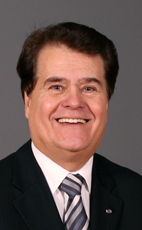
House of Commons photo

Crucial Fact

  • His favourite word was health.

Last in Parliament March 2011, as Liberal MP for Pierrefonds—Dollard (Québec)

Lost his last election, in 2011, with 31% of the vote.

Statements in the House

Petitions February 4th, 1997

Mr. Speaker, pursuant to Standing Order 36, I have the pleasure of submitting a petition signed by people in my riding and the surrounding area.

The petitioners are calling for an indivisible Canada, in that the boundaries of Canada, its provinces and territories, as well as its territorial waters, must not be modified.

National Organ Donor Day Act December 12th, 1996

Mr. Speaker, on behalf of the Parliamentary Secretary to the Minister of Human Resources Development, I am happy to give the government's response.

The Government of Canada strongly believes that minority official language communities are entitled to receive services in the official language of their choice. That is why under the Official Languages Act the Government of Canada as a whole is firmly committed to ensuring that any member of the public can communicate with the federal institutions and receive available services from these institutions in either official language.

The Government of Canada is also committed to ensuring that services provided on behalf of federal institutions are provided in either official language.

Since the Government of Canada recognizes the importance of this basic right, Part II of the Employment Insurance Act was amended to ensure that access is provided to benefits and measures in both official languages in areas of significant demand.

Since minority and community organizations are concerned about how they will be affected by federal-provincial negotiations on labour market agreements, I would like to reiterate that this question is part of negotiations and that any agreement will contain clauses guaranteeing that services will be provided in both official languages.

I asked all Human Resources Development Canada officials to translate this commitment toward respecting the rights of minority groups with respect to official languages into their day to day activities as well as to ensure that adequate and equitable resources are made available to serve these communities.

I hope this information helps to convince the member of the Government of Canada's commitment to ensuring the vitality of anglophone and francophone minorities and of our support for their economic, cultural and social development.

Our actions also reaffirm this government's desire to work closely with communities to ensure that the rights of minorities are respected throughout Canada.

Port Of Montreal December 12th, 1996

Mr. Speaker, I am pleased to inform you that the Port of Montreal will finish up the year 1996 in very good shape.

By the end of the year, there will be a 3 per cent increase in cargo handled. There was a spectacular 10 per cent jump in the volume of container traffic during the first 11 months of the year.

This increase is attributable to shipowners' confidence in Montreal's port facilities and in the quality of services available there. It is important to remember that a good part of this increase came about at the expense of the ports of New York and Baltimore.

The port authority is expected to post a net profit for the seventeenth year in a row. This profit should be in the neighbourhood of $11 million.

We pay tribute to the work of the port's administrators and we urge them to keep up the good work they are doing as the engine of Montreal's economy.

Nunavut Implementation Commission December 11th, 1996

Under the provisions of Standing Order 32(1), I have the honour to table in both official languages copies of the 1995-96 annual report of the Nunavut Implementation Commission.

Mr. Speaker, pursuant to Standing Order 32(2), I have the honour to table, in both official languages, copies of a report entitled Compilation of 1995 supplementary reports of the Nunavut Implementation Commission.

Inuvialuit Final Agreement December 11th, 1996

Mr. Speaker, pursuant to Standing Order 32(2), I have the honour to table, in both official languages, copies of the annual review for 1994-95 on the implementation of the Inuvialuit final agreement.

Interparliamentary Delegation December 10th, 1996

Mr. Speaker, pursuant to Standing Order 34, I have the honour to table, in both official languages, the reports of the Canadian section of the International Assembly of French-Speaking Parliamentarians, as well as the financial report of the meetings of the 22nd regular session of the IAFSP and its executive, held in Antananarivo, Madagascar, July 6 through 10, 1996.

Revenue Canada December 4th, 1996

Mr. Speaker, following the tour organized by our caucus last summer in the Gaspé and Lower St. Lawrence region, I am pleased to announce to the House that Revenue Canada has finally accepted the arguments of the stakeholders in the customs office matter.

Indeed, the Minister of National Revenue just decided that the customs office located in Rivière-du-Loup would remain open and be manned on a full-time basis by a customs inspector. The Rivière-du-Loup office will become the processing centre for claims coming from the whole region.

Raising Revenue Canada's profile in that region is great news for economic stakeholders.

While still complying with the need to cut costs, Revenue Canada has just demonstrated that it is sensitive to people's needs.

North American Free Trade Agreement December 3rd, 1996

Mr. Speaker, on this opening day of the Quebec UPA convention, I have very good news for Quebec farm producers: the NAFTA arbitration panel has just dismissed the U.S. complaint in the matter of poultry and dairy products.

We will recall that, under pressure from the poultry and dairy producers lobby, the American government tried on two occasions in recent years to have the Canadian supply management system invalidated.

The dispute settlement panel ruled that, under both World Trade Agreement and NAFTA rules, Canada has every right to protect its products.

Producers from Quebec and the other Canadian provinces will be pleased to hear this. That is what I call another great Canadian victory.

Investments November 28th, 1996

Mr. Speaker, yesterday, the Japanese federation of economic organizations, which made a fact-finding trip to Canada this past September, submitted its report to our Prime Minister.

Let me quote some excerpts from this document. "Following our visit, we now wish to inform our business people of the favourable economic conditions they may find if they invest in Canada. Canada never provided a more conducive environment for Japanese investments".

Then, in reference to Quebec's political context, the federation said: "The Quebec issue is only a slight concern to us. That being said, we may be hesitant to invest in that province".

Generally speaking, we are very pleased with the report. We only hope that the Government of Quebec will put an end to the uncertainty generated by its separatist project, so that Quebec can also benefit from the investments that the Japanese are about to make in Canada.

Nuclear Technology November 26th, 1996

Mr. Speaker, the Prime Minister of Canada has announced today, in Shanghai, the sale of two Candu reactors to China.

As the Prime Minister said, this sale confirms Canada's leadership role in the area of nuclear technology.

This contract is a direct spinoff of the work done by Team Canada in 1994.

It is estimated that this $4 billion contract, including $1.5 billion in Canadian content, will generate direct and indirect jobs equivalent to 27,000 person-years in Canada over the next six years.

Here is another concrete measure that shows job creation is our government's number one priority.