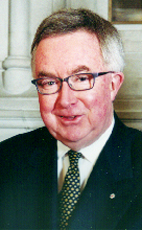
House of Commons photo

Crucial Fact

  • His favourite word was commons.

Last in Parliament May 2004, as Progressive Conservative MP for Calgary Centre (Alberta)

Won his last election, in 2000, with 46% of the vote.

Statements in the House

Points of Order September 25th, 2001

Madam Speaker, I rise on a point of order. I wrote to the Prime Minister last night asking if he would make a full statement to the House, as is the custom in this place, with regard to his recent conversations yesterday with the president of the United States on a matter of such grave interest to the House of Commons.

Has the House received any indication as to whether or not the Prime Minister would take advantage of that parliamentary opportunity to inform parliament, in the normal way, of those discussions?

Terrorism September 24th, 2001

Mr. Speaker, the question was whether the Prime Minister had proposed an initiative. I guess the answer to that is he did not.

In the United States democracy was struck directly by these attacks. The president immediately involved the leadership of America's political parties. The elected members of the U.S. senate and congress were put to work immediately, devising better ways to protect aircraft, tighten security and fight terrorism.

In Canada no committees of the House of Commons have been allowed to work on those issues. When the Prime Minister reports here tomorrow, as I trust he will, will he act also to let Canadian MPs get to work immediately against terrorism?

Terrorism September 24th, 2001

Mr. Speaker, my question is for the acting prime minister. When the terrorist leaders are clearly identified, the challenge will be to have those persons tried under a system of justice that is trusted by the nation which suffered the attacks.

Countries harbouring terrorists may be reluctant to release them to the United States. Did the Prime Minister propose today alternate arrangements that would allow American law to apply in an acceptable third country? That was done when the accused Lockerbie terrorists were tried by Scottish law in Holland.

Is the Prime Minister making practical proposals like that which might produce the terrorists and perhaps avoid a military strike?

Sir John A. Macdonald and the Sir Wilfrid Laurier Day Act September 24th, 2001

Mr. Speaker, it gives me great pleasure on behalf of the most recent coalition in the House of Commons to pay tribute to two distinguished Canadians whose career constituted the establishment of coalitions in the House and in the country.

Bill S-14 is an act respecting Sir John A. Macdonald day and Sir Wilfrid Laurier day. The bill, introduced by the leader of the opposition in the other place, Senator John Lynch-Staunton, so far has received in both Houses unqualified support.

At a time when Canadians are thinking so seriously about our future, our future as a comprehensive, cohesive and identifiable national community in a world transformed by technology and our future as individuals in a world where terrorists kill people simply for going to work, it is useful for us to reflect on our past and on the extraordinary individuals who faced down risk, faced down fear and faced down disappointment to define a Canadian nation and identity.

Let me speak for a few moments about the origins of this bill and what it seeks to do and what it does not do. It blends into one two private members bills which died on the order paper with the call of the last general election—one bill celebrating the birthday of Macdonald, the other celebrating the birthday of Laurier.

The bill does not ask for the declaration of a national holiday. This is not about a day off. The bill celebrates work. It calls on us to remember two men whose extraordinarily hard work on behalf of Canada shaped and sustained this nation.

By happenstance, the celebration of their lives and their contributions to Canada will occur at opposite ends of the year: in February for Sir John; in November for Sir Wilfrid. This will given Canadians, especially those in our school history classes, at least two occasions to reflect on the building of this great country and on those who contributed so much.

Anyone who has had the honour of serving as prime minister knows that the two standards against whom everyone else will always be judged were Sir John A. Macdonald and Sir Wilfrid Laurier. They embodied the young country as well as leading it. Each in his way symbolized how essential it is in a large and diverse society to reach out to others, to embrace them and to respect the differences which make them distinct.

Professor Desmond Morton, then director of the McGill Institute for the Study of Canada, testified in the other place. He stated:

They were political opponents with all the differences that our adversarial system creates. Canada made them surprisingly similar, too, when faced with the responsibilities of power because the realities of this country do not change very easily even when governments change...along with their steadfast vision of Canada and its potential came a skill in compromise that history has shown to be indispensable for any common future

These two men were able to lead and lead successfully during challenging times. It was for Macdonald to link and draw the country together and it was for Laurier to hold it together, linguistically and culturally.

Through the passage of the bill, we will give Canadians an opportunity to reflect on how this country came to be, the values it reflects and on how individuals citizens can shape and fashion the values and the nature of this country.

We Canadians do not spend enough time celebrating our origins. Not enough Canadian history is taught in our schools. We do not know enough of our past. The designation of these days will give all Canadians an opportunity to pause and consider our beginnings as a country and the difficulties faced in the early days of keeping it together.

As Professor Morton has said, the careers of Macdonald and Laurier overlapped. They engaged with each other. They were practical politicians, both with overarching commitments to Canada.

Their time together is perhaps best symbolized by Sir Wilfrid's comments made in the House of Commons on June 8, 1891. In the death of Sir John A. Macdonald he stated:

The place of Sir John A Macdonald in this country was so large and so absorbing that it is almost impossible to conceive that the politics of this country--the fate of this country--will continue without him. His loss overwhelms us. For my part, I say, with all truth, his loss overwhelms me, and that it also overwhelms this parliament, as if indeed one of the institutions of the land had given way.

Sir John A. Macdonald now belongs to the ages, and it can be said with certainty that the career which has just been closed is one of the most remarkable careers of this century...

He went on to say:

As to his statesmanship, it is written in the history of Canada. It may be said without any exaggeration whatever, that the life of Sir John Macdonald, from the time he entered parliament, is the history of Canada.

Laurier himself had his own indelible contribution to the future of Canada dealing with the challenges of francophones outside Quebec, of the Catholic Church in Quebec and of the threat to national unity posed by World War I.

However, it is in his commitment to a united Canada that we remember him best, as he stated at the Club National in Montreal:

We, people of French origin, have a sense of our own individuality. We want to pass on to our children the language we inherited from our ancestors. But while we cherish this feeling in our hearts, we refuse to admit that it is incompatible with our being Canadians. We are citizens of Canada and we intend to fulfill all the duties that this title implies.

This being said, whenever we invite men from another race to our table, we affirm that they are our fellow citizens, just as they affirm that we are their fellow citizens. Our country is their country: their political opinions are our political opinions; our aspirations are their aspirations.

What they want, and what we want, is that the rights of minorities be respected; that our constitutional guarantees be safeguarded; that the provinces remain sovereign and that Canada be united in its diversity.

It is to remember these two leaders that we should set aside the days of their birth in our calendars and celebrate their contributions to the Canada we enjoy today.

On behalf of my colleague the leader of the opposition in the other place, the sponsor of this bill, I would like to publicly thank the member for Don Valley West for sponsoring the bill in this House and I would like to thank all of those in this parliament who have spoken in support of Bill S-14.

Canada-U.S. Meeting September 20th, 2001

Madam Speaker, I appreciate the opportunity to take part in this debate tonight. I agree in principle with the position of the leader of the Bloc Quebecois concerning the role of parliament.

I think our situation and our position have, changed. It is in the interest of Canada to have a situation where parliament will have an opportunity to vote on all major international commitments in the future.

I express my thanks to the member for Winnipeg Centre who recognized my difficult travel schedule tonight and gave me the opportunity to speak before he did, on this occasion only I am sure he would want me to say.

Everybody in the House agrees that terrorism must be fought and that it requires Canada to take its place with other allies against terrorism. The debate tonight is about two issues: first, what a country like Canada should do; and second, how a democracy like Canada should do it.

The Prime Minister will go to Washington on Monday. The Americans will have a series of demands. We know what some of them will be. They will ask him to stop money to terrorists, to stop movement by terrorists, to crack down on terrorist cells or activities in Canada, to extradite or deport people who are wanted for crimes and return them to the countries where they are wanted, and to declare no tolerance for nations or entities that support terrorism.

The country knows that the Prime Minister goes to Washington on Monday with the goodwill of Canadians but these are complex issues. As the leader of the Bloc Quebecois has just indicated, there are dimensions to some of the considerations Canada will have to take in the months and years to come that will be very complex.

The Prime Minister would have had much more authority in Washington on Monday speaking for Canada if he had consulted this parliament in detail before he went to Washington. In addition to responding to the President's demands, I would hope the Prime Minister would also make Canadian proposals.

I hope he would outline precisely what Canada is prepared to do militarily. I hope he would lead in establishing multilateral auspices as Canada led in causing the gulf conflict to be conducted under the auspices of the United Nations. I would hope that he might propose initiatives that Canada might take with countries that are critical to this issue and countries where Canada has an unusual influence because of our association in the Commonwealth and la Francophonie, and our long association with international development. I hope he would set forth Canadian concerns about sovereignty and liberties which an international response simply has to consider.

Again, the Prime Minister would have much more authority in Washington had he discussed those proposals first, in detail, here in the Parliament of Canada. Instead, the government is shutting parliament and Canadians out. Compare the situation with that in the United States where Congress right now is actively acting to consider methods to improve security and where Congress is briefed regularly on security and intelligence matters. On the very first day of this crisis, this government should have put the committees of parliament to work so that our transport committee could look at ways in which our transport system could be made more secure and so that our immigration committee could have done a similar thing.

Sadly, all that elected representatives can do here is debate, a debate which the Prime Minister may or may not attend or pay attention to. There is a very sharp difference between the systems. Canadian legislators are allowed to talk. American legislators are encouraged to act. That is a difference that does not serve this democracy well.

Look at the deliberate confusion the government has created about terrorist cells in Canada. First the minister responsible said that he is not responsible, that it is the RCMP, that it is CSIS. Imagine Janet Reno having said that about the FBI at Waco.

When I asked the Prime Minister whether the al-Qaeda cells of bin Laden were or had been operating in Canada, he said he did not think so. CSIS said yes. The international journal Jane's said yes. The king of Jordan said yes. Then the government said the information was too sensitive to be trusted to the people of Canada and parliament.

The government does not seem to understand the concern and the anxiety of Canadians since these planes crashed on the Pentagon and into the twin towers in New York City.

Ordinary people died when they were going about their lives as usual. Throughout the country, ordinary people are now wondering which of their usual activities could now cost them their life.

They need reassurance. They need comfort, but they also want to be told the truth. They want to know the facts as they are. If terrorist cells are present in Canada, they want to know it. The government should be straightforward with those it represents.

In the aftermath of terrorism, we are trying to restore order to the world, but we also have an obligation to restore peace of mind to ordinary Canadians whose world has been turned upside down. Ordinary people were killed for doing ordinary things just the other day. That creates fear. We must create a peace of mind in the country.

How do we do that in democracies? We set out the facts. We do not hide them, as the government is hiding information about terrorist cells. We demonstrate active leadership. We have cabinet meetings, as the British did. We put legislators to work, as the Americans did. We initiate immediate action on issues that matter to people, as the European Union just did on border matters.

When we ask questions in this parliament, the government replies with scorn. Just yesterday when I asked a question, the Prime Minister belittled my experience in these matters. Well, I do have some experience in these matters. My diplomats were able to get American hostages out of Iran. I cast Canada's vote to have the gulf war conducted under United Nations' auspices. I was part of a government which made the leader of the NDP at that time a privy councillor so she could receive confidential briefings. The government could do that now to ensure that information was broadly shared in this parliament.

I briefed parliament and Canada regularly in detail day after day through the gulf war. The government could do that now if it cared about a consensus in this country.

There are others in the House with other experience who could help Canada now. There are Canadians outside the House whose experience Canada needs. There are millions more who are seized by a sudden fear and who wonder if the reason their government is so secretive is because it does not know what to do.

We hope the Prime Minister will come into the House tonight and tell parliamentarians first what he intends to tell the president of the United States on Monday. This is not about courtesy. This is about authority. If the Prime Minister is to speak with real authority for Canadians, he has to deal honestly and openly with Canadians. I sincerely hope, that he will do that.

Business of the House September 20th, 2001

Mr. Speaker, I may have missed a nuance. Will the Prime Minister be here tonight?

Business of the House September 20th, 2001

Mr. Speaker, I rise on a point of order. I wonder whether the government House Leader would indicate whether it is the intention of the Prime Minister to be present in the House tonight during that debate to outline his plans in Washington and to receive directly the advice and views of members of the House of Commons?

House of Commons September 20th, 2001

Thank you, Mr. Speaker. Parliament has a right to know what terrorist cells operate in our country. The Prime Minister has given confusing answers. My question is for the acting prime minister, knowing of course that some of that information must be kept confidential for security reasons. Would the acting prime minister agree to authorize an immediate briefing tonight or tomorrow to the parliamentary committee which studies national security to give clear and reliable information about what terrorist cells operate in Canada and what threat they constitute?

House of Commons September 20th, 2001

Mr. Speaker, we presume the Prime Minister is on the telephone, meeting with his cabinet.

Canadians want to support a common action against terrorism, but parliament has a right to know what terrorist cells operate--

House of Commons September 20th, 2001

Will the Prime Minister be here?