
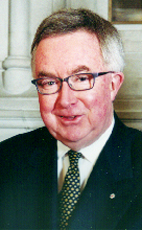
House of Commons photo

Crucial Fact

  • His favourite word was commons.

Last in Parliament May 2004, as Progressive Conservative MP for Calgary Centre (Alberta)

Won his last election, in 2000, with 46% of the vote.

Statements in the House

Nelson Mandela June 12th, 2001

It is the right country. As I said, it was in Lusaka, Zambia. I know my geography and history, perhaps even better than the Canadian Alliance.

It was in Lusaka, Zambia, where Mr. Mandela had his first meeting in exile with the members of the African National Congress. It was not possible for them to meet in South Africa. It was one of the elements of the apartheid regime.

What struck me most was his behaviour. He was not bitter. He was not full of vengeance. He was full of hope.

On February 11, 1990, the unforgettable day of his release from prison, Mr. Mandela could have, with one flick of his wrist or one misstated word, triggered a revolution and his country would have been in flames. He did not. He did the opposite.

What I will always remember is that he recognized that the most turbulent element of that society at the time were the young people who had fought at his side and on his behalf, who had forgone their formation and their training to be supporters of his while he was in prison. His words to them were to put the past behind them and to build immediately for the future.

He spoke at the Soweto rally two days after his release, and I think it is well for this House to remember those words. Mr. Mandela said to the young of his country:

It has been the policy of the ANC that though the school and the entire education system is a site of struggle, the actual process of learning must take place in the schools. I want to add my voice, therefore, to the call made at the beginning of the year that all students must return to school and learn. We must continue our struggle for People's Education within the school system and utilise its resources to achieve our goals.

In other words, he was saying that the young people of that country should not reject the system that had rejected them. What they should do instead is embrace that system, improve it and move it forward into the future.

None of us who met Nelson Mandela can help escape personal reactions. I have to say to the House that the single, most dramatic incident in my political life was precisely in that meeting in Lusaka when he came out to meet the African National Congress in exile. I was there because Canada had chaired the commonwealth committee on Foreign Ministers on Southern Africa and I was the chair of that committee.

I recall that a question was put to Mr. Mandela that invited him to be highly critical of the Afrikaner who had imprisoned him for all those years. His answer was “we have to understand how difficult this is for them”.

I was overwhelmed by the generosity of a man able to come out of prison and out of the conditions he had endured, who could speak for generosity and understanding of the other side. Yet it was precisely that capacity that made it possible for people who, for reasons of colour, of hatred, of ignorance, had been on other sides in South Africa, to come together in that extraordinary rainbow coalition to try to establish a nation that could thrive into the future. It goes without saying that in that tolerance and in that generosity there are extraordinary lessons for us in this diverse but much easier country than South Africa.

Nelson Mandela acknowledged Canada's efforts to end apartheid. When he spoke in these Chambers on June 18, 1990, he said of former prime minister Brian Mulroney:

We have been greatly strengthened by your personal involvement in the struggle against apartheid and tyranny, and the leadership you provided within the United Nations, the Commonwealth, the Group of Seven and the Francophonie Summits.

Our efforts however pale in comparison to those of Nelson Mandela. We should all be proud to have Nelson Mandela declared an honorary citizen of this free country, Canada.

Nelson Mandela June 12th, 2001

Mr. Speaker, I am proud and happy to support, along with my colleagues in the House, the motion of the member for Markham to make Nelson Mandela an honorary citizen of Canada.

This motion is intended to recognize his extraordinary efforts and leadership in his quest for democracy for South Africa and respect for the rights and freedoms of all.

I will never forget my first meeting with Mr. Mandela in Lusaka, Zambia, only a week after his release. I was at the time the first member of a western government—

National Defence June 12th, 2001

Mr. Speaker, let me quote the Prime Minister himself saying that the Deputy Prime Minister “presided over a committee to look at the process of establishing the bids that are out”.

I would like to ask a question of the Deputy Prime Minister. During his tenure as chair of the cabinet committee overseeing the maritime helicopter project, did the Deputy Prime Minister receive any representations or any interventions from any companies interested in bidding on this contract?

National Defence June 12th, 2001

Mr. Speaker, the Prime Minister and the Minister of National Defence have now admitted that there has been a secret cabinet committee overseeing the replacement of the Sea King helicopters, chaired by the Deputy Prime Minister.

Could the Deputy Prime Minister tell the House what powers that secret committee of his exercised? Did it order changes made to the contract process? Did it recommend splitting the procurement contract?

National Defence June 7th, 2001

Mr. Speaker, yesterday the Prime Minister said that the Deputy Prime Minister was not chairing any cabinet committee on the Sea King replacement. The Minister of National Defence, before the standing committee in March, said:

The cabinet has had discussions through a committee chaired by Mr. Gray—

Was there a cabinet committee overseeing the procurement of the Sea King replacement? Was the Deputy Prime Minister involved in that committee? What is the Deputy Prime Minister's role now in assessing this project which has profound implications for his own constituency?

Parliament Of Canada Act June 6th, 2001

Mr. Chairman, I remember those circumstances very well and I remember the reaction that was ignited in the country. There was a substantial decline in respect for this institution, in part as a result of the sense that we had been self-serving as a country. What we should do in this parliament is learn from past experience.

The public holds parliament on a short leash. The growth of cynicism in this parliament is one of the most serious issues we face. There is no doubt that action on pay contributed to that cynicism then and action on pay will contribute to that cynicism now unless we adopt the motion that has been brought forward by my colleague, which will say that this parliament has the determination and the foresight not to profit from its own acts. That is why we are proposing this amendment.

Parliament Of Canada Act June 6th, 2001

Mr. Chairman, I will be very brief.

First I want to point out that there are some part time nurses in the country who are earning less than $20,000 a year as their total salary, less than the income here. Yes, I am advantaged. Yes, the hon. member is advantaged. Yes, members of parliament who had investments in golf courses are advantaged. Of course there are advantages, but that is not the issue.

The issue here is this: should parliament confer advantages on itself? That is the issue. What this proposal would do is say no, we do not confer advantages on ourselves, we establish a regime that will not apply until after there has been an election. That is the principle. I think the hon. member can understand it. It should be enshrined in the legislation of a parliament that respects its reputation, as much as we all should be defending and respecting the reputation of this parliament in a cynical age.

Parliament Of Canada Act June 6th, 2001

Mr. Chairman, let me deal first of all with the Lumley report. It is a report, a recommendation to us. It is not a direction to the House. It does not absolve the House of its responsibility to take its own decisions. The government and members of the House cannot hide behind a report. It is nothing more than a report.

On the question that was raised by my colleague from Calgary Southeast, what the Lumley report does with respect to retroactivity is speak with eloquent silence. It gives no authority at all for the action that the government is taking.

If the government is saying that it cannot depart from the Lumley report on other matters, then it is inconsistent in pretending that on a question where the Lumley report is silent, as it is silent on this issue of retroactivity, the government can reward members of parliament for service already performed by adding extra income to each one of us. That is simply wrong. It is illogical. It cannot be defended in the context of the report and it certainly, if I may return to the question of the Lumley report generally, the Lumley report in any event is only a report to the House. It is not a directive that binds us.

We are people here with the opportunity to make our own individual and free decisions, and that is what should be done.

The dilemma we face and are trying to address with this particular amendment has nothing to do with the level of compensation. That is, as everyone knows, a very real problem. We are dealing however with a much more serious issue, which has to do with the sense so alive in the Canadian public that this is an institution with the primary interest of serving its own interests. To take the a very current matter, this is an institution that puts the interests of the pay of members of parliament ahead of the safety of children who might be assaulted by activities on the Internet. That is the concern.

The issue is not about the level of contribution. The issue is about the degree to which we can win back respect for the House of Commons. The way to avoid the impression of being self-serving is to say that what we pass will not apply to us, that the pay raise we authorize will not apply to us. It will not apply until a later parliament. It is a very simple principle. It is a very strong principle. We should not be self-serving in the House. If we want to deal with and combat the cynicism alive in the land then we have to find a way in which we stop this image instead of reinforcing the image of being a self-serving institution.

Another point is that surely there should be a practice here that when we go to the electorate we should be honest with the people who vote for us. The government House leader did not talk in the last campaign about the salary increase. He did not, nor did I, nor did any one of us indicate that one of the first things we would do in the first six months we were back would be to enrich ourselves through the salary payment.

We have to be honest with the people of the country. To do it this way by bringing in a bill like this so early, giving it such priority and trying to sneak it through at the end of a session, simply undermines the kind of respect that can be won for a House of Commons of this kind.

I was rather surprised by my colleague and friend, the hon. member for Winnipeg—Transcona, who expressed his concern that there would be debate at the next election campaign. I recall an instance some years ago in which a party leader suggested that election campaigns were not the place to debate national issues. I did not think that was right then and I do not think it is right now. Obviously these issues should be debated in election campaigns. We should not resort to devices that would deny the opportunity for the people of Canada to debate issues which they consider to be of importance to them.

I would like to come back for a few moments to the matter of conflict of interest. I agree there is no conflict of interest in the strict meaning of the word, but as far as an apparent conflict of interest is concerned, there is certainly that. The election was in November. Now we are in June. Six months after the election, one of the first actions of this parliament is to give us way more money. This is guaranteed to be perceived as a major conflict of interest.

The very real problem we all face is the country's cynicism about public life. Why is that? Because our actions earn cynicism. The action of moving forward now on a salary increase as one of the first priorities of parliament will bound to be seen with cynicism. Is there a way to protect against it? Yes there is. The way to protect against it is to adopt the amendment proposed by my colleague from Pictou—Antigonish—Guysborough, which would ensure that we in this parliament do not profit from the salary increase, only parliamentarians in subsequent Houses would profit from that increase.

Parliament Of Canada Act June 6th, 2001

Two classes. Two systems.

Parliament Of Canada Act June 6th, 2001

So two systems.