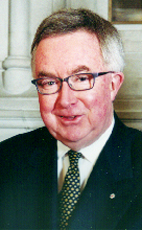
Mr. Speaker, I am honoured to take part in this debate on behalf of my colleagues in the parliamentary coalition.
Six days and a few hours ago the world we knew changed brutally and forever when hijacked planes were flown deliberately into crowded buildings with the explicit purpose of killing innocent people and breaking the confidence of societies built upon freedom and order. Our hearts go out to the individuals and families, including far too many Canadians, who have been struck directly. The shock and the losses that engulf those families are almost beyond belief.
This atrocity was unexpected as well as brutal. The victims started their day Tuesday, as we all did, expecting the ordinary. Suddenly, without warning, without reason, their precious lives were taken by a terrible, premeditated strike against order and humanity.
My young nephew, Scott Delaney, worked until very recently on the 51st floor of the World Trade Center. He was scheduled six days and a few hours ago to go back there for a job interview. Another obligation intervened and he did not go. That chance decision saved his life, just as the deliberate decision of the terrorists stole the lives, the futures and the hopes of thousands of sons, daughters and friends from around the world.
Last Tuesday's tragedy shook the entire world. On that day, all of us became victims, victims of acts of horrific cruelty aimed at creating upheaval in public order and all of humanity. The world we live in today is far different from the one we were living in only six short days ago. On September 11, 2001 the face of the world changed and it, and we, will never be the same again.
Words will never be enough to express our sadness or our support for those who have lost family members or friends. However, as well as extending our thoughts and prayers, we also wish to express our determination to make sure that, despite the tragic and murderous consequences of terrorism, free societies will never give in to terrorist acts and that the values we hold so dear will continue to prevail.
We can never grieve enough for those victims, for their families, for the futures that were torn away. We must offer them more than our grief, more than our sympathy and more than our prayers. We owe them our determination to ensure that while terrorists can take lives, they cannot destroy free societies.
I want to echo very strongly a sentiment expressed by other leaders in the House; that an essential element of our free society is that we judge people on their character and accomplishments, not upon where they come from, not upon their colour and not upon their faith.
The people who committed this atrocity are extremists. That is who they are. We must be very careful that in responding to this crisis that we do not create new victims or blame whole communities for the acts of people who in any society would be judged extremists. To be clear and for the record; all of us in the House know that no one is more shocked or more offended by this atrocity in the United States than members of the Canadian Arab and Muslim communities. No one is more offended than they are.
If we in this parliament seek to be fair, so must we be forceful. Our response must be effective, focused and strong. This is a challenge in which Canada must play a leading role. We are not neutral on issues of terror, freedom and order. They reach to the heart and the core of our nature as a nation.
The Prime Minister said that Canada should not become a fortress against the world. That is true. However, Canada should be a fortress in the world, a nation known by our friends and allies to be strong and reliable. That is the challenge for Canada in the months to come.
At our best, Canada's role in the world has been to ensure that freedom and order prevail and prevail together. We have done this in times of war and we have done that in times of peace. We have earned a reputation as a nation that stands on the frontline of defending and advancing free societies. That is where it must stand now.
I congratulate the Prime Minister for the firmness he finally showed on Friday. This nation, our people, our traditions, our parliament and government can play leading roles in shaping the world's response to this new terror. That is what Canada does in this difficult world. We put our values to work. We did that when NATO was formed, when peacekeeping was established, when new treaties of trade were framed and when apartheid was fought. We must do that now with our closest friends next door and with our allies against terror around the world.
The place to start is with one stark and simple fact. Our world changed profoundly Tuesday morning. People and places that once felt secure, now feel exposed. Systems of protection and prevention, which on Monday night seemed adequate, were proven Tuesday to be brutally inadequate.
We must rebuild that sense of security. Indeed, free people themselves are already doing that. What we are seeing in the long lines of volunteers at blood banks and in the people going back to work in places that so recently were targets is more than just compassion, or courage or defiance.
It represents the strength of the values which we have always claimed free systems nourish: the optimism, the activism, the balance in resisting a rush to judgment and, most of all, the palpable sense of personal and community responsibility in such a material and self-indulgent world.
One sometimes wonders whether those values will erode. Now they have been put to a shocking test. They are robust and resilient, rational and responsible.
Those attacks also demonstrate how much the world has changed. How wrong it would be for us to pretend that old ways work and how urgent it is to deal with the real threats of Tuesday, of today and of tomorrow.
We must rebuild the feeling of security Canadians enjoyed, whether rightly or wrongly, until last Tuesday. This time, however, we have an obligation to rebuild it on a solid foundation, to immediately undertake all necessary steps to ensure that such a tragedy does not take place ever again.
The government must imitate the speed with which Canadians moved into action. After this massacre, the Canadian people immediately moved into action with all the vigour of a friend or family member.
We parliamentarians have an obligation to follow their example of prompt action, to not abandon them, to take indepth actions immediately, to ensure that the necessary changes are made without delay. In these days of mourning and deep distress, our leaders have a duty to console Canadians, and the only concrete action possible will be to ensure that this is done.
This is work in which the whole nation should be engaged and certainly work in which all the nation's representatives assembled here in parliament should be engaged.
The government has come to parliament with a resolution, that the House of Commons, representing all of Canada, can do much more than resolve. We can be and we should be an active instrument of Canada's response to this terror.
With agreement, which I am sure would exist, the government could act today to authorize the committees of the House on transport, immigration, justice, foreign affairs and other relevant matters to begin immediately to gather evidence and to gather advice in public on what changes we need to make our nation more secure.
These issues are too important to be left to ministers and public servants meeting in secret. The changes that may be required may be too radical to leave to the custodians of the status quo.
If the government is serious about an honest analysis of our system, let it trust parliament to help in that work. Let parliament reach out to the people who elect us so they can be reassured in this time of doubt.
The government cannot close its mind in advance to changes in any area or policy related to security. It must be prepared to reconsider funding levels to CSIS. It must be prepared to examine immigration policy, airport security, aircraft security, border security and the activities of groups that might be associated with terrorism.
Even before Tuesday's tragedy the government was warned of weaknesses in our security arrangements. The Leader of the Opposition has mentioned several actions which Canada could have taken.
In that spirit, let me quote from the CSIS report released on June 12, 2001, less than three months before planes ploughed into the Pentagon and the World Trade Center towers:
Terrorism in the years ahead is expected to become more violent, indiscriminate and unpredictable...There will likely be terrorist attacks whose sole aim would be to incite terror itself. A hardening attitude, and a willingness on behalf of certain terrorist organizations in North America, reinforce the belief that Canadians, now more than ever, are potential victims, and Canada a potential venue, for terrorist attacks.
That was the warning given by CSIS to parliament, to government, less than three months before the attacks of Tuesday. Let me quote from the auditor general's report of 2000, which said the Department of Immigration:
—could also improve the way it collects criminal intelligence information...gathered by various stakeholders.
It said that information is not systematically exchanged because computer systems are not compatible and data are not always shared among the Department of Immigration, the RCMP and CSIS.
That was a warning more than a year ago by the Auditor General of Canada about our capacity to deal with people who might be seeking to come here to wreak terror on this continent, elsewhere in the world, or here in our home.
Those are only two examples among many of the warnings that were given and not acted upon. They are clearly areas where the government can act now, immediately, to strengthen the security of Canada and of the world.
Parliament should be given a detailed description of what the government now knows about the Tuesday attacks. Parliament should be told what changes the government is now contemplating, what reviews of policy it plans, what military, intelligence or other role Canada can play in a campaign against the terrorists.
If some of that information is confidential then let the government give that information to parliamentary leaders on a confidential basis.
This is a Canadian concern. This is parliament's concern. This is not a matter reserved to those who sit in the secrecy of the Privy Council Office. To rebuild the trust of the public, to rebuild the trust of our allies, to rebuild the trust of financial markets, parliament must be fully informed and advised.
The Tuesday attacks have obvious economic implications, implications for growth, for revenues, for spending priorities. This government has yet to present a full budget to Canadians.
We know the minister's revenue forecasts were wrong before the attack. Parliament and Canadians have a right to know what the facts are now. We need to know the costs of the projected new spending the government has proposed.
As those new figures must be known within the government which authorized the spending, let the public know so the public can be heard in deciding whether these priorities are more important than the priority of making our nation secure.
It is not often that we recognize a turning point in history, but we are a different world than we were a week ago. However let us bear this in mind. The technology of terror did not change. Nor did the purpose of terror, which is and always has been quite precisely to explode the order and the confidence which are the bases on which most of us live our lives.
What changed was the audacity of the terrorists. They have warned us that the threat runs wider than it did before. That means that our response must change, must be broader, tougher, itself more audacious.
This was a calculated attack upon the kind of open and safe society in which Canadians believe so profoundly. It was a direct attack on us, on all of us, and we must be prepared to respond directly.
We must deny the terrorists the psychological victory they seek. We must organize ourselves to protect and assert the civilized values that were so deliberately attacked. No nation has a greater stake in that response than Canada, and we must play our full part.
Our grieving will continue for days, months and years to come, but today, immediately, we have a duty to act to ensure that the values we hold so dear, the values that characterize us, prevail.
In the next few days, months and years we will grieve, but now we must also act to ensure that the values we hold so dear prevail.
That will involve hard decisions. It will require us to apply our values in the context of a new, changed, real tough world. The world needs an active Canadian government and at a time when democracies are under scrutiny an active Canadian parliament.
We have an opportunity to shape this new world if we are prepared to look at these issues, open to new realities, determined to play a role of leadership. The world needs Canada's leadership and strength now and this parliament, I am confident, would be prepared to support a government that showed that kind of leadership.