Thank you very much. You were right on time.
We have MP Michael Chong next, for five minutes.

Evidence of meeting #14 for Foreign Affairs and International Development in the 45th Parliament, 1st session. (The original version is on Parliament’s site, as are the minutes.) The winning word was diaspora.
A recording is available from Parliament.
Liberal
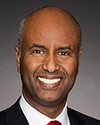
The Chair Liberal Ahmed Hussen
Thank you very much. You were right on time.
We have MP Michael Chong next, for five minutes.
Conservative

Michael Chong Conservative Wellington—Halton Hills North, ON
Thank you, Chair.
I'd like to talk about something that you mentioned in your opening remarks. As you reiterated, the government has done a pivot on its foreign policy. The Prime Minister and the Minister of Foreign Affairs have indicated that the government's number one foreign policy priority is defence and security. The second priority is economic resilience, part of which is diversifying trade and ensuring that Canada is a reliable trading partner, which is something you referenced in your opening remarks.
Building on that second pillar, the Prime Minister said about three weeks ago that the government is working to expedite the export of Canadian energy, particularly oil and gas. He indicated that Canada is an unabashed “energy superpower”. He said, “We have the third-largest reserves of oil [and] we have the fourth-largest reserves of LNG.” He also added, “We've just started our first LNG shipments”.
Africa, as you know, is a continent of 1.3 billion people. They use as much oil as we do on any given day—about four million barrels of oil a day, which is a bit more than we do—but we're a country of 40 million people. They desperately need energy—oil and gas—to expand.
Is there now a whole-of-government focus, particularly within the Department of Foreign Affairs, to build on the Prime Minister's commitment to expedite Canadian exports of oil and gas to the African continent, where they are in need of energy? What is being done through the whole of government, particularly foreign affairs, to do that?
Director General, Pan-African Affairs Bureau, Department of Foreign Affairs, Trade and Development
I think one of the issues in Africa is that the use of energy is not very efficient. Electrification in Africa remains a major problem as 300 million Africans remain without electricity. Energy poverty is a serious problem. That is not necessarily due to a lack of fossil fuels, for example. A country like Nigeria has tens of millions of people who don't have access to electricity, yet perhaps—I don't know for sure—the single largest export from Nigeria is oil.
Where Canada, I think, can be helpful in this regard, in terms of expanding Canadian exports in the energy sector, is through our technology. We see that in Nigeria, Tanzania and other markets where Canadian energy technology can be applied, where that can—
November 20th, 2025 / 4:55 p.m.
Conservative
Michael Chong Conservative Wellington—Halton Hills North, ON
I would just interject by saying that the fastest way to ramp up electricity production in a way that's lower carbon than conventional coal is through natural gas. Canada has 30 trillion cubic metres of natural gas reserves. Nigeria has maybe six billion cubic metres. We have more natural gas than the entire African continent, and that's a surefire way to increase electricity output. That's why, when Ontario closed its coal-fired plant in Nanticoke, it replaced a lot of that coal-fired generation with natural gas plants throughout the province of Ontario to fill in the gap.
We have an opportunity here to ensure that Africa doesn't become reliant on coal, like China has, in increasing electricity output and contributing massively to global emissions. Gas has about half the greenhouse gas output per kilowatt hour produced that coal has.
I think it's something that needs to be incorporated into the government's approach to Africa. As I said, Africa is short on energy and Canada has the third- and fourth-largest reserves of oil and gas in the world. I think it needs to be part of what the government is doing in Africa.
Assistant Deputy Minister, Africa Branch, Department of Foreign Affairs, Trade and Development
I would just add that obviously Global Affairs Canada and Export Development Canada have been tasked with delivering on the government's agenda to diversify trade. Africa will be a part of that trade diversification strategy as it rolls out.
Liberal
Liberal

Anita Vandenbeld Liberal Ottawa West—Nepean, ON
Thank you.
I want to pick up on something you said, Mr. Smith, about the brand of Canada, particularly when it comes to things like resource development.
When I was in the D.R.C. and speaking to officials there, there was a very strong sense that they want more Canada. The reason they said they want more Canada, particularly on resource development, is that Canada brings those values. Canada ensures it's looking after the local communities. It's not creating conflict in local regions because of conflict over those minerals. Environmental standards.... We bring something that others do not. That is an advantage for Canada.
I also note that, in global trade, generally, Canada has been bringing a kind of trade that is more people-to-people. It is trade that will not just benefit corporations and elites but also involve the population and benefit the people of a country, which is vitally important today, when we're seeing more and more turning against globalization. We're seeing isolationism. In order to counter that, I believe we almost have to do for global trade what the welfare state did for capitalism and make sure this is something that is actually benefiting people.
Can you further elaborate on how Canada is perceived, particularly in these areas but also regarding the kind of work we're doing with FinDev and the African Development Bank? We are leveraging private capital, but is it in a way that will have broad benefits for communities and local populations? There are many comments about countries in Africa, where you have rich countries but poor people. Where can we play a role through trade to ameliorate that?
Assistant Deputy Minister, Africa Branch, Department of Foreign Affairs, Trade and Development
I'll start, and then I'll turn it over to Drew.
I think this gets at the heart of mutually beneficial relationships. Canada can engage in a way that is beneficial for its own economy and security but do so in a way that benefits the countries we're partnering with.
Our values and standards are things that make us an attractive partner for African governments and institutions. When we were developing the Africa strategy, we did so not only thinking about the opportunities in Africa but also thinking reflectively about what Canada has to offer. Therefore, we took into consideration the advantages we have that are considered to make us a partner of choice for those very reasons.
We also know there are certain sectors that African partners are looking at in Canada. For example, we get asked about agriculture. We have those education partnerships. ICT is an area. We want to be focusing on sectors that are Canadian strengths, which is where we are asked to partner with them.
Our linguistic ties, which were also brought up at this meeting, provide us with an advantage when we're doing business, because there are a number of countries that want to do business with a French-speaking country. With the Africa strategy, we want to better leverage those aspects that are Canadian advantages and make sure we maximize them.
I don't know whether Drew wants to add anything.
Director General, Pan-African Affairs Bureau, Department of Foreign Affairs, Trade and Development
I have a concrete example of what we're looking at when we talk about broadening this mutual benefit.
I quite like the work we do with the African Guarantee Fund. There's a project we have at the African Development Bank called AFAWA. It provides guarantees to African financial institutions. This encourages them to lend and provide financial services to women. The amazing thing is that women are great clients but are oftentimes seen as too risky. These guarantees provide the incentive for financial institutions to lend to women. We're seeing that those guarantees are rarely used, because women are a much better bet than expected.
Liberal
Anita Vandenbeld Liberal Ottawa West—Nepean, ON
Thank you very much.
There is youth as well. I know we've worked with the African Development Bank for young people who don't have credit or experience. For that population, you see a greater return. I appreciate that.
It's in Canada's interest, especially when we are trading, to be trading with democratic countries that have good governance and that are accountable back to their citizens—pluralistic countries. We've touched on governance. I know Canada is doing a lot of capacity building when it comes to good governance. It's far better when a country is accountable back to its people and provides the necessary services, health and education through its own systems. That is far more sustainable than continuing to provide external aid.
Can you talk about democracy and governance?
Liberal
The Chair Liberal Ahmed Hussen
We are way over time. Unfortunately, that will have to wait for another time. We're 40 seconds over. Thank you very much.
We go next to MP Simard for two and a half minutes.
Bloc

Mario Simard Bloc Jonquière, QC
Thank you very much, Mr. Chair.
I'd like to come back to the energy issue raised by my colleague Mr. Chong.
A little earlier, when Mr. Oliphant questioned you, you talked about a pivot and changing paternalistic relationships to one of equal relationships between economic partners. This reminds me of the language we use to talk about our relationship with indigenous communities. We say that choices must be free and informed. In terms of energy, I think we have to distinguish between industrial energy needs and individual energy needs.
Mr. Smith told us that most countries don't have access to electricity. In these circumstances, low-cost energy sources tend to be wind and solar. If our goal is to give people energy, not industrial processes, we need to promote solar and wind energy. In that sense, we mustn't confuse our commercial interests, which are to trade in oil and gas, with the energy development of Africans.
I don't know if you agree with me, but clean energy sources may be more attractive to them than gas and oil.
Director General, Pan-African Affairs Bureau, Department of Foreign Affairs, Trade and Development
I can answer that in a general sense. My colleagues may have specific examples that they could add. I would say that one of the challenges in Africa, when you talk about renewables, is that you can do it on a small scale. You could have microgrids, and you could apply solar and wind on a very small scale, but to do that on a much larger scale, not for commercial use but for the population, is very challenging. As one MP was mentioning, this transition from oil to coal, with natural gas being a better choice, I think is being looked at quite closely in many parts of Africa, where the grid doesn't allow for renewables to be applied immediately.
I'm not sure if anyone has anything to add.
Director, Central and Southern Africa Bilateral Relations Division, Department of Foreign Affairs, Trade and Development
I want to give you a practical example of a balanced relationship.
We can look to South Africa and Canada's investments in the just energy transition, which is meant to move South Africa's dependence from coal to other avenues and create commercial opportunities for Canada. Foundational in this approach is a sovereign loan to the Government of South Africa that they pay back every six months, which is enabling this transition, decommissioning coal mines, training a new workforce and dealing with significant unemployment in the country. It's also creating opportunities in this new space.
Liberal
The Chair Liberal Ahmed Hussen
Thank you very much. Thank you for your appearance and for your testimony today. We really appreciate it. I now ask for unanimous consent from members to go into an in camera session, so that we can have a discussion of committee business.
[Proceedings continue in camera]