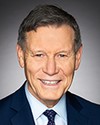
Evidence of meeting #13 for Natural Resources in the 45th Parliament, 1st session. (The original version is on Parliament’s site, as are the minutes.) The winning word was products.

A video is available from Parliament.

On the agenda

Members speaking

Before the committee

Skiffington  Chief Executive Officer, Kap Paper Inc.
St-Gelais  President, Boisaco Inc.
Cormier  Special advisor to the President, Groupe Rémabec
Lampron  First Vice-President, Organizational Development and Public Affairs, Groupe Rémabec

The Chair Liberal Terry Duguid

Colleagues, good afternoon. I call this meeting to order.

I'd like to acknowledge that we are meeting on the unceded territory of the Algonquin Anishinabe nation.

Welcome to meeting number 13 of the Standing Committee on Natural Resources. Today's meeting is taking place in a hybrid format pursuant to the Standing Orders, and I would like to make a few comments before we start, for our witness in the room.

You can use the earpiece and select the desired channel. I'm sure the clerk has taken you through that.

This is a reminder to all of us in the room that all comments should be addressed through the chair.

Before we start, I would like to ask members if they agree to have a sixth complete meeting on the forestry industry. The first meeting, as you recall, was only half a meeting, as we received officials from the department and then did committee business.

Colleagues, we're a little thin today, so we're trying to accommodate all witnesses. You'll hear a motion about the minister coming, shortly, but this is just to round out our study, and I know it's of great interest to all members.

I see no objection to that, so we will proceed.

I'd like to welcome back our members who were on travel status to the Saguenay and to Sudbury. I have proof positive that you were on the road. These are nickel pellets from Vale Base Metals, and unfortunately I have to give them back. I hear it was a good trip and was very rewarding. Perhaps we can find time on a future agenda just to hear from all of you, and you can share your experiences.

Thank you to the clerk, to the analyst and to all the staff who went along. I know that they had a rewarding time as well. At least, that's what they told me.

Colleagues, pursuant to Standing Order 108(2) and the motion adopted on Thursday, September 18, the committee resumes its study of the forestry industry.

I'd like to welcome our witness on the first panel. We have Terry Skiffington, chief executive officer for Kap Paper Inc.

Mr. Skiffington, you will have five minutes or less for your opening remarks. We might cut you a little slack today because you are the only witness. You'll be getting our full attention, I assure you.

Please proceed.

Terry Skiffington Chief Executive Officer, Kap Paper Inc.

Thank you, Mr. Chair and members of the standing committee, for the opportunity to appear before you today. My name is Terry Skiffington. I'm the CEO of Kap Paper, a pulp and paper mill located in Kapuskasing, in northeastern Ontario. Our mill has operated for 103 years and remains the cornerstone employer and economic engine of our region.

For generations, Kap Paper has played a central role in supporting Ontario's integrated forestry model. The strength of that model comes from long-term sustainable harvesting, regeneration and silviculture, ensuring that our northern boreal forest remains a perpetual and renewable resource.

For this model to function properly, every component of the forest must be used in a way that generates the highest possible value. Today, the greatest value of the boreal forest comes from solid wood products, and in our region, northeastern Ontario, the high pine and spruce content allows us to produce what is widely recognized as some of the strongest, clearest and most consistent dimensional lumber in the world.

When logs are harvested and converted from round to square, roughly 65% of the volume that's harvested becomes what we call residuals: bark, sawdust, shavings and chips. These residuals must have a home for the system to remain viable. Typically they flow to facilities that produce energy or pulp and paper products, and that's where Kap Paper comes in. We use bark, sawdust and shavings to produce energy. We use chips to manufacture paper products, anchoring the integrated sustainable model for the three regional sawmills in our area, located in Hearst, in Kapuskasing and in Cochrane, Ontario.

Collectively, these operations support 600 direct jobs, more than 1,900 indirect jobs and numerous first nation forestry contractors. Together they contribute $330 million per year in regional economic activity, along with $69 million per year in direct revenue to the Province of Ontario through energy purchases, rail and payroll deductions.

Unfortunately, the situation we face today is stark. In 2002, Ontario had 21 facilities like Kap Paper spread across the north. Today, only three remain, two in the northwest—in Thunder Bay and Dryden—and just us in the northeast. These closures were driven by declining financial viability in global pulp and paper markets. As these facilities disappeared, harvesting levels collapsed by over 50%. Large volumes of merchantable timber are now left in the bush, where they ultimately burn, and sawmills struggle to manage residual chip and biomass volumes.

That struggle has an endpoint, and we are rapidly approaching it. Kap Paper itself is now on the verge of closure. Newsprint markets have been declining for years, but our competitive cost structure allowed us to stay marginally profitable. The recent trade war, however, has collapsed those markets entirely. At present, we are no longer economically viable.

At this point, I'd like to acknowledge and sincerely thank those who have helped us to continue to operate as we seek out alternatives. Premier Ford and the Province of Ontario have supported us with operating loans since mid-2024. More recently, the federal government, with the support of Ministers Hajdu, Joly and Hodgson, provided loans to keep us operating, along with funding to accelerate our search for new products and new markets.

We are also applying to the strategic response fund for large-scale capital assistance as we prepare for a major transformation of our facility. The challenge for us, and for the broader sector, is time. COVID, followed by the trade war, compressed what would normally have been two decades of market evolution into just five years. No company could adapt that quickly.

We are fortunate, however. Ontario has one of the best forest resources in the world and one of the largest inventories of unused, sustainably available timber, and that's nearly three times our current harvest level. That forest is in the bush, and we're not harvesting, and it's ultimately rotting and turning to forest fire fuel. There is a future for Kap Paper in higher-value, tariff-resilient and diversified markets, and with rapidly developing technology there's even growing potential to use surplus fibre to displace oil. Technologies emerge that can produce from a cubic metre of wood what has traditionally come from a barrel of oil.

Maintaining an active and managed forestry sector positions Ontario and other regions of Canada to thrive as the world transitions to a zero-carbon economy, but this cannot just be a transition for Kap Paper. There must be a broader pivot across the sector. Without it, we face a cascading collapse, hundreds of thousands of jobs lost, and lasting economic harm.

At Kap Paper, we have been working on and are closing in on a plan to transition away from traditional pulp and paper products towards engineered wood products aligned with the federal government's housing strategy— products that Canada and the world urgently need and that are not targeted by U.S. tariffs. We believe this plan will attract strategic capital investment from partners experienced in producing these products, enabling us to repurpose existing infrastructure, expand first nations participation in the sector and sustain and grow our economic activity.

The benefits to the taxpayer will be substantial, both in absolute terms and relative to the alternative. This is an opportunity to preserve and strengthen a way of life that the people of northern Ontario deeply value, but to realize this potential, we need time and support from both levels of government to complete this transformation.

Thank you, Mr. Chair.

The Chair Liberal Terry Duguid

Thank you, Mr. Skiffington.

We're going to go to questions and comments from our colleagues. Before we do that, if members agree, I would like to propose making the first two rounds of questions six minutes per party, and then we'll have the usual allotted time for subsequent rounds for the first panel, as we only have one witness.

You're going to get a lot of attention, Mr. Skiffington.

I see no objection to that.

Mr. Viersen, we're going to start with you.

3:40 p.m.

Conservative

Arnold Viersen Conservative Peace River—Westlock, AB

Thank you, Mr. Chair.

For the sake of our committee here, what does the tariff duty regime look like in your area? I'm from Alberta. We're facing about a 45% tariff duty as stuff crosses the border. What is it in your area, and is that affecting you directly on pulp, or is it just the softwood in your area?

3:40 p.m.

Chief Executive Officer, Kap Paper Inc.

Terry Skiffington

On our side of the business, which is pulp and paper, we were initially exposed to tariffs. When the notion first came about in August or September 2024, we were exposed, and that wreaked havoc in our markets. Subsequently, we do not pay tariffs on the pulp and paper products, because they're covered under the CUSMA.

That's my sector, but in the sector that I am absolutely reliant on, meaning the softwood lumber sector, it's the same. It's about 45% in Ontario, about 35% of which is the duty. The additional 10% is the tariff. Our supply chain, which is the three sawmills that supply us with chips, is struggling financially, so while I just described my business to you as being in great peril, so is theirs, and this house of cards could collapse on either side of that equation based on the tariffs.

3:40 p.m.

Conservative

Arnold Viersen Conservative Peace River—Westlock, AB

Okay. You're still selling your product. It's not a sales problem. It's an input problem for pulp. Is that correct?

3:40 p.m.

Chief Executive Officer, Kap Paper Inc.

Terry Skiffington

Our particular problem is a revenue problem from the sales of our products. The reason that is the case is that even though the tariffs didn't actually come into effect on our sector, the notion wreaked havoc in the market.

In a way, there are two markets: the North American market and the global export market. In the North American market, meaning almost entirely the U.S., those buyers retreated to North American suppliers, with the expectation that they would then be shielded from the tariffs. Then our global export markets literally collapsed because of the expectation that there would be all kinds of Canadian product needing to go offshore instead of going to the U.S., which is exactly what happened. Our markets were hit by about a 20% drop in revenue without a tariff even actually coming into effect.

3:40 p.m.

Conservative

Arnold Viersen Conservative Peace River—Westlock, AB

Okay.

Fibre access is a major concern in my area. What it sounded like from your presentation is that you're able to get fibre, and there's lots available. Is that the case?

3:40 p.m.

Chief Executive Officer, Kap Paper Inc.

Terry Skiffington

We have plentiful, high-quality fibre available.

3:40 p.m.

Conservative

Arnold Viersen Conservative Peace River—Westlock, AB

Okay, so it's not a layering effect. You're not being restricted in your access to that fibre.

3:45 p.m.

Chief Executive Officer, Kap Paper Inc.

3:45 p.m.

Conservative

Arnold Viersen Conservative Peace River—Westlock, AB

We're just wondering about some of the effects of this pursuit of 30 by '30 that the government is taking. Is that affecting your allowable cut at all in your area?

3:45 p.m.

Chief Executive Officer, Kap Paper Inc.

Terry Skiffington

Not at all. As I mentioned in my comments, in Ontario we peaked at about 24 million cubic metres of harvest per year. We're down now to around 10 million or 11 million cubic metres of harvest.

There's plenty of volume available, and it's all in very good places. It's just that with the retreat of the industry and the closure of the 18 mills that I referenced in my comments, the volumes have dropped dramatically.

3:45 p.m.

Conservative

Arnold Viersen Conservative Peace River—Westlock, AB

There are lots of trees, but you don't need them.

3:45 p.m.

Chief Executive Officer, Kap Paper Inc.

Terry Skiffington

It's a bit of a tangent to your question, but the tree quality is dropping because we're not harvesting at the peak maturity levels. As we saw in northwestern Ontario this summer, much of that volume burned. We were very fortunate in the northeast, in a weird way, because it was so wet, but we're going to get hammered next summer.

3:45 p.m.

Conservative

Arnold Viersen Conservative Peace River—Westlock, AB

Would a softwood lumber deal bring the stability you need going forward?

3:45 p.m.

Chief Executive Officer, Kap Paper Inc.

Terry Skiffington

That's an excellent question. That is the question.

A softwood lumber deal would solve half of the equation. It would give the sawmillers the opportunity to increase their harvest and production of lumber, but on the other side, what do you do with the chips and the biomass without people like us being viable? It doesn't work. They become constrained. Both need to be solved at the same time.

3:45 p.m.

Conservative

Arnold Viersen Conservative Peace River—Westlock, AB

We've gone about 10 years without a softwood lumber agreement. How have you survived to this point? You said since COVID, it's changed a lot.

3:45 p.m.

Chief Executive Officer, Kap Paper Inc.

Terry Skiffington

I'm not directly in that sector. I'm not an expert, but my colleagues....

The recent changes took the tariff levels from—

3:45 p.m.

Conservative

Arnold Viersen Conservative Peace River—Westlock, AB

The last four weeks or so....

3:45 p.m.

Chief Executive Officer, Kap Paper Inc.

Terry Skiffington

The last four weeks had the additional 10%. Prior to that, it went from.... I shouldn't say the number, because I don't know it, but it went up to 35% from a much lower number, and then there's the 10% that's come on top of that. That's the recent change.

3:45 p.m.

Conservative

Arnold Viersen Conservative Peace River—Westlock, AB

Thank you very much.

The Chair Liberal Terry Duguid

Thank you both.

We'll move on to Mr. Hogan for six minutes.

Corey Hogan Liberal Calgary Confederation, AB

Thank you, Mr. Skiffington, for being here. Thank you for your important work with Kap. It's an incredibly important piece of the local economy, and it's an incredibly important piece of the forest ecosystem. That's the point I want to pick up on, and I think it follows pretty naturally from Mr. Viersen's comments.

You talked in your opening remarks about the interconnectivity of the forestry sector. Truly, the more softwood lumber we produce, the more we need to think about residuals. It's quite an integrated ecosystem.

I'm wondering if you can expand for the committee on that integration and exactly what that looks like in terms of forestry clusters. When a sawmill gets a log, what happens? How is it all used?

3:45 p.m.

Chief Executive Officer, Kap Paper Inc.

Terry Skiffington

I'll try to stay within the softwood lumber side of that. There's quite a spectrum, but I'm most familiar....

When we go into a stand of conifers and harvest that stand—and let's say it's pure conifer—about 25% of that stand is not of sufficient quality for dimensional lumber, so 25% of the harvest needs to find a home, as I mentioned, in terms of alternative processing, in pulp, paper, energy and other products.

Then, when we process that tree into lumber, about 45% of that lumber-quality tree is actually converted to lumber. The remainder—bark, sawdust and shavings—is between the round tree and a finished two-by-four. That 55% also then has to find a home to be processed into something of value. When we take that tree, we're dividing it into different areas that then need to generate economic viability for processing, so then that whole tree gets converted to value.

As we just mentioned, the softwood lumber duties and tariffs have wreaked havoc on the ability to actually make money on the two-by-four and then through, let's say, evolving global pulp and paper markets.

The reality in Ontario is that our assets are aged. We've not been able to continue to make money on the pulp and paper side of that equation. Then, there have been events like the global financial crisis and COVID that accelerated that evolution.

We are, today, in a situation. The sawmilling business in Ontario, in terms of assets, productivity and cost, is very good, but the softwood dispute is wiping out all of that. I can just speak for Kap Paper, but generally, in Ontario, our traditional way of processing those other portions has run its course, and we need to pivot out of those traditional products and into new products.

Corey Hogan Liberal Calgary Confederation, AB

That is a perfect lead-in to my next question.

I agree. Our forests are very high quality because of our approach to forest management. We end up with a really great product, as long as we get it at that right point. To your point, it can sometimes go too far. The economics of sawmills are such that they are only economical when the entire tree is being used.

If paper demand is declining and if pulp and paper markets are evolving, what are our alternatives for the use of residuals, and how can governments help the market get there faster?

3:50 p.m.

Chief Executive Officer, Kap Paper Inc.

Terry Skiffington

We are advancing very quickly away from traditional pulp and paper markets and into advanced building material markets. It's not just Canada; many markets around the world are pivoting themselves to wood-based building manufacturing.

There's technology that has evolved over the last 10 years or so, with products like MDF, CLT and OSB. I'm sorry for the acronyms. MDF is the highly compressed board that you'll see for high- quality kitchen cabinets. It's very much part of building furniture. It's very big in the flooring business. Due to the natural quality of the northern boreal softwood, it's turning out to be a very good quality to make a superior engineered wood material for building, for a bunch of reasons.

It's primarily because we grow a tree in the northern boreal that's a diameter of about 30 cm in 75 years. The density of that tree is extremely high, whereas in the U.S. south, they'll grow a tree of similar diameter in 23 years.

To your point that we manage the forest very well, this is exactly correct. However, Mother Nature also gave us the tremendous advantage of our summer-to-winter temperature cycle and the fact that most of our forest grows in what I'll call a swamp. The trees grow very slowly and are very high quality.

There are advanced building materials that we in Ontario are moving toward. There are several already. There's a large plant in Sault Ste. Marie. Georgia-Pacific just announced an expansion of their plant in Englehart, Ontario.

Corey Hogan Liberal Calgary Confederation, AB

Thank you.

The Chair Liberal Terry Duguid

Mr. Simard, you may go ahead for six minutes.

Mario Simard Bloc Jonquière, QC

Thank you, Mr. Chair.

Mr. Skiffington, first I'd like to make sure you can hear the interpreter's lovely voice instead of mine.

3:50 p.m.

Chief Executive Officer, Kap Paper Inc.

Terry Skiffington

My French is not great, so I'll try and do....

Mario Simard Bloc Jonquière, QC

I just want to know whether you are getting the interpretation.

3:50 p.m.

Chief Executive Officer, Kap Paper Inc.

Mario Simard Bloc Jonquière, QC

Excellent.

You did a good job of explaining how integrated the forestry sector is. Value is captured at every link in the chain. If you take away a link, it puts everything else at risk. That is why the dispute around the anti-dumping and countervailing duties is hurting the sector as a whole. I'd like to hear your thoughts on a proposal that's going around right now. I'll have the clerk send it you.

There are two proposals. The first is to compensate the industry commensurate with a portion of the countervailing duties. We know that $11 billion in countervailing duties is currently sitting in U.S. coffers. The government could buy back a portion of those countervailing duties. Although it is a lot of money, members of the industry, together with unions, recently came out with a new idea. They have suggested that the government purchase 50% of countervailing duties at the end of each month. That way, businesses could continue exporting to the U.S. market, keep people employed, and ensure manufacturing facilities for wood chips and pellets.

I'm not sure whether you heard about the proposal in Ontario, but it's gotten a lot of attention in Quebec.

Do you think the proposal has merit?

We'll send it to you in writing, and I'd like you to get back to us with a written answer.

3:55 p.m.

Chief Executive Officer, Kap Paper Inc.

Terry Skiffington

Mr. Chair and Mr. Simard, I apologize, but it's really not my area of expertise. My experience and my whole focus is on the downstream side of the secondary residual processing. Although I'm victimized, let's say, through the downstream on the tariff, I'm not an expert by any means on the mechanisms around recovering tariffs in different ways. I apologize.

Mario Simard Bloc Jonquière, QC

We'll send you the question in writing. It may be easier that way. I was talking mainly about the countervailing and anti-dumping duties, which are at 35% right now.

In your opening statement, you spoke at length about what we now call bioproducts. For example, cellulose fibre can be used to replace petroleum-based products and clean fuels can be used to produce energy. The committee has talked about that. A number of witnesses told us that, in order to move in that direction, the government would need to keep carbon pricing in place and provide tax credits for these new clean technologies.

Do you support such a policy, which would make it easier to deploy bioproducts, be they biofuels or cellulose fibre?

3:55 p.m.

Chief Executive Officer, Kap Paper Inc.

Terry Skiffington

Absolutely I do. There's a national agenda on decarbonization. We provide a number of means towards that objective. What I mentioned earlier—minimizing forest fires and converting that carbon into a solid wood product—is one of the most powerful ways we can do it. Forest fires, as we know, are one of the largest sources of emissions in our country every year. The more we can take that material and convert it into carbon storage through products, and the more help that we can get on any form of incentive, whether it's a tax credit, whether it's recognition of the carbon reduction, or whether it's through a green-energy power purchase agreement.... We completely agree with and support any mechanisms that can accelerate our being able to both do that ourselves and attract private sector investors.

Mario Simard Bloc Jonquière, QC

You talked about the significant decline in the pulp and paper sector. That is a fact.

When it comes to converting wood waste into chips, what is the best path forward for the forestry sector?

From a technology standpoint, where should we step up our efforts to help ensure that the sector is healthy?

4 p.m.

Chief Executive Officer, Kap Paper Inc.

Terry Skiffington

As I mentioned, it's the emerging technologies on advanced building materials, moving away from traditional pulp and paper products and putting in MDF medium-density and high-density production lines.

The beauty of that technology is that it's in place around the world. It's proven. It's quick. A two-year project almost could replace two Kap Papers in terms of softwood chip consumption. It's a very, very quick way to make a step change in bringing our balance back.

You mentioned the other—

4 p.m.

Liberal

The Chair Liberal Terry Duguid

Could you wrap up your answer?

4 p.m.

Chief Executive Officer, Kap Paper Inc.

Terry Skiffington

Okay.

Also, then, there's a suite of opportunities in the bio space. As I mentioned, and if we look at the facility in Temiskaming, which is already well down that path, deploying those sorts of technologies in northern Ontario is the next....

4 p.m.

Liberal

The Chair Liberal Terry Duguid

Thank you.

We're going to our second round now, colleagues.

Mr. Martel will be followed by Mr. Guay and then Mr. Simard for six minutes each.

4 p.m.

Conservative

Richard Martel Conservative Chicoutimi—Le Fjord, QC

Thank you, Mr. Chair.

Mr. Skiffington, thank you for being with us today. It's a pleasure to have you.

Describe, if you would, the condition of your facility and the major challenges you face in order to stay operational?

4 p.m.

Chief Executive Officer, Kap Paper Inc.

Terry Skiffington

Thank you.

To describe our facility, we would be considered a medium-scale pulp and paper complex. We employ 300 people directly at our plant. It's a large facility. It has a blend of newer technology and historical technology. Our energy assets are quite historical. Our effluent treatment assets are world-class.

Although we produce a very good product, as I mentioned in my earlier comments, in spite of producing a good product we are unable to cover our operating costs because of the havoc that has been created in the marketplace, particularly through the trade war. What we do have in terms of infrastructure, though, is enviable.

We sit on the Trans-Canada Highway. We sit on the main east-west gas pipeline, which runs across our property. We have the Ontario high voltage network on our property, and we have the main rail line between northern Ontario and Toronto on our property. Also, of course, we have a well-trained and readily available workforce that wants to stay and live in the north. From an infrastructure point of view, as I mentioned earlier, for the fibre that we have related to our three regional sawmills, we're absolutely poised to pivot the facility, and we must. We just have to.

4 p.m.

Conservative

Richard Martel Conservative Chicoutimi—Le Fjord, QC

Would you need to upgrade your processing facility in order to increase production?

4 p.m.

Chief Executive Officer, Kap Paper Inc.

Terry Skiffington

Yes, we would. It really wouldn't be considered an upgrade. It would be a replacement. We would be replacing our existing manufacturing lines with completely new manufacturing lines that would take advantage of the infrastructure I just described. We would do that in a fashion that would allow us to continue our current operations over a period of several years and then switch to the new lines.

As I mentioned, we're concentrating on the engineered wood products. We are discussing...well, more than discussing; we're very active with the federal government's strategic response fund on supporting that exact transformation. It's hundreds of millions of dollars. It's not billions, but it's hundreds of millions of dollars. We are looking to support that from the provincial level, from the federal level and from the private sector.

4:05 p.m.

Conservative

Richard Martel Conservative Chicoutimi—Le Fjord, QC

You said you received provincial assistance from Mr. Ford. You also received federal support from Ms. Joly.

What kind of help did you receive from the federal government?

4:05 p.m.

Chief Executive Officer, Kap Paper Inc.

Terry Skiffington

At the federal level, we've received through FedNor, for the period of October to the end of this year, an opex loan of $10 million. We have another tranche coming through FedNor, but I'm not sure I can say that publicly yet. I don't know what my constraints are or the rules, but I don't think I can.

The Chair Liberal Terry Duguid

You just said it.

Voices

Oh, oh!

4:05 p.m.

Chief Executive Officer, Kap Paper Inc.

Terry Skiffington

Pardon me. I can't go into detail on it. It is public knowledge, but the actual details are not public knowledge. I'm sorry.

The Chair Liberal Terry Duguid

You have a minute, Mr. Martel.

4:05 p.m.

Conservative

Richard Martel Conservative Chicoutimi—Le Fjord, QC

You've been in pulp and paper for years.

Could you tell us what the last decade has been like for the sector in Canada?

4:05 p.m.

Chief Executive Officer, Kap Paper Inc.

Terry Skiffington

I certainly can. The digital revolution has moved away from print media on all aspects of print media. I can quote some numbers. In 2006, say, or 20 years ago, North America was producing and consuming about 14 million tonnes per year of newsprint for newspapers like the Toronto Star. We know what they are. We're now down to about two million in that short period of time.

The Chair Liberal Terry Duguid

Thank you.

Next is Mr. Guay, followed by Mr. Simard.

Claude Guay Liberal LaSalle—Émard—Verdun, QC

Thank you, Mr. Skiffington, for being here. It's much appreciated. Thank you for what you do. I think for northern Ontario it's super important.

I'm going to kind of push you in another direction, maybe, out of curiosity. We all know that the traditional two-by-four business has been challenged for years. We've had multiple wars with the Americans. Is there a world or a product that would make the economics work, so that you could actually take the whole tree and do something different from two-by-fours versus the current model?

I have no idea. I'm just asking if you've ever thought about that.

4:05 p.m.

Chief Executive Officer, Kap Paper Inc.

Terry Skiffington

Again, I need to stay within the limitations of my expertise. I'm not a sawmiller. I'm a pulp and paper guy. My expertise has always been on processing the residuals.

I do know from my involvement in the sector that particularly in northeastern Ontario, with our spruce and our pine, there is not a two-by-eight or two-by-10 on the planet that can compete with that product in terms of quality. There's a term called “MSR”, for material stress rated. Our two-by-eights or two-by-10s that we can use for floor joists and rafters.... Nobody else in the world can produce them. It's a very, very high-quality product.

Claude Guay Liberal LaSalle—Émard—Verdun, QC

What I'm saying is, imagine that in the world there is no mill. Is there a kind of product for which you would process the whole tree to do something else? Do they ever think about that?

4:10 p.m.

Chief Executive Officer, Kap Paper Inc.

Terry Skiffington

The honest answer is no. I don't know that there isn't, but no, I haven't really thought about that.

If we look around the world, there are regions in the world that do that, but not with softwood. They do that with hardwood, with eucalyptus, which is growing on a very rapid cycle, a seven- or eight-year growth cycle. They're growing a tree this big in seven years. The economics, because of that rapid growth and the fact that they're very close to their large mills.... There's a mill that's being built in Brazil right now that will produce 3.5 million tonnes a year of hardwood pulp. That's 10 times the size of the mill in Thunder Bay. It's a giant, and they do it with the whole tree with hardwood, but there's no.... Nothing comes to mind in terms of anybody who's doing that with softwood.

Claude Guay Liberal LaSalle—Émard—Verdun, QC

Let me ask you a completely different question. You talked about, and it's probably more in your field, having help from FedNor. From the federal government, you've had help from FedNor. You're still discussing another tranche with them. You're in discussion for the strategic response fund. You said it's a multi-decade transformation that you're trying to accelerate. Is there anything else we can do? It sounds like you're getting a lot of help from Ontario and from the federal government. What else could we be doing to help you, aside from solving the crisis for the mills?

4:10 p.m.

Chief Executive Officer, Kap Paper Inc.

Terry Skiffington

The short term is to keep us operating, and both the federal and the provincial governments are doing that right now. We have a commitment to the end of the year, and we're in discussions about next year. The provincial government has provided the vast majority of that support for us.

The federal government has responded remarkably fast, through both FedNor and then, with the SRF, accelerating us, partly because we're in crisis but also because there's a relatively short pathway, two years, to a significant step up in terms of consumption and return to viability.

Minister Joly's people and Minister Hodgson's people, I would say, couldn't be more helpful in helping us to converge very quickly into the queue, and we are in the queue on the SRF program. The SRF program, from my understanding, is perfectly suited to support us. It's for tariff-exposed, market diversification, higher product value from natural resources, which is exactly what we're doing at Kap Paper.

I'm not sure what the right word is. I'm non-partisan, but the federal government has been extremely helpful.

The Chair Liberal Terry Duguid

Thank you.

Mr. Simard.

Mario Simard Bloc Jonquière, QC

I'm going to try to help you become partisan, for fun.

I digress. You said something very important. You have to keep operating in order to get through this crisis and have players.

In response to a question from my friend Mr. Martel, you said you were trying to transform your facility and create new production lines.

As I understand it, you work in pulp and paper, so it's odd to me that you are going from pulp and paper, a chemical product, to engineered wood.

What is it? Is it a type of pressed wood?

4:10 p.m.

Chief Executive Officer, Kap Paper Inc.

Terry Skiffington

It's a very good question.

There are two worlds in pulp and paper. There's a chemical world and a mechanical world. We are in the mechanical world of pulp and paper. Fundamentally, it starts with a softwood chip. That softwood chip can be processed through a mechanical pulp process into a product such as MDF. Instead of making a sheet of newsprint, we make a sheet of very compressed board. It is an entirely different production line, but it's similarly designed to take that sawmill residual chip and convert it into a higher-value product.

Mario Simard Bloc Jonquière, QC

I see. Thank you.

Moving from pulp and paper manufacturing to kraft manufacturing is very worthwhile. Where there's still demand, I assume it's currently impossible to retrofit a pulp and paper mill so that it can produce kraft pulp. I also assume doing that would be very expensive.

Since you want to manufacture engineered wood, how long could it take to get a production line up and running and gain access to an existing market?

You'll have to convert your facility, but the crisis is happening now. It takes five to seven years for a business to change direction and develop new products, does it not?

Clearly, it won't happen overnight, or even in six or 10 months' time.

Can you talk more about that?

How long could it take to build new production lines?

4:15 p.m.

Chief Executive Officer, Kap Paper Inc.

Terry Skiffington

We've modelled the transformation as taking 30 months. It's actually far less complex than, say, repurposing to a chemical pulp or a kraft pulp. It's quite fast.

We would need to keep our current production lines running in our traditional pulp and paper-based products, and 30 months later we would be able to start up the new....

Part of the interest in the SRF is that we can do something very rapidly. It's not a seven- to 10-year transformation. We're not developing the markets; we're taking an opportunity to be part of an existing growing market.

Mario Simard Bloc Jonquière, QC

If it's no longer worthwhile to keep your core operations going, you'll need liquidity to invest in a new production line.

I imagine that, without government support, there is no way to change the dynamics of the forestry sector and embrace new products.

Is that correct?

4:15 p.m.

Chief Executive Officer, Kap Paper Inc.

Terry Skiffington

That's correct.

Mario Simard Bloc Jonquière, QC

No company would make the move.

You said it would take at least 30 months to build the new production line. You talked about engineered wood.

Is there an existing market for that type of product?

4:15 p.m.

Chief Executive Officer, Kap Paper Inc.

Terry Skiffington

There is a well-established market, and it's growing rapidly. I mean, not rapidly, but it has healthy growth.

One of the reasons for that is that many markets, including ours in North America, and Europe and Asia, are moving back to wood-based construction. We're seeing a lot of discussion about multi-storey, wood-based towers, homes and all of the other associated components of building a home moving away from steel, concrete and plastic to wood-based products.

The Chair Liberal Terry Duguid

You have less than a minute.

Mario Simard Bloc Jonquière, QC

Thank you, Mr. Chair.

Mr. Skiffington, you would benefit if the government introduced an incentive.

I'm going to circle back to what I was telling you earlier.

We have asked the government numerous times to make the carbon footprint of materials a requirement for contracts awarded through public tenders. Such a requirement would favour the use of wood, because it has a much lower carbon footprint than other materials.

Applying such a policy to public tendering would send the right message: the government wants low-carbon products.

Do you think that would definitely help out the forestry sector?

4:15 p.m.

Chief Executive Officer, Kap Paper Inc.

Terry Skiffington

I'm not an expert in that field, but my intuition is that it absolutely would.

Mario Simard Bloc Jonquière, QC

See, you can be partisan too.

The Chair Liberal Terry Duguid

Colleagues, we're into our third round now. I've been a little lenient on some of the times, so we'll have time for three speakers.

Mr. Dawson, welcome to the committee again. Mr. Viersen, I forgot to welcome you. It's nice to see you today.

We will follow that with Mr. Danko.

Mr. Simard, you will be our last speaker on this round.

Mr. Dawson, you have five minutes.

4:20 p.m.

Conservative

Mike Dawson Conservative Miramichi—Grand Lake, NB

Mr. Skiffington, thank you for being here today.

Even with the provincial and federal support you received, how long can Kap Paper realistically continue to operate under the current market and tariff conditions?

4:20 p.m.

Chief Executive Officer, Kap Paper Inc.

Terry Skiffington

Our current support will take us to the end of calendar year 2025 in terms of opex support. We are in discussions with both governments right now to extend that well into 2026.

4:20 p.m.

Conservative

Mike Dawson Conservative Miramichi—Grand Lake, NB

Would you describe the recent support as a true stabilization plan or a short-term lifeline?

4:20 p.m.

Chief Executive Officer, Kap Paper Inc.

Terry Skiffington

It's a short-term lifeline. It's a short-term mechanism to keep us operating as we develop the stabilizing plan or the future plan. It's a step.

4:20 p.m.

Conservative

Mike Dawson Conservative Miramichi—Grand Lake, NB

In your own internal planning, roughly how many years of runway does the support buy you?

4:20 p.m.

Chief Executive Officer, Kap Paper Inc.

Terry Skiffington

It doesn't buy us years. It buys us months.

4:20 p.m.

Conservative

Mike Dawson Conservative Miramichi—Grand Lake, NB

What early warning signs should we watch for that the mill is moving from being challenged to becoming unsustainable?

4:20 p.m.

Chief Executive Officer, Kap Paper Inc.

Terry Skiffington

It's a very good question. Thank you.

The first sign would be both the provincial and federal governments announcing the next stage of opex support. That next set of announcements will include much more clarity on what we're doing in terms of scope and timelines to pivot to longer-term viability.

4:20 p.m.

Conservative

Mike Dawson Conservative Miramichi—Grand Lake, NB

Are the current support measures, loans, guarantees and programs feasible for you in the long term, or do they simply push the decisions a bit further down the road?

4:20 p.m.

Chief Executive Officer, Kap Paper Inc.

Terry Skiffington

It's a bit of both. They buy us time, but the basis for the loans is that there is a realistic, achievable solution. If it was simply to buy us time, then two things would happen: We wouldn't engage in those loans, and neither would the two governments.

4:20 p.m.

Conservative

Mike Dawson Conservative Miramichi—Grand Lake, NB

What would the framework look like for a mill like yours to be sustainable?

4:20 p.m.

Chief Executive Officer, Kap Paper Inc.

Terry Skiffington

It circles back to the repositioning from making traditional pulp and paper products to making products that create and generate higher value in growth markets.

4:20 p.m.

Conservative

Mike Dawson Conservative Miramichi—Grand Lake, NB

My colleague mentioned earlier having no trade agreements. If we stay in an environment of having no trade deal with recurring duty cycles, what do the next five to 10 years look like for Kap Paper?

4:20 p.m.

Chief Executive Officer, Kap Paper Inc.

Terry Skiffington

In terms of Kap Paper's business, we're at risk of not having fibre coming from softwood lumber mills, because those softwood lumber mills are fundamentally at risk of not operating. Even though we're not directly under any tariff or duty regime, we could be at risk of losing our raw material supply.

4:20 p.m.

Conservative

Mike Dawson Conservative Miramichi—Grand Lake, NB

Approximately what share of your production ends up in the U.S. market, directly or indirectly?

4:20 p.m.

Chief Executive Officer, Kap Paper Inc.

Terry Skiffington

It's about 30%, or a bit less—25% to 30%. We make only two products—paper and book grade products. Both of those are going into the U.S. market. Very small amounts are going into Canada. The rest is going to exports.

4:20 p.m.

Conservative

Mike Dawson Conservative Miramichi—Grand Lake, NB

You mentioned 300 jobs. How many direct jobs at the mill and how many indirect jobs in Kapuskasing and in the region depend on Kap Paper staying open?

4:20 p.m.

Chief Executive Officer, Kap Paper Inc.

Terry Skiffington

There are 600 direct jobs associated with our sawmills and Kap Paper, and there are 1,900 indirect jobs.

These are not our numbers. These are provincial multiplier numbers.

The Chair Liberal Terry Duguid

Thank you, both.

Next is Mr. Danko for five minutes.

John-Paul Danko Liberal Hamilton West—Ancaster—Dundas, ON

Thank you, Chair.

I have a couple of questions on using forestry residuals as a sustainable fuel source, which you spoke about earlier. Today, in question period, the Prime Minister reiterated Canada's commitment to the Paris accord, which is a goal of net zero carbon by the second half of this century. Most governments—provincial, municipal, indigenous—have set a net-zero carbon goal by 2050, including the City of Hamilton, where I'm a former city councillor.

The Province of Ontario eliminated coal-fired power in Ontario over 10 years ago, which has meant a drastic improvement in air quality in Ontario and a significant reduction in carbon. However, this week we saw that the Conservative-led government of the Province of Saskatchewan is now committing to burning coal to produce electricity up to 2050 and beyond, which is right out of Donald Trump's playbook and is one of the most short-sighted, irresponsible, negligent and environmentally and economically regressive decisions ever.

We were just in the port of Saguenay. A significant part of their business is exporting wood pellets to the U.K., specifically for the reason of replacing coal as a fuel source in electricity generation.

My question for you is this: Could forestry residuals from Ontario, Alberta, B.C. and across Canada be used to replace coal as a fuel source in Saskatchewan and jurisdictions around the world?

4:25 p.m.

Chief Executive Officer, Kap Paper Inc.

Terry Skiffington

Yes, absolutely. There are a number of different ways that the forestry sector could participate in energy substitution. The most direct and fastest way is through the generation of electricity by biomass-fuelled cogeneration facilities. We currently have four in Ontario now, in the forestry sector. Expanding the volume of biomass that we're converting to electricity doesn't generally get fuel to Saskatchewan, but it's a way of creating energy. Again, instead of biomass going into the atmosphere, we burn it. We still have an emission, but we've created electricity that's offset another emission somewhere else. That's a very direct way.

Another method is pellets. Pellets have their limitations. We have a pellet facility in Thunder Bay that is supplying pellets to the Atikokan OPG power plant. They do have limitations in terms of economic competition, so they can really work only if there's a subsidization process, so that the pellet can then be used to offset, say, coal or natural gas, because it can't compete directly economically.

There are technologies that are in place now and growing to create, basically, a substitute diesel product out of biomass. It is called pyrolysis, and that is emerging and growing, and there's also, interestingly enough, a sustainable aviation fuel that is getting more and more attention.

There are different opportunities out there, and all will need support.

John-Paul Danko Liberal Hamilton West—Ancaster—Dundas, ON

Thank you.

I have a follow-up question on sustainability. You spoke about the forestry sector as being a sustainable industry. I take it that you're talking about environmental sustainability as well as economic sustainability. I want to give you an opportunity to expand on the environmental sustainability of the forestry sector and how that fits into Canada's goals of net zero carbon by 2050.

4:30 p.m.

Chief Executive Officer, Kap Paper Inc.

Terry Skiffington

Sure. On both economic and environmental biodiversity altogether, we in Ontario manage the forest in a fashion that—I don't want to say mimics; that's a bad word—replicates the natural regeneration process, and the difference is that it doesn't burn. We step in on behalf of Mother Nature and regrow mixed forests, and then we harvest them, and then we regrow them, and the direct impact is less carbon going into the atmosphere.

The Chair Liberal Terry Duguid

Thank you.

Mr. Simard, you may go ahead. You have two and a half minutes.

Mario Simard Bloc Jonquière, QC

Thank you, Mr. Chair.

I want to follow up on what Mr. Danko said to you earlier, about wood pellets being manufactured in the Saguenay region and exported to Europe. The reason the company can export them to Europe is that Europe incentivizes that production. Businesses are encouraged to use that type of energy over fossil fuels.

What is astonishing is that we are moving in the opposite direction. The government has been dithering on the clean fuel regulations. Tax credits had been made available for clean technologies, but I saw that a cogeneration plant in my region, in Saint‑Félicien, was having trouble getting the tax credit. A cogeneration plant that produces electricity using bark is having trouble accessing that support.

We know that producing energy through cogeneration and energy from biomass costs more than producing fossil fuel energy.

Without an incentive, would it be hard to develop a market for such biomass products?

Please be clear and tell the committee what you think.

4:30 p.m.

Chief Executive Officer, Kap Paper Inc.

Terry Skiffington

It's financially not possible to compete against carbon fuel sources or fossil fuel, let's say, with biomass without some form of incentive. If we look at other jurisdictions—Scandinavia is probably the best example in the world—they recognize the broad economic impact of a sector. In order to make that sector sustainable and financially viable in the long term, it needs support through mechanisms like power purchase agreements, which Saint-Félicien had, as you referenced.

If we look at the pure fuel cost, biomass can't compete. If we look at the fact that it's a key element of stabilizing a region by growing economic development.... As I mentioned, we have some $300 million of economic activity just in our little region, which can then be grown with the addition of biomass-based power generation. It's not only that. Particularly in Ontario, we need electricity.

The Chair Liberal Terry Duguid

Thank you.

Mario Simard Bloc Jonquière, QC

Thank you.

The Chair Liberal Terry Duguid

Thank you, Mr. Skiffington, for your testimony today. It was very thoughtful testimony indeed. You got a good workout from being the only witness, but we have learned a lot from you.

As one of our members suggested, we welcome a brief from you. Feel free to share more with the committee if you didn't get a chance to highlight some of the points you wanted to make.

Colleagues, we're going to suspend for a few minutes while we welcome the next panel. We'll be back shortly.

The Chair Liberal Terry Duguid

Colleagues, perhaps we could take our seats and resume.

Let me start with a few comments for the benefit of our witnesses.

Those participating by video conference, click on the microphone icon to activate your mic, and please mute yourself when you are not speaking. Also, at the bottom of your screen, you can select the appropriate channel for interpretation: floor, English or French. Those in the room, you can use the earpiece and select the desired channel. Do keep in mind, folks, that we have very talented and excellent interpreters, so perhaps you could speak reasonably clearly and slowly. That always helps.

I will remind you that all comments should be addressed through the chair.

I would like to welcome our witnesses on the second panel.

We have, on Zoom, Steeve St-Gelais, president, Boisaco Inc. In the room, we have, from Groupe Rémabec, Julien Lampron, first vice-president, organizational development and public affairs; and Pierre Cormier, special adviser to the president.

You will each have five minutes or less for your opening remarks.

Monsieur St-Gelais, you have the floor. Welcome.

Steeve St-Gelais President, Boisaco Inc.

Thank you, Mr. Chair.

Honourable members of the committee, good afternoon.

We are grateful to the committee for taking the time to conduct this important study on our sector.

Boisaco group is a community-owned organization, belonging to some 300 co-operative workers and more than 800 citizen-investors in our community. Boisaco group's mission is to drive sustainable development through the responsible development of the woody resource, while ensuring that our community and sector thrive. In keeping with this mission, eight primary, secondary and tertiary processing companies have joined forces with Boisaco group. We operate mainly on the Haute-Côte-Nord and in the Saguenay region, in Quebec.

Our industry is in a dispute with the U.S., and it's been going on for far too long. Today, the situation has escalated. As a civic-minded organization with deep roots in the community, we are asking the federal government to show foresight. It is critically important that it recognize the significance of and need for the forestry sector. To that end, the government needs a true picture of forest management as practised in Canada.

Thousands of men and women have been managing and developing forest resources for multiple generations. They care about our forests. All too often, opponents of the forestry sector spread oversimplified messages, make erroneous claims and perpetuate myths. These things shape what Canadians think, and unfortunately, perception prevails over reality, casting a shadow on the hard-working, diligent and professional people who work in forests. Every single forestry worker is a professional in their respective field. They do not deserve to be treated with contempt. They deserve respect, recognition and consideration, like any worker in any sector.

Wood is the most environmentally friendly material there is, and Quebec's and Canada's forestry practices are among the best in the world. These practices are certified under internationally recognized criteria of sustainable forest management, ensuring that the needs of current generations can be met without jeopardizing the ability to meet the needs of future generations.

All Canadians depend on products that are the result of wood processing. From building materials to furniture parts, from toilet paper to sanitary napkins, from food-grade containers to cardboard packaging, from wood pellets to pallet components, wood is everywhere; we rely on it in every part of our lives. Every individual consumes an average of 1.5 to two cubic metres of wood products a year. Every product we consume is thanks to the hard work of thousands of men and women, often labouring in tough conditions in the heart of our regions and forests. It's ironic: as a society, we are all very glad that many of our needs can be met thanks to wood processors and the products they provide, but we condemn the work and effort that go into making those products. Enough is enough. It's time to give the forestry sector the respect it deserves, but above all, it's time to give all those who harvest and process lumber the dignity they deserve. It is thanks to them that all Canadians have access to these products.

The federal government has a pivotal role to play on that front. It must help raise collective awareness of the importance of the forestry sector across the country. It must create a favourable, future-focused environment for the sector, by encouraging the use of wood, supporting home building and providing access to liquidity during this very challenging time. At the same time, the government needs to encourage innovation in all its forms, across the primary, secondary and tertiary processing chain. Most of all, the federal government must work tirelessly and strenuously on the sector's behalf, especially when it comes to the long-running softwood lumber dispute with the U.S.

Thank you very much.

The Chair Liberal Terry Duguid

Thank you, Mr. St‑Gelais.

We're now going to go on to Mr. Cormier.

You have the floor for five minutes or less.

Pierre Cormier Special advisor to the President, Groupe Rémabec

Mr. Chair, members of the committee, thank you for having me this afternoon.

My name is Pierre Cormier. I am a forest engineer and a special adviser to the president of Groupe Rémabec.

With me today is Julien Lampron, first vice-president, organizational development and public affairs for Groupe Rémabec.

Groupe Rémabec is one of the largest private forest producers in Quebec and one of the top 10 forestry companies in Canada.

We manage our forests and remove three million cubic metres of wood a year from them. We operate mainly in three regions of Quebec: Mauricie, Saguenay—Lac-Saint-Jean and Côte-Nord. More than 2,000 families depend directly on our operations, a responsibility we take very seriously.

Our group is entirely integrated, working with affiliated companies that cover the entire value chain, from harvesting trees, producing lumber and selling a variety of products to cutting logging roads and managing lumber yards.

We are partners with Arbec Forest Products, and we operate seven lumber mills, representing 1% of total lumber production in North America.

Groupe Rémabec is also firmly focused on the future. We know that sound forest management is a pillar of the Canadian economy. Our group is responding to climate challenges through decarbonization and contributing to the vitality of hundreds of municipalities in our regions.

Given the declining use of wood by-products in pulp and paper, the group has chosen to invest in the new economy and produce renewable energy. Pyrolytic oil, biocoal and biochar are all new forest biomass products that are promising for the Canadian economy and that will decarbonize Quebec, Canada and the world. Groupe Rémabec has developed an integrated biofuel production complex at its Port-Cartier site on the Côte‑Nord.

Since 2022, the Bioénergie AE Côte-Nord plant has been producing biofuel from forest biomass. It is the largest fast pyrolysis plant in the world, with an annual capacity of 40 million litres. To date, it has sold nearly 50 million litres to replace heavy fuel oil and prevent 76,000 tonnes of CO2 from going into the atmosphere, the equivalent of emissions from 16,000 cars. The potential of this technology is immense, and biofuel from the forest can be used now to replace heating oil in industries and our institutional buildings and, soon, the gasoline sold at gas stations.

The Port-Cartier integrated complex also houses Carbonity, a biochar plant capable of producing 10,000 tonnes of biochar per year. It was built with our partners Airex Energy and Suez. The plant aims to replace coal and sequester carbon in the soil. This is one of the most promising solutions, and using it in agriculture can decarbonize and enrich our soils to deal with extreme weather events, which are now part of our new reality.

Despite these advances, the current political context for the forest industry is unsustainable. Resilience is a hallmark of our industry, and we have been suffering the after-effects of the softwood lumber crisis for many years. However, we all know that the current situation can't last much longer.

As you know, Canadian sawmills have paid over $10 billion—$11 billion was mentioned earlier—in countervailing duties, all in the context of a prolonged softwood lumber dispute. For Quebec, we're talking about more than $2 billion Canadian. The current combined rates and the additional 10% tax burden make us really vulnerable in the softwood lumber market as it exists today. The impact on our businesses is devastating. Lines of credit are being squeezed. Our ability to maintain jobs is also at risk.

It's all about cash flow—I think it was Mr. Martel or Mr. Simard who talked about that earlier. That's why we recently took a position on the various options to be able to help the softwood lumber industry and to ensure that we can have enough cash flow to operate.

To sum up, I will tell you that our company is really focused on the future. We believe in forestry, and we believe in promoting fibre to strengthen our forestry sectors in every region in Quebec and Canada.

We feel that wood must clearly be used for construction, but for value-added construction. We have the best wood to build and respond to the housing crisis, which the government is doing with federal solutions to solve the housing crisis in our communities. We also make bioproducts such as pulp, biofuel, biochar and biocoal. Producing pyrolytic oil will give us an opportunity to diversify our green energy portfolio and help decarbonize our entire country, which would strengthen our forestry sectors by developing fibre.

What we need are opportunities. We already produce bioproducts, so the government needs to support our system, whether through regulating bioproducts or adding incentives, to bring our biofuels to gas stations and institutions. We should develop opportunities in our institutions.

We are currently in discussions with universities about heating, but we could also use our bioproducts to transform federal institutions. All of that would make our forestry sectors stronger and oriented towards the future. Our jobs, which are so important to the development of our regions, would stay here.

The Chair Liberal Terry Duguid

Thank you, Mr. Cormier.

Thank you, witnesses, for your testimony today. We're going to start on our rounds of questions.

We're going to start with Mr. Martel for six minutes.

4:55 p.m.

Conservative

Richard Martel Conservative Chicoutimi—Le Fjord, QC

Thank you, Mr. Chair.

Thank you to the witnesses for being here this afternoon.

Mr. St‑Gelais, the tariffs have been increased to 45%, but they could go up to 55%. How is it that you are still in operation?

4:55 p.m.

President, Boisaco Inc.

Steeve St-Gelais

We're not a very big exporter. We're not one of the biggest exporters of softwood lumber. If you look at all products generated by similar companies, the percentages vary. Our lumber production for export varied between 5% and 10%. Obviously, the tariffs are having a negative impact on us. They were 14% or 15% in August, then they rose to 35% and are now at 45%.

Our export volume means that we can leave the U.S. market if it maintains its tariffs and go back to our traditional market, which is the Canadian market. That's what we've done so far. Even if we don't close the door on selling to the United States, it doesn't make sense to export there given the current tariffs. As a result, we haven't been selling our products to the United States for a few months now. Since we were not a major exporter, we managed to find our place in the Canadian market. However, we have to be aware that, unfortunately, the biggest exporters are returning part of their production to the Canadian market. At the end of the day, we're all affected in one way or another.

4:55 p.m.

Conservative

Richard Martel Conservative Chicoutimi—Le Fjord, QC

Do you think the government lacks the will to negotiate the agreement with the Americans? It's not just Mr. Trump. Tariffs have been in place since 2015, when Mr. Obama was in power. There were no negotiations and nothing in the agreement was changed.

In your opinion, is there a lack of will to do that?

Why don't we want to change anything?

4:55 p.m.

President, Boisaco Inc.

Steeve St-Gelais

That is one of the things we have to realize. The steel, aluminum and energy sectors are the ones that have been prioritized.

Now, the fact is that the softwood lumber industry has been in this situation since 2017. This is the sixth softwood lumber crisis in the past 40 years. The current crisis dates back to 2017.

I'm sure you will understand why it is all the more important for us to prioritize softwood lumber. We understand the significant challenges facing aluminum, steel and energy, but there have been negative repercussions on the softwood lumber sector since 2017. It is all the more important to solve the problem once and for all.

4:55 p.m.

Conservative

Richard Martel Conservative Chicoutimi—Le Fjord, QC

Mr. St‑Gelais, do you think the support measures the government has put in place are sufficient?

Are they helping the industry in your region?

4:55 p.m.

President, Boisaco Inc.

Steeve St-Gelais

At this point, we haven't really had a chance to take advantage of them. However, we were able to implement a program to promote innovation. We'll see how it goes.

Loan guarantees are debts. However, trying to solve a problem by going further into debt is not ideal. In addition, the deposit buyback measure is appealing to us, because the amounts to be repaid are known for the first three years.

Since additional debt would not be created, deposit buyback should be one of the things to consider before thinking about additional funds. We think that deposit buyback is the best way to go.

4:55 p.m.

Conservative

Richard Martel Conservative Chicoutimi—Le Fjord, QC

How much time do I have left, Mr. Chair?

The Chair Liberal Terry Duguid

You have two minutes left, Mr. Martel.

4:55 p.m.

Conservative

Richard Martel Conservative Chicoutimi—Le Fjord, QC

Mr. St‑Gelais or Mr. Cormier, this afternoon we will be voting on a budget.

If you've read it, could you tell us if it meets your needs?

4:55 p.m.

President, Boisaco Inc.

Steeve St-Gelais

Mr. Martel, unfortunately I haven't had a chance to look at the recent news about the budget.

4:55 p.m.

Conservative

Richard Martel Conservative Chicoutimi—Le Fjord, QC

Mr. Lampron, have you read the budget?

Julien Lampron First Vice-President, Organizational Development and Public Affairs, Groupe Rémabec

The measures are promising.

That said, we want funding to be available as quickly as possible. The announcements have been made, and now we need them to take effect so that we can have access to liquid assets as quickly as possible. That's what we're trying to figure out right now.

5 p.m.

Conservative

Richard Martel Conservative Chicoutimi—Le Fjord, QC

Now let's talk about regulations. I've heard that the building code could be amended to include a procurement policy, which would help the industry.

Mr. Lampron, what do you think about the regulations and the new policy?

5 p.m.

First Vice-President, Organizational Development and Public Affairs, Groupe Rémabec

Julien Lampron

We are definitely very pleased that Canadian wood content is being promoted in new construction. In fact, we see this as the way to get us out of the crisis.

In the short and medium term, we want to be able to be part of an industrial sector that provides predictability. Canadian wood content in construction is essential to get through the crisis.

5 p.m.

Conservative

Richard Martel Conservative Chicoutimi—Le Fjord, QC

Policies need to be put in place.

Is that correct?

5 p.m.

First Vice-President, Organizational Development and Public Affairs, Groupe Rémabec

Julien Lampron

That's exactly right.

5 p.m.

Conservative

Richard Martel Conservative Chicoutimi—Le Fjord, QC

I'll leave it there and turn it over to my colleagues.

5 p.m.

Liberal

The Chair Liberal Terry Duguid

Monsieur Guay, you have an extra 10 seconds, if you want.

I'm just kidding. You have six minutes.

5 p.m.

Liberal

Claude Guay Liberal LaSalle—Émard—Verdun, QC

We will likely be voting on the budget today. I would therefore invite the witnesses to read it and give us feedback. The tax credit measure for biomass is retroactive, and it applies to 2023. I think your company could benefit from that. I invite you to read it.

Mr. St‑Gelais, if I understand correctly, Boisaco was created when outside pressure was causing the value of forest products to drop. Although 2017 was mentioned earlier, we all agree that this type of situation involving the Americans has been going on since the 1980s. This is the fifth or sixth iteration of American pressure. In addition, your co-operative bought the Sacré-Coeur plant in the 1980s.

How are the challenges that the industry and your region have been experiencing for many years similar to the ones you are facing today?

What can the government do to help Boisaco prosper and continue operating?

5 p.m.

President, Boisaco Inc.

Steeve St-Gelais

You're quite right, Mr. Guay.

Boisaco was established in 1985, after three very tough years at the Sacré-Coeur sawmill. After the plant closed for good in 1982, people in the industry got together and refused to dismantle the facilities, which led to the creation of Boisaco.

At the time, interest rates were exceedingly high. It was not a positive environment. However, the current environment is obviously very challenging too. We recognize that, and we know that it's not always easy to deal with our American neighbours in the current environment.

That said, we need to at least do what we can. Earlier, I was talking about deposit buyback, and I said that the amounts to be repaid were known. Since we know that this money will come back, there is no risk. For example, if the federal government ever decided to buy back residual deposits from the first three years, the risk would be zero. In fact, the amounts paid by businesses during those years exceed the rates that should be applied according to the Americans' calculations. Those are actual American calculations. These amounts will definitely come back one way or another. Making that cash flow available to businesses would be very helpful.

The other part of it is innovation. Measures have been put in place. As I said earlier, we were able to take advantage of some of them. We're waiting to see how that goes.

We need to find a way to promote innovation, because the future definitely depends on it, as Mr. Cormier, the Rémabec representative, said earlier. Good things have been done at Port-Cartier, but we have to find a way to continue to promote more and more by-products, as well as secondary and tertiary softwood lumber processing.

For example, modular construction needs to be taken further. The housing shortage crisis is a fundamental challenge. We really need to encourage modular construction and adopt bold enough measures to build more. That would really be very helpful for our sector, and it would help us better meet housing needs.

Claude Guay Liberal LaSalle—Émard—Verdun, QC

You talked about an innovation program that you applied for.

Is this the $500‑million innovation program that was announced in the budget?

5:05 p.m.

President, Boisaco Inc.

Steeve St-Gelais

I assume so, yes. The program falls under Economic Development Canada.

I'm pretty sure it's that program because it's recent.

Claude Guay Liberal LaSalle—Émard—Verdun, QC

Thank you.

Mr. Cormier and Mr. Lampron, you temporarily closed a number of plants, I believe, in Lac-Saint-Jean, Mauricie and Port-Cartier.

Earlier, you mentioned that the Port-Cartier plants were closed indefinitely.

What does each of these plants do? Is it processing or diversification?

5:05 p.m.

Special advisor to the President, Groupe Rémabec

Pierre Cormier

On the Port-Cartier site, we currently have a sawmill, a biofuel plant and a biochar plant. We call it an integrated complex, and that's kind of our vision for the new forest economy.

It gives us a tool box for forest management. Through the integrated complex, we can recover all the by-products, bring high-quality, high-value lumber to the market, recover all the biomass from primary processing and salvage wood affected by forest fires or budworm. We can also salvage unclaimed wood at harvesting sites.

We need to be able to adapt the integrated supply of these three plants into a single operation so that the cost of the fibre delivered to the plants makes them profitable.

The Chair Liberal Terry Duguid

Thank you.

Mr. Simard, you have the floor for six minutes.

Mario Simard Bloc Jonquière, QC

Thank you, Mr. Chair.

Gentlemen, we've had many conversations. For the benefit of the committee and so that it appears in the report to be drafted, we can safely say that the forestry sector is currently going through an unprecedented crisis. Given the events of the past few years, including forest fires, what happened with the boreal caribou and the explosion of American tariffs, the industry is not doing very well. I think you will agree with that.

The best short-term solution for keeping a significant number of players in the forestry sector in business is to help them access liquid assets by opting for a buyback program.

Is everyone in favour of that? Does everyone agree that we should reflect all of that in our report?

5:05 p.m.

First Vice-President, Organizational Development and Public Affairs, Groupe Rémabec

Julien Lampron

Yes, we absolutely agree.

Mario Simard Bloc Jonquière, QC

Two proposals have been circulated. One was to implement a buyback measure for all amounts currently withheld in the United States. We can imagine that it would have been a big deal for the government if it had had to pay out $11 billion for all of Canada, including $2 billion for Quebec. If we'd had to buy back 70% or 80% of that amount, the bill would have been very high.

A compromise was put forward by a group of players in the forestry sector, including Mr. Lampron. They proposed that the government prospectively buy back the countervailing duties paid by the forestry sector to the tune of 50% at the end of each month. That would enable industry players to stay in business and access some of the cash flow that the United States has deprived them of.

I would like to hear your comments on this compromise.

Just to be clear, can you let the committee know if you support that proposal and that measure?

5:10 p.m.

First Vice-President, Organizational Development and Public Affairs, Groupe Rémabec

Julien Lampron

We do support the industry's proposal. Given our current ability to pay, we think this is a worthwhile measure that, as you mentioned, would not cost the government anything.

It would also help us get liquid assets immediately and, in some cases, continue diversifying or simply do business in other regions.

At the moment, we feel that there is an immediate response that is relatively simple to put in place and is very respectful of taxpayers.

Mario Simard Bloc Jonquière, QC

Do you agree with that, Mr. St‑Gelais?

5:10 p.m.

President, Boisaco Inc.

Steeve St-Gelais

Yes, and I think that's a solution that makes sense.

There is a dispute between our two countries, and companies are paying the price for it. Restoring as much access to the U.S. market as possible would be beneficial for everyone involved. When products are not sold in the United States, they are sold in Canada. As a result, there is too much supply to meet demand, which penalizes everyone.

Mario Simard Bloc Jonquière, QC

If I understand correctly, even companies that don't export to American markets are penalized, because the biggest players come and sell their products on the Canadian market, which destabilizes the ecosystem.

Mr. Cormier, you spoke at length about Rémabec's integrated complex, which produces biofuel and biochar. You had to make investments over a number of years to get to this point.

For other players in the forestry sector, going in this direction would involve fairly considerable investments. Making investments on that scale may not be realistic in the near term.

What is your take?

It's a good solution for you, but it may be difficult to apply to other businesses.

5:10 p.m.

Special advisor to the President, Groupe Rémabec

Pierre Cormier

It took 10 years to develop the expertise needed to produce biofuel on the Côte‑Nord. It was a long and difficult journey that took a lot of perseverance, but above all a vision. We always had to keep our eye on the ball.

Today, the model we have in place in Port-Cartier can be reproduced, because we have the teams to build and the engineering teams to support the technology. The same type of complex can be replicated at different scales.

In fact, if we had predictability in terms of procurement and the associated funding, and if all the conditions were in place, we could build a new complex in 24 months. We know how to do it. That's what's exciting.

Rémabec is a group of business owners who handle all operations, from forestry to the sale of products. We are very good at biofuel technology. We can replicate that.

We sincerely believe that it is possible to help, and we want to do so. Those are two important things to understand.

The Chair Liberal Terry Duguid

Thank you, Mr. Cormier.

Mr. Martel, you have five minutes.

You're on deck, Mr. Danko.

5:10 p.m.

Conservative

Richard Martel Conservative Chicoutimi—Le Fjord, QC

Thank you, Mr. Chair.

I'll be sharing my time with my colleague.

I'll start with you, Mr. St‑Gelais.

We are hearing good things about the forestry industry here today.

You talked about recognition, but why don't you get the recognition you deserve?

How is it that the forestry industry is not recognized and respected?

5:15 p.m.

President, Boisaco Inc.

Steeve St-Gelais

I highlighted the fact that we need to recognize the importance of forestry. There has probably been a lack of good communication of what's been going well in the industry over the last 25 or 30 years.

However, as I said at the outset, the one thing that is certain is that our governments need to recognize the importance of the forestry sector. Once we get that recognition, we may then be in a better position to work on highlighting what the forestry sector is all about.

The forestry sector is one of the most promising sectors for the future. Wood is a renewable resource, and it is one of the most environmentally friendly products out there. When we use wood to make construction materials, most of them sequester carbon. I'm thinking in particular of softwood lumber, panels and cabinet components.

We really have all the ingredients that enable us to build a sustainable future by producing wood. Wood is part of the solution, and we are fortunate to be able to contribute to the fight against climate change.

We have all the ingredients we need, but it is essential to find a way to collectively become aware of them. We have to make that clear and put in place the necessary measures or the right environment to make our sector more prosperous in the future.

5:15 p.m.

Conservative

Richard Martel Conservative Chicoutimi—Le Fjord, QC

Mr. Cormier, do you want to add anything?

5:15 p.m.

Special advisor to the President, Groupe Rémabec

Pierre Cormier

It is important to understand that, strictly speaking, forestry takes up a lot of land. Forestry isn't rational, it is emotional. We have a special connection to our forests.

When we harvest trees in the forest, called the final harvest, we immediately become the centre of attention. This activity paints a negative picture. We are then on social media, and this image circulates everywhere. However, it's only a snapshot. We know that instant communication can be quite harsh. You may agree. However, that's the reality of forestry. For those unfamiliar with this industry, this image portrays a disaster. It's the end in itself. It's as if we just killed the forest.

It is important to understand what forest management entails. The dynamics of the forest over time must be taken into consideration. The final harvest is just one stage of forest management. This activity allows the forest to continue to develop and fulfill its role. If people were invited to come and see the state of the forest ten years after the final harvest, they would realize that it wasn't an end in itself. It was the beginning of something new.

Forestry techniques are improving. The tools used in forestry work are becoming increasingly sophisticated. We are moving toward a different image of forestry, which will lead to greater social acceptance.

We are seeing more and more forests that were returned to production, reforested, and managed. Having an overview will lead to greater social acceptance. We are already beginning to see this in some provinces. We can see that harvesting is cyclical. There is an initial thinning, referred to as commercial thinning, followed by a second thinning. Understanding this will help people realize that we are gardening and taking much better care of our forests than we do during the final harvest.

When people see the final harvest, they think we haven't taken care of the forest, that we have destroyed it. We need to raise awareness. We need to take the time to explain things.

All this will be possible, in my opinion, if we have a vision of what we want to do with our forest heritage. Having a vision is important, because we need to know what we want to do with this national treasure we have in our hands.

The Chair Liberal Terry Duguid

Thank you to you both.

Mr. Danko, you have five minutes.

John-Paul Danko Liberal Hamilton West—Ancaster—Dundas, ON

Thank you, Chair.

I want to continue the discussion on the role of the forestry industry in achieving Canada's climate goals.

Again, you heard today that the Prime Minister reiterated that Canada is committed to meeting our Paris Agreement for net zero carbon by the second half of the century. Some of the tools the government is using to achieve that are, of course, the industrial price on carbon, biofuel requirements and embodied carbon requirements as part of efficiency standards in building codes. I think all responsible governments are working towards that goal; however, I don't think it's a stretch to say that, if you're anti-climate, you're also anti-forestry. We have a Leader of the Opposition who seems to share Donald Trump's views that climate change is some sort of global hoax.

In terms of the broader role of the forestry industry and the forestry sector towards reaching Canada's climate goals, what responsible, pragmatic certainty do you need from the government to make sure those incentives remain in place?

An hon. member

[Inaudible—Editor]

The Chair Liberal Terry Duguid

We do get this kind of thing from both sides, but it's in order.

John-Paul Danko Liberal Hamilton West—Ancaster—Dundas, ON

Please proceed.

I'm sorry; I didn't even hear if there was a point of order, but anyway, the question is—

5:20 p.m.

Special advisor to the President, Groupe Rémabec

Pierre Cormier

I think I understand what you asked.

I'm a forester, then. This is it. This is it. As a Canadian nation, we are sitting on 368 million hectares of forest. That's a jewel.

What we have in our hands is a gem.

That's what we need to understand. When you work to take care of these forests, you will put carbon in your house and your building, and then, with technology, with your bigger building and with the new code, we can build 18 storeys, I think, and that's what we need to do. That's the first step. Take our best wood for those products. Then you have less wood to go to the south, and you build in your own country what you need to build with that renewable product. That's really important to understand.

Behind this, you need to use the by-products of this first transformation, which is really important. If you bring the wrong wood direct from the forest to, I would say, a biofuel plant directly—you take the wood there and you bring it directly to the biofuel plant—because of the cost of the fibre at the plant, there's no business there; the cost is too high. That's why you need a fully integrated suite of forest products.

The first value is building with the best wood. The second is bioproducts, which can be pulp. Pulp is a smart way to use bioproducts, with chips, good-quality chips. Then, after bioproducts, there are biofuel, biochar and biocarbon to help our iron industry and our aluminum industry as substitute fuel. We can already use the bioproducts we are making in the North Shore in Quebec. Be in the middle of each region. Help to heat when you need help. Substitution is smart when you put this in a full integrator.

That's the way we have to think about forestry. That's the way we can capture carbon and help to reach the goal we need to reach. Look at what's going on in provinces like New Brunswick. Half is private and half is public. Look at the care they are taking of the forest. What about the forest fires there? They have forest fires, like everywhere, but small ones.

The Chair Liberal Terry Duguid

Thank you, Mr. Cormier.

5:25 p.m.

Special advisor to the President, Groupe Rémabec

Pierre Cormier

Do you understand? This is the way. That's why we need a vision.

Excuse me. That's my passion.

The Chair Liberal Terry Duguid

We appreciate your passion. It's very nice to see.

Mr. Tochor, I understand you might have a motion that you want to put on the floor.

5:25 p.m.

Conservative

Corey Tochor Conservative Saskatoon—University, SK

Yes, Chair. Actually, the notice of motion was ready, on this, on Friday, November 14.

Mario Simard Bloc Jonquière, QC

Pardon me, Mr. Chair. I have a point of order.

Should the Conservatives not have to wait for their turn in order to introduce such a motion?

The Chair Liberal Terry Duguid

No. That's fine.

Mr. Tochor, you have the floor.

5:25 p.m.

Conservative

Corey Tochor Conservative Saskatoon—University, SK

I'd like to move the following motion:

That the committee invite the Minister of Energy and Natural Resources to appear before the committee to testify in relation to the supplementary estimates (B) 2025-26, for two hours, and hold this meeting by no later than December 4, 2025.

I so move.

The Chair Liberal Terry Duguid

Thank you, Mr. Tochor. I'll have a response to that in a moment.

(Motion agreed to)

Colleagues, as I indicated the last time, I did speak with the minister's office. He will be coming before us on the 24th—that's next Monday. As you know, the first hour will be with the minister, and the second hour will be with officials.

Thank you for the motion. It has passed, and I think we're all looking forward to seeing the minister on the supplementaries (B) and on his mandate, as well as on the budget.

Proceed, Monsieur Simard, for two and a half minutes.

Mario Simard Bloc Jonquière, QC

Thank you, Mr. Chair.

Let's come back to your passion, Mr. Cormier.

I completely understand your point when you say we need to value and create added value to fibre as a whole. I think we all agree on that.

Quebec's forestry sector has two models that are quite effective. There's your bioeconomic model, and there's the Chantiers Chibougamau model, which produces glued-laminated timber.

When we talk to people at Chantiers Chibougamau, we always get the same response, which is that it happens over a 15 to 20-year period. At present, the problem is that we need to develop new markets and, simultaneously, new products. This isn't possible.

I liked your response earlier. You said that, within 24 months, we could deploy new technologies comparable to what you have.

That said, the committee and government need to be aware that we are in the middle of a crisis and we need to deal with that before thinking about developing new products and new markets.

I would like to know what you and Mr. St‑Gelais think about that.

What can we do? What's the best way, for government, to deal with this crisis?

Next, we could do two things, which is to develop new markets and develop new products.

What needs to be done first?

5:25 p.m.

First Vice-President, Organizational Development and Public Affairs, Groupe Rémabec

Julien Lampron

In my humble opinion, we need to strike on both fronts simultaneously. We need to be able to have an immediate response to the crisis and the perfect storm we are traversing. At the same time, we need to unlock new markets.

Groupe Rémabec was a pioneer in wood biofuel. We proved that it works. To date, we have sold 50 million litres of pyrolytic oil.

What we need to do is replicate local successes at the national level. It works. We can reduce carbon emissions for all federal buildings using heating oil, such as heavy fuel oil.

Let's use wood from now on. It is possible. It works. Others have done so. Industries have done so. It's a viable economic argument. Not a single industry will want to reduce emissions with another technology if it undermines their competitiveness.

The product is based on a viable economic model. Why could the federal government not lead by example by fostering the expansion of the forestry industry and by allowing other players such as us to participate?

We paved the way. Others can follow it. We look forward to collaborating with other players in the industry to create a much more resilient forestry industry with these by-products, among other things.

The Chair Liberal Terry Duguid

We go to our final two speakers. I'm going to start with Mr. Viersen for five minutes, and then, to wrap up, go to Mr. Hogan for five.

5:30 p.m.

Conservative

Arnold Viersen Conservative Peace River—Westlock, AB

Thank you, Mr. Chair.

To Mr. St-Gelais, I was just wondering whether you could talk a bit about the “death by a thousand cuts” that your industry is facing, and talk a bit about provincial versus federal jurisdiction and the impact of caribou range plans on your industry.

5:30 p.m.

President, Boisaco Inc.

Steeve St-Gelais

We shouldn't be too pessimistic either. In our industry, printing paper is a declining product, but all other products, such as waferboard and cardboard, are still growing.

The current context is obviously very difficult, and we must ensure that businesses have access to liquidity in the short term. We must also try to unfreeze the US market in every way possible.

That said, I would like to return to a fundamental point that was mentioned. In the medium and long term, we need integrated complexes. At Boisaco, in Sacré-Cœur, we have an integrated complex where the primary processing plant is located next to a waferboard plant, a litter plant and a pellet plant. That is the direction we need to take in the medium and long term.

Currently, fibre is still being used. Paper mills that manufacture printing paper are therefore still in operation. It is not in our interest to cause them to close in the short term.

We need to lay the groundwork in the medium and long term to ensure there are opportunities for fibre. This market will eventually open up if printing paper continues to decline.

That is why it is important to have integrated complexes. This allows for the development of sufficiently significant synergies, including primary processing, to come out on top.

5:30 p.m.

Conservative

Arnold Viersen Conservative Peace River—Westlock, AB

Monsieur Lampron, do you have any responses to my questions?

5:30 p.m.

First Vice-President, Organizational Development and Public Affairs, Groupe Rémabec

Julien Lampron

We also believe that the future lies in integrated complexes. With wood, a number of different directions can be taken.

For our part, we think it's an extraordinary energy. A tree is carbon, and that carbon can be used to reduce emissions for the economy as a whole.

5:30 p.m.

Conservative

Arnold Viersen Conservative Peace River—Westlock, AB

Perhaps I can redirect a little. I'm interested in knowing about federal caribou range plans and provincial management of a resource. Forestry is a provincial resource managed by a province, yet the federal government sticks its fingers in that management through caribou range plans. I'm wondering if you have comments about that.

5:30 p.m.

First Vice-President, Organizational Development and Public Affairs, Groupe Rémabec

Julien Lampron

The current challenge is due to the fact that the price of fibre varies from province to province. We are competing with each other using unequal pricing.

Furthermore, we need to find a way to respect provincial jurisdiction on land use. There needs to be healthy competition at the national level, so that the price of a tree is the same everywhere.

It is not easy to do. We are very respectful of the work being done to achieve balance in terms of this land use.

I hope this is a more direct response to your question.

5:30 p.m.

Conservative

Arnold Viersen Conservative Peace River—Westlock, AB

No. My question was about caribou range plans—an animal.

5:30 p.m.

Special advisor to the President, Groupe Rémabec

5:30 p.m.

Conservative

Arnold Viersen Conservative Peace River—Westlock, AB

Yes, please. Something's lost in translation here, I'm afraid.

5:30 p.m.

President, Boisaco Inc.

Steeve St-Gelais

I would like to respond.

Caribou are one of many important factors related to supply. For businesses to be able to plan ahead, it is important for them to have access to a predictable supply. They need to feel confident in this regard. That is why perceptions need to be restored throughout Quebec and Canada.

In Quebec, 71% of public forests are not subject to any forest management. Not many people know this. Only 29% of Quebec's public forests are subject to harvest management and forest management. It is therefore important for the Canadian public to be aware of these facts, because they change public perception. Unfortunately, some perceptions do not correspond to reality.

Furthermore, we must remember that the forestry sector democratized access to forests. It is therefore normal for people using forest roads to see that trees have been harvested. Without these roads, there would be no harvesting.

The Chair Liberal Terry Duguid

Thank you, Mr. St-Gelais.

Wrapping up, we have Mr. Hogan for five minutes.

Corey Hogan Liberal Calgary Confederation, AB

Thank you, Mr. Chair.

I also want to thank all the witnesses for their testimony.

We touched upon many subjects today, and this is now the last five-minute round.

Would you like to add anything that has not been mentioned yet, Mr. Cormier?

5:35 p.m.

Special advisor to the President, Groupe Rémabec

Pierre Cormier

Can I talk about the caribou?

Corey Hogan Liberal Calgary Confederation, AB

By all means, go for it.

5:35 p.m.

Special advisor to the President, Groupe Rémabec

Pierre Cormier

The species at risk issue is fundamental. It really needs to be addressed.

I recognize that there are federal and provincial jurisdictions. However, the most important thing is to always maintain dialogue.

This discussion must be ongoing and apolitical. The uncertainty that currently exists due to the perfect storm in forestry is related to land access. We must clearly recognize that there are endangered species. This is not just about the caribou, but other species too.

There must be more clarity regarding protected areas, the management of protected areas, and the classification of protected areas. Canada has international obligations.

We want to have certified products. Therefore, this dialogue between the federal and provincial governments must be ongoing and transparent. Investors in the proposed new economy need to know which parts of the area are accessible and what supplies are needed.

We need to generate an appetite for investing in a system that will allow us to decarbonize the country. That is fundamental. Let's develop a shared vision for our national treasure of 300 million hectares of forest, which we must take care of.

Since I have the opportunity, I would like to add something that has not been mentioned, namely the fact that we cannot do this without consulting first nations. This is fundamental. They must be part of the discussion in order to achieve the common vision needed to continue developing our regions and decarbonizing our country. We are talking about 210,000 direct jobs in forestry in Canada and 57,000 direct jobs in Quebec.

I agree with Mr. St‑Gelais. Let's foster pride in being foresters in Canada.

Corey Hogan Liberal Calgary Confederation, AB

Mr. St‑Gelais, what do you think?

5:35 p.m.

President, Boisaco Inc.

Steeve St-Gelais

I agree with Mr. Cormier.

This vision must be developed. To do so, we must be able to take stock of the real situation. It is important to work together to develop an inclusive, rather than exclusive, vision. This will prevent a return to situations where some people do not identify with the various approaches taken by the provinces.

We have always said that the solution lies in consultation. All parties must therefore be able to sit down together and, above all, agree on a vision for the future.

This is key to the future of the forestry sector and, above all, the future of many forestry communities. It is very important to understand that the forestry industry is located in all forestry communities.

The Chair Liberal Terry Duguid

Thank you. That's a great place to end, at a common vision for the future.

Colleagues, these have been two excellent panels. We've learned a lot.

I would say that the level of enthusiasm with this panel was very high. We thank them for that.

Mr. McKinnon.

Ron McKinnon Liberal Coquitlam—Port Coquitlam, BC

I want to make sure that we remind our guests to submit a brief. I think they have more to say.

The Chair Liberal Terry Duguid

Yes, that's a great suggestion.

Colleagues, just as we leave, I have a couple of friendly reminders.

Thank you to our witnesses. We really appreciate you for being with us today.

The recommendations for the report on critical minerals are due this Friday, November 21, at 5:00 p.m. Be sure to send them to the clerk before that time. We will do the drafting instructions on the forestry study at the meeting after the study is over, probably around December 4. Finally, I propose to set the deadline for the witness list for the energy sector study to Friday, December 5, at 5:00 p.m. Please send your lists to the clerk before that date.

Colleagues, if I just could say as we close, this is the clerk, Geneviève's, final meeting. I think you'll agree with....

Oh. It's not your final meeting.

The Clerk of the Committee Geneviève Dubois-Richard

It's at the end of December.

The Chair Liberal Terry Duguid

I thought this was the last meeting. Okay. Well, I just fired her.

You're fired.

Voices

Oh, oh!

The Chair Liberal Terry Duguid

No, you're not fired.

Anyway, I think you'll agree the clerk's been doing a great job. I thought it was after today. I apologize. We'll have Geneviève with us for a few more meetings.

With that, colleagues, it's the will of the committee to adjourn. We'll see you in the House in about an hour.