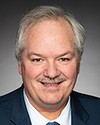
Evidence of meeting #56 for Finance in the 45th Parliament, 1st session. (The original version is on Parliament’s site, as are the minutes.) The winning word was system.

A recording is available from Parliament.

On the agenda

Members speaking

Before the committee

Steven MacKinnon  Minister of Transport
Bijimine  Assistant Deputy Minister, Policy, Department of Transport

The Chair Liberal Karina Gould

Colleagues, I call this meeting to order.

Welcome to meeting number 56 of the House of Commons Standing Committee on Finance.

Pursuant to the order of reference of Wednesday, June 3, and the motion adopted by the committee on Tuesday, September 22, the committee will resume consideration of Bill C-31, a second act to implement certain provisions of the budget tabled in Parliament on November 4, 2025.

I would like to welcome the witnesses.

Today we have Minister of Transport Steven MacKinnon joining us. He is accompanied by Serge Bijimine and Jennifer Little from Transport Canada.

Thank you for being here today.

As you know, colleagues, we were going to have this meeting last week, but because of the day of mourning, we had to reschedule.

Minister, thank you very much for joining us so soon afterwards.

With that, you have five minutes for your opening remarks.

5:15 p.m.

Gatineau Québec

Liberal

Steven MacKinnon LiberalMinister of Transport

Thank you, Madam Chair.

Members of the committee, thank you for undertaking this study of Bill C‑31. I'm very pleased to speak with you today about this bill and the future of air passenger protections in Canada.

Air passenger protections play an important role in ensuring that travellers are treated fairly when their travel plans are disrupted, but we also recognize that the way these protections are delivered needs to improve. Travellers need a system that is clear, effective and capable of resolving complaints in a timely manner.

On May 1, I announced the government's commitment to eliminating the backlog of air passenger complaints and rebuilding travellers' trust in Canada's air travel system. Bill C‑31 contains important measures to delivering on that commitment. Today, I would like to focus on three key areas.

First, we need to streamline passenger protection regulations to make them clearer, easier to enforce and more effective while taking the needs of a competitive air sector into consideration.

Second, we need to clear the backlog of complaints and improve how future complaints are handled to ensure travellers receive faster responses and solutions.

Third, we need to strengthen accountability by enhancing transparency and giving the Canadian Transportation Agency more effective tools to enforce regulations.

Bill C-31 includes important measures to deliver on our commitment to eliminate the backlog of air passenger complaints and rebuild travellers' trust in Canada's air travel system. Let me briefly expand on how we will do this.

First, we are streamlining the air passenger protection regulations, or APPR. Bill C-31 transfers regulation-making authority for the air passenger protection regulations from the Canadian Transportation Agency to me as Minister of Transport. This will allow Transport Canada to develop a simpler, clearer regulatory framework that better reflects the government's commitment to passengers.

To ensure continuity while the new framework is developed, the existing regulations will remain in place until the new regulations have gone through all the required steps.

Second, we are addressing the backlog and improving complaint resolution. When travel plans are disrupted, passengers deserve timely and effective resolution. The current backlog has made that more difficult and has undermined confidence in the complaints process.

Bill C-31 would provide the flexibility to transfer the processing of outstanding complaints from the CTA to an alternative dispute resolution provider. While this would help accelerate the resolution of outstanding complaints, Canadians must be confident that the process remains fair, impartial and focused on the traveller's best interests. I am, therefore, open to considering ways to further reassure Canadians that alternative dispute resolution providers will act independently and in the interest of travellers.

It would also enable the development of a more efficient complaint resolution method for the future by drawing on approaches that have shown real-world results, notably in Europe.

The goal is straightforward: to help travellers get answers and resolve their complaints more efficiently.

Third, we are strengthening accountability and enforcement. Passenger protections must be backed by meaningful consequences when obligations are not met. Bill C-31 would give the CTA stronger tools to enforce the rules, including increasing maximum fines to $1 million. It would also make the complaints process more transparent by removing the current confidentiality requirements imposed on passengers.

Together, these changes would help hold airlines accountable and give travellers greater confidence that their rights will be respected.

In closing, I would say Bill C‑31 is an important step toward a more effective, transparent and fair air passenger regime. By simplifying regulations, accelerating complaint resolution and strengthening enforcement mechanisms, we can better protect travellers' rights and build a system that works more effectively for everyone.

Thank you.

The Chair Liberal Karina Gould

Thank you very much, Minister.

We'll begin now with six minutes for Mr. Albas.

5:20 p.m.

Conservative

Dan Albas Conservative Okanagan Lake West—South Kelowna, BC

Thank you, Madam Chair and Madam Clerk.

Minister, thank you for your ongoing commitment to our great country, and thank you to your officials today.

Minister, your government gave the CTA $76 million over three years to increase complaint processing capacity and modernize the system. Today, we're looking at a backlog of 100,000 complaints and years of waiting for people to have their cases heard.

What went wrong, and who has been held accountable?

Steven MacKinnon Liberal Gatineau, QC

Thank you for that question.

The air passenger protection regulations are overly complex and overly expensive to enforce, regulate, oversee and litigate. Yes, they have resulted in a significant backlog that the agency has proven to be incapable of reducing in any material way.

In regard to your question about who is being held accountable, I think there is lots of accountability to go around. It is a system designed with a number of complicators, a gradient scale of hours of waiting and different reasons for delays, and an agency that is a very effective and even world-leading regulator, but is probably not as equipped to deal, if I can put it this way, at a retail level with consumer-level-type processing. All of these things have conspired to make the system very unwieldy.

5:20 p.m.

Conservative

Dan Albas Conservative Okanagan Lake West—South Kelowna, BC

Minister, you said that the CTA was incapable. You also spoke in your opening statement about “consequences when obligations are not met.” Has anyone at the CTA been held accountable? Did anyone responsible receive performance pay or bonuses?

Steven MacKinnon Liberal Gatineau, QC

I think I've been pretty transparent about the factors that have conspired to put us in the situation that we're in. These are relatively new regulations, as are the implementation difficulties that have been encountered by the CTA.

By the way, I didn't say they were incapable. I said that they've been proven incapable of implementing this particular system, but a number of things have conspired.

The CTA, though, is an independent agency. It receives its own parliamentary allocation and—

5:20 p.m.

Conservative

Dan Albas Conservative Okanagan Lake West—South Kelowna, BC

Yes, and right now we're going to be paying for two separate systems, because you're adding a private contractor while the CTA continues to handle new complaints.

You said that transparency is important to you. What will this second system cost, and when will the backlog be cleared?

Steven MacKinnon Liberal Gatineau, QC

As soon as we hopefully receive royal assent for this piece of legislation, we will rapidly do an RFP and solicit bids from ADR companies.

There are, as I mentioned in my remarks, not only experiences elsewhere in the world but also cost benchmarks elsewhere in the world that we will be following. Obviously, we'll be happy to share that information when it is available.

5:25 p.m.

Conservative

Dan Albas Conservative Okanagan Lake West—South Kelowna, BC

Where the APPR went wrong was that Parliament was never told what the laws were. It gave all of the authority to the government and the CTA.

For example, under Bill C-31, airlines could choose from government-designated private adjudicators, and the airlines could pay the cost of resolving complaints against them. How does that guarantee independent adjudication for passengers, Minister?

The problem with the APPR is that you've always had all of the cards and Parliament keeps giving you the power, but things never seem to roll. Can you please explain the private adjudicators and whether that's independent adjudication for passengers?

Steven MacKinnon Liberal Gatineau, QC

Yes, we believe it is independent. It's independent when it works elsewhere in the world. I would draw your attention to the experience in the U.K. or in Germany.

We are, as I mentioned in my remarks, open to ways to further reassure air passengers that this system acts independently. We just don't believe that taxpayers should continue bearing the cost of these adjudications. While we are prepared to get this backlog eliminated, we are no longer prepared to subject taxpayers to the responsibility and the burden of paying for this system.

Dan Albas Conservative Okanagan Lake West—South Kelowna, BC

Again, Minister, the burden of paying for your system is going to be on the passengers themselves, because the airlines will simply pass it on to them.

Minister, this morning, CBC reported on four cases where Air Canada denied compensation based on safety-related maintenance, even though the functioning aircraft originally assigned to those flights were reassigned elsewhere. Air Canada acknowledges that these were commercial decisions.

Does swapping a working aircraft to another route qualify as a safety exemption, yes or no?

Steven MacKinnon Liberal Gatineau, QC

I'm unfamiliar. Obviously, the CTA has the responsibility to investigate infractions and instances of airlines exhibiting behaviours or using practices that they should not. The CTA is the regulator in this instance. I expect that they will continue to investigate those complaints. They have and will continue to have the ability to assess administrative monetary penalties—

5:25 p.m.

Conservative

Dan Albas Conservative Okanagan Lake West—South Kelowna, BC

Yes, but Minister, your government proposed regulations to eliminate these grey areas in December 2024. Here we are nearly two years later, and they're still not final. When will you give Canadians a date for those rules to come into play?

The Chair Liberal Karina Gould

Thank you, Mr. Albas. That concludes the time.

Thank you, Minister.

We'll continue now with Mr. Leitão for six minutes.

Carlos Leitão Liberal Marc-Aurèle-Fortin, QC

Thank you very much, Madam Chair.

Good afternoon, Minister. Thank you for being here.

You did a good job of explaining some elements of Bill C‑31 in your opening remarks. Perhaps we can start this discussion where we left off.

I'd like to address the issue of regulations or definitions that address maintenance for security reasons. In my opinion, the new proposals we are debating here could prevent such occurrences in future. I think once the bill is passed—and I'd like to have your views on that—the fact that fines are increasing to a maximum of $1 million is a good thing. It's not a question of $20,000 here and there. There is a much bigger incentive for companies not to engage in these types of processes.

Can you share your thoughts on increasing fines to a maximum of $1 million?

Steven MacKinnon Liberal Gatineau, QC

We want to introduce a system where a deterrence due to potential fines, which could be a maximum of $1 million, will be a big consideration for airlines when it comes to their behaviours. The agency will continue to have the option and capacity to investigate cases where airlines exhibit behaviours that are contrary to the provisions we are going to put in place. In that sense, I think it's a good balance.

Airlines will now bear the costs associated with dispute resolution. They will now face much higher fines. They will pay a very high price for what I would call systemic or systematic behaviours.

Basically, we obviously want to have airlines address customer needs, give genuine grounds and reasons for delays and continue to work hard to keep to the departure and arrival times they promise their customers.

Carlos Leitão Liberal Marc-Aurèle-Fortin, QC

Right now, there is a significant backlog of complaints that are awaiting processing. It would therefore be important to deal with this backlog. One way of doing that is to rely on the involvement of private businesses in that exercise to ensure that the process moves forward as quickly as possible. Some people have said that this concerns the private sector and have implied that airlines will work things out. However, it would seem to me that these companies have a reputation to protect. They are active in this area and they don't stand to gain by being connected to these types of things.

Can you tell us how you see that? Personally, I think there's no risk. On your side, how will you make sure these businesses, which will collaborate in this process, will be impartial?

Steven MacKinnon Liberal Gatineau, QC

First and foremost, airlines will select an independent firm from a list of government-approved firms. The firms will be subject to appropriate random verifications. The firms will be expected to comply with a set of criteria, with independence ranking at the top.

As I said in my opening remarks, I am open to implementing additional measures to reassure travellers, customers, that the firms are truly independent. However, we don't think taxpayers should continue to bear the cost of this type of process or this system. That is why we will verify the identity and registration of firms. We will leave airlines the option to do business with a firm on the list.

As we have seen in other parts of the world, including in Germany, England and the United Kingdom, this system can operate effectively.

The Chair Liberal Karina Gould

Thank you, Minister. Time is up.

Thank you, Mr. Leitão.

We will now move on to Mr. Thériault for six minutes.

Luc Thériault Bloc Montcalm, QC

Good afternoon, Minister.

Air Canada launched a pilot project that is similar to what is in the bill well before this bill was announced and tabled in the House. Does this mean that Air Canada had some knowledge of the content of the bill before its first reading in the House?

Steven MacKinnon Liberal Gatineau, QC

No, I don't think so.

Air Canada is an international airline that already participates in systems that are similar to what I've just described to Mr. Leitão, in other parts of the world, including the United Kingdom and Germany. The airline would therefore have been familiar with how this system works.

I welcome the fact that Air Canada looked for solutions to protect its reputation and ensure disputes are handled in a timely manner. Obviously, no information was shared with Air Canada.

Luc Thériault Bloc Montcalm, QC

So you're swearing to us, hand on heart, that this clause of the bill was not disclosed before it came through the House. Was Air Canada a source of inspiration?

Steven MacKinnon Liberal Gatineau, QC

No. I would say the experience of Europeans, who were basically the first to establish air passenger rights regimes—

Luc Thériault Bloc Montcalm, QC

Do these people have a transportation agency?